Showing posts with label Japanese economy. Show all posts

Sunday, October 7, 2012

Comparing China with Japan and Other Stories

Is it possible or relevant to compare China with Japan and if so which Japan? Should it be 1970s Japan or late 1980s Japan? While many commentators argue that China is better compared to 1970s Japan, Michael Pettis argues that China resembles 1980s Japan because of the unbalanced nature of its economy.

Japan in the late 1960s and early 1970s may share many developmental characteristics with China today, but the Japanese economy in that earlier period never achieved, as far as I can see, the kinds of imbalances that it did much later in the 1980s, and so it is not really comparable to an extremely unbalanced China today.
These imbalances are well documented. The important characteristics of Japan in the late 1980s would almost certainly include the following:
  • Japan in the late 1980s grew at extraordinary rates fueled by a credit-backed investment boom funded at artificially low interest rates.
  • Although for many decades much of the investment may have been viable and necessary, by the 1980s investment was increasingly misallocated into expanding unnecessary manufacturing capacity, as well as fueling surges in real estate development and excess spending on infrastructure.
  • Artificially low rates, set nominally by the central bank but in reality by the Ministry of Finance, and coming mainly at the expense of household savers also fueled a bubble in local assets.
  • An artificially low currency fueled very rapid growth in the tradable goods sector while also constraining household income growth.
  • Because the growth model constrained growth in household income and household consumption, it forced up the domestic savings rate to extraordinary levels.
  • The combination of low consumption and excessive manufacturing capacity required a high trade surplus in order to balance production with demand.
  • And finally, and most worryingly, debt levels across the economy began to soar as debt rose much faster than debt servicing capacity.
All of this is true of China today, and this is why it is much more important to understand how Japan rebalanced after 1990 if you want to understand the challenges and risks facing China today. China is not like Japan in the 1950s, 1960s or 1970s in any meaningful way even if its current development level is much closer to Japan during those decades. Because of the serious imbalances China is much more like Japan in the late 1980s, with the major difference being that Japan never took debt, investment, and consumption imbalances to anywhere near the levels that China has taken them.
Ouch ... How, then, will the imbalances be reversed.
For this reason what we really have to consider when thinking about China is how these imbalances tend to be reversed. Since they were reversed in Japan in the period following 1990, Japan provides at least one possible model for China’s rebalancing process and, perhaps much more importantly, it demonstrates the kinds of pressures that China will face as it is forced into rebalancing. ... 
What about Europe?
Economic growth in Europe over the next ten years ... will not be anything like economic growth in the last ten years adjusted for changes in demographics, taxes, or anything else. We will be dealing with a Europe in which the tremendous debt, currency, and labor cost imbalances of the past decade must be reversed, and since the most likely form of the reversal will entail the breaking up of the euro, any growth predictions that do not at least acknowledge this chaotic rebalancing process are likely to be flimsy at best.
Currently Paddy Power is offering odds for both the end of the Euro and for individual countries leaving the Euro. Interestingly Greece is not included. Too short or what? My prediction is for an exit during the Xmas-New Year period, if if indeed happens. It's possible of course that European policy-makers will do whatever it takes to keep the currency going. (In other words I'm not suggesting you take a bet!)


The problem for the world economy is that the credit-fuelled growth strategy prevalent in most of the world has to at best stabilise or keep reversing.
Likewise with predictions of US consumption growth, which will have to deal with reversals in the savings and consumer credit trends of the past decade, and with sharp change in two decades of housing behavior.
For Australia there is, at best, volatility ahead.
Predictions about the prices of hard commodities, which have to consider a major dislocation in the source of commodity demand since the early part of the last decade, are also likely to be highly unstable.
As Pettis points out economic predictions are very difficult.
If you want to make economic predictions, in other words, whereas a long historical view will be very useful because it allows you to consider the dislocations created by a reversal of unsustainable imbalances, recent economic data are largely useless, as are predictions based on linear adjustments of recent economic data. Instead of projecting from past data you must model the various paths by which rebalancing can occur, and your prediction must be limited to those paths.
Pettis gives relatively short shrift to the view that insights from neuroscience could make a difference in predicting economic events.
This suggests that we don’t really need a radically new understanding of economics. To understand the global rebalancing, or the European debt crisis, or the upcoming Chinese economic adjustment, we need only to read the works of John Maynard Keynes, Hyman Minsky, Charles Kindelberger, Friedrich Hayek, or dozens of other economists of the 19th and 20th centuries. In every case they fully understood how economies can beetle along in one direction and then suddenly, as imbalances become unsustainable, reverse course and follow a dramatically different path.
This is simply a logical outcome of disequilibria, and doesn’t require anything quite so mysterious as brainwave patterns or irrational behavior mechanisms to explain the process. I think it was Herb Stein, President Nixon’s economic advisor, who reminded us that "If something cannot go on forever, it will stop."
In other words, as Keynes was reputed to have said: the unsustainable cannot be sustained.
It would have been much more powerful, I guess, if Stein had expressed this idea in a way somewhat more mathematical and abstruse, but anyway it seems like a pretty good explanation of what has happened in the US and in Europe in the past few years and what will happen in China in the next few. Just because many economists fail to see the point doesn’t require an overhaul of the discipline – perhaps it only requires an overhaul of the way the discipline is taught.
Pettis then goes on to quote a number of news sources outlining some very bad news for Australia.

From Bloomberg
Copper inventories at bonded warehouses in Shanghai probably climbed to a record as import premiums dropped to a four-month low, signaling demand in China may not be improving as much as expected after a summer lull.
Reserves were 650,000 metric tons, according to the median of nine estimates from traders, analysts and warehouse managers, compiled by Bloomberg. Five said that this was a record. The amount compared with an estimate of 550,000 tons by Macquarie Group Ltd. on Aug. 20. Fees paid by importers over the London Metal Exchange cash price are about $40 to $60 a ton on a cost, insurance and freight basis, the lowest since May.
Or this Financial Times article:
The southern Chinese province of Yunnan has launched a subsidy programme for metals producers, in a sign of the pain hitting the Chinese metals sector as demand growth remains low. Slowing economic growth in China, the world’s biggest consumer of commodities, has meant falling profits at Chinese raw materials producers, including copper smelters, steel mills and zinc smelters.
An official at the Yunnan Provincial Industry and Information Technology Commission confirmed that a small “stockpiling” programme, which has not been publicly announced yet, was launched in September and would continue until the end of the year. The programme targets copper, zinc, aluminium and other small metals, the official said.
Under the programme, which covers 300,000 tonnes of metals, producers will be able to draw subsidised loans from banks using their material as collateral. Banks will give the companies loans based on preset “purchase” prices for the commodity, and the Yunnan government will subsidise the process by paying for the interest on the bank loans. The system is designed to help smelters by providing them with more liquidity as financing gets more difficult. “The targets of this stockpiling system are the companies,” the government official explained.
But perhaps the inevitable pain could be delayed by more stimulus.
In Saturday’s South China Morning Post there was another article on roughly the same topic:
A group of state-owned Chinese shipping companies has placed a US$4.5 billion order for 50 supertankers, throwing a financial lifeline to struggling shipbuilders.
The order adds to a flurry of infrastructure investments by state companies in recent weeks - a key element in Beijing's effort to reverse a painful slowdown in economic growth. The government has approved a wave of spending on new steel mills, subway lines and other corporate and public works projects.
…Chinese shipbuilders, the world's biggest by tonnage, have been among the industries hit hardest in the slowdown. Orders have fallen by more than half, and shipyards are cutting jobs.
"Small and medium-size shipbuilding companies are either out of business or near bankruptcy," said Xia Xiaowen, an analyst for the China Shipbuilding Economy Research Centre, a think tank in Beijing. If the reports of new orders are accurate, "it will definitely be good news for those large manufacturers, and they don't need to worry about survival any more", Xia said.
But eventually, Pettis argues, rebalancing will have to occur.
no matter what analysts or policymakers may say, there is absolutely no way to resolve the problem of growing excess inventory except by abandoning the development model. Until China rebalances, in other words, it cannot resolve the problem of excess inventory because excess inventory is one of the inevitable consequences of the process that created the imbalances.
Hold onto your hats.

Thursday, February 3, 2011

Latest Data on the World Economy

The Reserve Bank of Australia provides a monthly snapshot of the world and Australian economies through its Chart Pack. As I've argued before there really is no better source of graphical insight into the Australian economy. Unfortunately, they won't release the raw data for some of the graphs because some of the data is subject to copyright.


This first one shows the recent downturn in world growth and why Australia has done relatively better than the rest of the world. Compared to the world as a whole, Australia's trading partners have recovered more rapidly, with China and India (and the rest of Asia) doing far better than the Europe (with the exception of Germany) and North America.  But it also shows just how severe the drop in growth was at the bottom of the recession and how government action made such a big difference. Paying off some of that govt action, however, will make a difference to GDP growth with the UK's recent economic contraction an indicator of possibilities elsewhere of retrenchment. The US of course has eschewed such hairshirt policies and the graphs below on unemployment and inflation in the US provide some indication as to why this is the case.

This second graph shows just how severe the recession was in Japan, the United States and Euro area. The contraction was most severe in Japan, but it has recovered better.

Compare this to the Chinese and Indian experiences of the global recession. Note there was no slip into negative territory although some commentators argue that anything below 5-6 per cent growth in China might feel like a recession!! For an interesting take on Chinese GDP figures, have a read of Michael Pettis's recent blog piece.


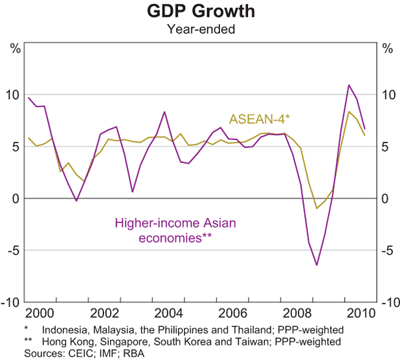
The rest of Asia did not do quite so well, but it shows why many commentators are arguing that Asia had a good global recession and why many people now think the 21st century will be dominated by Asia.


There is also a big debate going on about inflation pressures and many worry that monetary authorities (especially in the US and Europe) are not taking them seriously enough. Many of these same commentators don't seem to be too concerned about unemployment partly because they get extremely worried when labour markets tighten up (as they are in Australia). But the next two graphs show that at the moment unemployment should be the major concern of policy-makers in the US and Europe. Inflation obviously isn't the problem in Japan! Japan's issue is deflation. But falling prices might not be the good thing that your grandma might imagine. Just imagine her saying "things used to be so much cheaper when I was young". To crudely understand why this is a problem, think about why you would buy something today when it will be cheaper tomorrow.


The graph on unemployment should make us realise just how good a global recession we've had in Australia compared to the United States. With the amount of building work to be done to deal with natural disasters, it's unlikely that aggregate unemployment is going to be a major concern in Australia. No doubt, however, there are more concerns when we disaggregate the labour market and start to think about skills development and training etc.

Inflation, however, is a problem for China and India and efforts to deal with it could have an impact on Australia.

The next graphs shows the impact of Chinese government efforts to bolster the economy during the downturn. The year-ended growth figures are truly astounding as was the growth in credit. Although credit growth has declined, note what it has declined to!! It 'only' grew by around 20 per cent during 2010!


What does all this mean? Well for one thing how the Chinese government handles inflation and the growth in the Chinese property market are going to have large implications not only for Australia, but for the rest of Asia and, indeed, the whole world.

Thursday, December 16, 2010

Predictions of Doom 1

This one from Eisuke Sakakibara via William Pesek.  Sakakibara argues that “the world is set for a long-term structural slump reminiscent of the 1870s” meaning that he thinks that there will be a return to recession in 2011 lasting until 2018.

Pesek argues:
recent data in the US and Japan and financial turbulence in Europe suggest a fresh global recession is a distinct possibility in 2011. If that happens, what levers are realistically available to revive demand? Interest rates are already at, or close to, zero. That leaves increased government spending as the only real way to stabilize things.

The trouble is, there’s little support for opening the fiscal floodgates in a meaningful way.

One reason is that there’s already loads of public debt out there.
What worries lots of doomsters is that the world might be heading for 1937 again where Roosevelt and many others felt the recession was over and relaxed only for the US economy to go backwards the following year.

As with my previous post a real question for coming years is how long China can continue to grow without expanding demand for its exports from the US and Europe.
If Sakakibara is right, the global economy is in deep trouble. He envisions a broad slowdown that might drag on for seven to eight years. China can live a couple of years without US and European growth, but eight?

To head it off, governments need to up spending. And, for the most part, they aren’t. Yet the US can, and should, borrow more. To do that, it just needs to become a bit more Japanese, says Richard Duncan, author of the “The Corruption of Capitalism.”

There’s a single reason why Japan’s 10-year bond yields are below 1.3 per cent and Asia’s No. 2 economy isn’t being downgraded. Since about 95 per cent of Japan’s debt is held domestically, there’s no risk of capital flight. Japan borrows from its companies and people, an arrangement that’s roughly the mirror image of the US.
The problem for the US on the other hand is the extent of financial vulnerability due to foreign holdings of its bonds.
That so many Treasuries are held in China and elsewhere makes the US highly vulnerable. Duncan, chief economist at Blackhorse Asset Management in Singapore, says the US needs another FDR-like New Deal to restore growth and competitiveness. Funding one means greater borrowing and the way to do it is by tapping private-sector cash, Japan-style.

Such suggestions are likely to fall with a mighty thud on Capitol Hill, which is moving in the opposite direction. Lawmakers calling for Ben Bernanke’s head forget why the Fed chairman is taking US monetary policy into uncharted territory. It’s because Congress failed to pump enough money into the economy in the first place.

Japan is a cautionary tale. On the surface, the 4.5 per cent annualized increase in third-quarter gross domestic product looked promising. The detail, however, showed that deflation is worsening no matter how many yen the Bank of Japan churns into the economy. This is anything but a typical recession, and world leaders are too distracted to see it.

In the US, the focus is on China’s currency. While a stronger yuan would be in the best interests of the global economy, it’s not the answer to all the US problems. Japan is even more obsessed with exchange rates. And Europe is linearly focused on convincing investors that the euro zone won’t unravel.

In our time of currency fixation, perhaps a guy called Mr. Yen is the ideal messenger. Too bad his message is one of economic gloom as far as the eye can see. Perhaps even to 2018.
For a more local prediction of possible doom see one of my favourite bloggers Leith van Onselen, who highlights China's empty cities and what they might mean for Chinese demand for Australian resources when the Chinese have to EVENTUALLY stop building stuff no one is buying.

Friday, October 15, 2010

An Alternative View on Japan's Stagnation

There can be lots of easy comparisons between the economic crisis faced by Japan twenty years ago and the crisis now facing the United States. Both had severe real estate and financial busts which badly affected the real economy.

The literature on financial crises points out that financial crisis induced recessions go for longer than boom-bust business cycle recessions and this appears to be happening currently in the United States where consumers are restricting their spending to deal with the build-up of debt.

The general contention is that Japan failed to deal with its crisis and as a consequence has suffered twenty years of stagnation. Some worry that the United States is facing a long period period of sub-par growth.

Paul Krugman seems to delight in iconoclasm - or what we might call contrariness.
A decade ago, Japan was a byword for failed economic policies: years after its real estate bubble burst, it was still suffering from chronic deflation and slow growth. Then America had its own bubble, bust and crisis. And these days, Japan’s record doesn’t look that bad to an American eye.
Why not? For all its flaws, Japanese policy limited and contained the damage from a financial bust. And the question in America now is whether we’ll do the same — or whether we will take a hard right turn into economic disaster.
In the 1990s, Japan conducted a dress rehearsal for the crisis that struck much of the world in 2008. Runaway banks fueled a bubble in land prices; when the bubble burst, these banks were severely weakened, as were the balance sheets of everyone who had borrowed in the belief that land prices would stay high. The result was protracted economic weakness.
And the policy response was too little, too late. The Bank of Japan cut interest rates and took other steps to pump up spending, but it was always behind the curve and persistent deflation took hold. The government propped up employment with public works programs, but its efforts were never focused enough to start a self-sustaining recovery. Banks were kept afloat, but were slow to face up to bad debts and resume lending. The result of inadequate policy was an economy that remains depressed to this day.

But Krugman argues the black and while view of Japan's 'failure' is too simplistic and although its economy has been depressed it has avoided depression. Unemployment remained at relatively low levels compared to the current US situation partly because of government spending. The verdict is that Japan has avoided disaster. For the US the jury is still out and Krugman worries that the Republicans are stopping any comprehensive solution for a weak economy. 
Like their Japanese counterparts, American policy makers initially responded to a burst bubble and a financial crisis with half-measures. I’ve lamented that fact, but at this point it’s water under the bridge. The question is: What happens now?
Republican obstruction means that the best we can hope for in the near future are palliative measures — modest additional spending like the infrastructure program President Obama proposed this week, aid to state and local governments to help them avoid severe further cutbacks, aid to the unemployed to reduce hardship and maintain spending power.
Even with such measures, we’ll be lucky to do as well as Japan did at limiting the human and economic cost of the economy’s financial woes. But it’s by no means certain that we’ll do even that much. If the Republicans go beyond obstruction to actually setting policy — which they might if they win big in November — we’ll be on our way to economic performance that makes Japan look like the promised land.
It’s hard to overstate how destructive the economic ideas offered earlier this week by John Boehner, the House minority leader, would be if put into practice. Basically, he proposes two things: large tax cuts for the wealthy that would increase the budget deficit while doing little to support the economy, and sharp spending cuts that would depress the economy while doing little to improve budget prospects. Fewer jobs and bigger deficits — the perfect combination.
More broadly, if Republicans regain power, they will surely do what they did during the Bush years: they won’t seriously try to address the economy’s troubles; they’ll just use those troubles as an excuse to push the usual agenda, including Social Security privatization. They’ll also surely try to repeal health reform, which would be another twofer, reducing economic security even as it increases long-term deficits.
So I find myself almost envying the Japanese. Yes, their performance has been disappointing. But things could have been worse. And the case Democrats now need to make — the case the president finally began to make in Cleveland this week — is that if Republicans regain power, things will indeed be worse. Americans, understandably, are disappointed over, frustrated with and angry about the state of the economy; but disappointment is better than disaster.
One can only imagine how strong the United States economy would be if it abandoned its antipathy to certain regulations and supports for society such as education and health reforms.

Remember that the US right and big business is not opposed to regulation - just think about patents, copyrights, licences and the like and the health industry in general - just regulations that help to distribute wealth downwards. Bill Gates has no problems when it comes to government regulation of copyright and attempts to enforce it world wide. Regulations that distribute wealth upwards are fine. Big pharmaceutical companies have no problems with regulations that enable them to make billions on protected medicines whose marginal costs of production are negligible. (for an excellent exposition of these arguments see Dean Baker Taking Economics Seriously.

For those wanting a more traditional take on Japan's stagnation see the excellent series of articles on Japan in the New York Times, called "The Great Deflation"

Monday, August 16, 2010

China Passes Japan as Second-Largest Economy

While this has long been mooted, it registers another milestone in the rise of China.

David Barboza in the New York Times reports.
Experts say unseating Japan — and in recent years passing Germany, France and Great Britain — underscores China’s growing clout and bolsters forecasts that China will pass the United States as the world’s biggest economy as early as 2030. America’s gross domestic product was about $14 trillion in 2009.
But as I've reported in earlier posts here and here, measuring the size of economies depends on whether we convert a country's GDP in the local currency to USD or use purchasing power parity (PPP) conversions.

On a PPP basis China has been bigger than Japan for quite some time.

According to Nicholas Lardy:
“It reconfirms what’s been happening for the better part of a decade: China has been eclipsing Japan economically. For everyone in China’s region, they’re now the biggest trading partner rather than the U.S. or Japan.”

The figures therefore say something about China, but also about Japan, which has been stagnating economically since the early 1990s.
But as I noted in The Vulnerable Country (ch. 3) China is still a poor country:
But while Japan’s economy is mature and its population quickly aging, China is in the throes of urbanization and is far from developed, analysts say, meaning it has a much lower standard of living, as well as a lot more room to grow. Just five years ago, China’s gross domestic product was about $2.3 trillion, about half of Japan’s.
This country has roughly the same land mass as the United States, but it is burdened with a fifth of the world’s population and insufficient resources.
Its per capita income is more on a par with those of impoverished nations like Algeria, El Salvador and Albania — which, along with China, are close to $3,600 — than that of the United States, where it is about $46,000.

Despite this, however, China is exerting more influence on the global economy:
Yet there is little disputing that under the direction of the Communist Party, China has begun to reshape the way the global economy functions by virtue of its growing dominance of trade, its huge hoard of foreign exchange reserves and United States government debt and its voracious appetite for oil, coal, iron ore and other natural resources.
China is already a major driver of global growth. The country’s leaders have grown more confident on the international stage and have begun to assert greater influence in Asia, Africa and Latin America, with things like special trade agreements and multibillion dollar resource deals.
“They’re exerting a lot of influence on the global economy and becoming dominant in Asia,” said Eswar S. Prasad, a professor of trade policy at Cornell and former head of the International Monetary Fund’s China division. “A lot of other economies in the region are essentially riding on China’s coat tails, and this is remarkable for an economy with a low per capita income.”
Regardless, China’s rapid growth suggests that it will continue to compete fiercely with the United States and Europe for natural resources but also offer big opportunities for companies eager to tap its market.


...

Although its economy is still only one-third the size of the American economy, China passed the United States last year to become the world’s largest market for passenger vehicles. China also passed Germany last year to become the world’s biggest exporter.
Global companies like Caterpillar, General Electric, General Motors and Siemens — as well as scores of others — are making a more aggressive push into China, in some cases moving research and development centers here.
Some analysts, though, say that while China is eager to assert itself as a financial and economic power — and to push its state companies to “go global” — it is reluctant to play a greater role in the debate over climate change or how to slow the growth of greenhouse gases.
China passed the United States in 2006 to become the world’s largest emitter of greenhouse gases, which scientists link to global warming. But China also has an ambitious program to cut the energy it uses for each unit of economic output by 20 percent by the end of 2010, compared to 2006.
Assessing what China’s newfound clout means, though, is complicated. While the country is still relatively poor per capita, it has an authoritarian government that is capable of taking decisive action — to stimulate the economy, build new projects and invest in specific industries.
That, Mr. Lardy at the Peterson Institute said, gives the country unusual power. “China is already the primary determiner of the price of virtually every major commodity,” he said. “And the Chinese government can be much more decisive in allocating resources in a way that other governments of this level of per capita income cannot.”


Sunday, May 9, 2010

Just How Big are the US, Japanese, Chinese, ASEAN, Korean and Australian Economies?

Percentage of World GDP and the Differences between PPP and USD Measurements

Table 1 shows relativities between countries on the basis of their percentage of the total global economy. It is measured on a current prices basis, which means that the measures are taken at the time and do not account for changing prices. Constant price GDP measures do account for inflation and measure GDP or GDP per capita using a base year, which is then used to measure ‘constant ‘prices. But for our purposes the failure to account for inflation doesn't matter because we're considering the percentage of the total at particular points in time.

Table 1 is constructed on a PPP basis. It shows that the United States’ percentage has fallen slightly but it remains the world’s largest economy by a long way. ASEAN has increased its share from 2.3 per cent of the world economy to 4.1 per cent. China’s growth has been the most dramatic, however, increasing from 2 per cent to 13.3 per cent. Japan’s percentage of the total has declined from 7.9 per cent to 5.9 and India has more than doubled its percentage from 2.2 per cent to 5.2 per cent, as has Korea from 0.8 per cent to 2 per cent.


Table 2 shows the percentage of world economic GDP accounted for by our countries of interest except this time on a US Dollar exchange basis. By this measure the developing countries and ASEAN are much smaller and the figures are profoundly affected by the USD exchange rate. Indeed as a percentage of global GDP ASEAN has not advanced its relative position very far at all, ASEAN accounted for 2.2 per cent in 1980 and 2.8 per cent in 2010. In 1985 at the height of the dollar in terms of its value, the US accounted for 35 per cent of global GDP. In 1995 at the height of the value of the yen, Japan accounted for 17.8 per cent of global GDP, falling to 8.5 per cent in 2010. Australia has advanced considerably, partly because of continuous growth since 1990 and partly because the AUD has increased in value since its low point in 2000.


Measuring the Size of Economies

A COMPARISON OF GDP

I just constructed these measurements for selected countries in Asia plus the US and Australia for the sake of comparison. The data is from the IMF. The measurements are for an Open University Course I'm writing called The Political Economy of East Asia. The course should probably be called The Political Economy of Power in East Asia but that's a bit too much of a mouthful. The particular module is called Rising Powers II: ASEAN and India.
Table 10.1 shows the relative size of all relevant economies for our course. It shows the continuing dominance of the US economy and the amazing growth of the Chinese economy since 1990. China will overtake Japan (on USD terms in 2010 – it passed it a while ago on PPP terms). Japan has done poorly since 1995, especially on USD terms as the value of the yen declined after the mid-1990s. On USD terms, the Japanese economy is roughly the same size it was in 1995! The table also shows just how well Australia has done since the 1990 recession.

The countries that make up ASEAN now grew rapidly between 1990 and 1995 but then contracted during 1995 and 2000, showing the major impact of the East Asian financial crisis. The figure for 2010 is an estimate, but is an estimate that factors in recent turmoil in the global economy. The figures were constructed for the April 2010 IMF World Economic Outlook Database.

India too has grown rapidly since 1990 from a smaller GDP on USD terms than Australia in 1990 to considerably larger in 2010.

Table 10.2 measures the size of our selected countries and ASEAN on purchasing power parity terms. It shows that on this basis ASEAN is much larger as is China and India. Indonesia is a considerably larger economy than Australia on PPP terms and ASEAN is nearly four times larger. None of our Asian countries, which contracted between 1995 and 2000 on an exchange basis, contracted when measured in this way. One of the impacts of the financial crisis was a sizeable decline in the se countries exchange rates in relation to the USD.


Wednesday, October 21, 2009

China, Japan and the United States


Though recent wild currency swings could delay the reckoning, many economists expect Japan to cede its rank as the world’s second-largest economy sometime next year, as much as five years earlier than previously forecast.
At stake are more than regional bragging rights: the reversal of fortune will bring an end to a global economic order that has prevailed for 40 years, with ramifications across arenas from trade and diplomacy to, potentially, military power.
China’s rise could accelerate Japan’s economic decline as it captures Japanese export markets, and as Japan’s crushing national debt increases and its aging population grows less and less productive — producing a downward spiral.
“It’s beyond my imagination how far Japan will fall in the world economy in 10, 20 years,” said Hideo Kumano, economist at the Dai-Ichi Life Research Institute in Tokyo.
Not long ago, Japan was “the economic miracle,” an ascendant juggernaut on its way to rivaling the United States, which has the biggest economy.
While China has caught up quickly to Japan in recent years in terms of its total economy (due to China's rapid growth and Japan's stagnation) it still has a way to go on a per capita basis.

But the Japanese growth miracle and its subsequent slowdown, crisis and stagnation show that things change. We often think about China growing forever on a linear path, without recession and without a generalised slowdown.

No doubt if it does Australia will benefit, but contrariwise if problems emerge this will badly affect Australia.