Showing posts with label China and the United States. Show all posts

Sunday, March 15, 2015

Charts of the Week

The two booming components of the Australian economy. House and holes as one commentator calls himself. (from MacroBusiness)


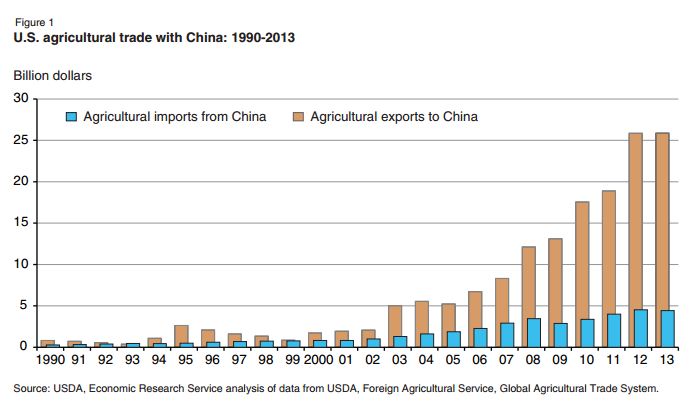
The following are a series of graphs on Chinese agricultural trade. Important because so many policy-makers and business people believe that Australia's next boom will centre around agricultural exports to China. If China continues to become wealthier, then opportunities for exports will grow. Other countries, of course, are keen to take advantage of this possibility. From the US Department of Agriculture. 


Finally a graphic on food spending at home and away. (from Max Roser)


Wednesday, September 3, 2014

She'll Be Right Mate? Australia's Economic Future

Real GDP per Capita is an important measure of real aggregate progress. While it doesn't tell us anything about the distribution of growth, it does tell us how much an economy is growing per person so that it removes the impact of population growth and immigration. Remember that in a country with a rapidly growing population, growth can be, at least in part, a consequence of that population growth.

The Reserve Bank Governor Glenn Stevens recently gave a speech highlighting Australia's relatively good performance in comparison with other developed countries.

In comparison to the US, UK, Euro area, Canada, Japan and New Zealand. The graph measures performance since 2005 by making all countries equal (100 on the Index) at this point.

As the Governor notes, these figures don't tell us what's coming but he outlines three possible sources of future growth.
Which sectors would be available to lead such an expansion? In the broad, there are three. There are households, governments and firms. Let's think about each briefly.
Households being willing to increase their debt and lower the share of current income being saved was a striking feature of Australia's economic landscape from the early 1990s until just prior to the financial crisis. Consumption spending consistently rose faster than income and the ratio of debt to income went from about 60 per cent in 1993 to 150 per cent by 2006. Households are servicing that higher debt quite well – mortgages make up most of their debt and arrears are running at about one half of 1 per cent, which is low by global standards. But as I have argued before, it seems unlikely that household debt can rise like that again. Nor would it be desirable. So while we can expect that household consumption spending can grow in line with income, or maybe a little faster given the rise in net worth over the past two years, the odds are against households being a driver of strong growth the way they were a decade ago.
What about the government sector? Most governments in Australia are trying to strengthen their own balance sheets by containing the build-up in debt that has been occurring. Public final spending is scheduled, according to the stated intentions of federal and state governments, to be subdued over the next couple of years. In fact, it is forecast to record the most subdued growth for a long time. By and large then, the public sector is not in the phase of using its balance sheet to expand demand faster than normal. 
That leaves the business sector. ...
My conclusion would be that many businesses are in a position to play their part in the growth dynamic over time. The fact that in some areas outside of mining the level of gross fixed capital spending is barely above depreciation rates suggests that, over time, capital spending in those areas will have to increase. The forward estimates of non-mining business capital spending released recently do show a further upgrading of intentions. That won't offset the impending fall in mining investment and it would be good to see further, and more substantial, upgrades over time. But the available data suggest that things are at least heading in the right direction.
Stevens canvasses the external environment in the first part of the speech and it appears that he is fairly sanguine about future possibilities.
Overall then, the global environment remains ‘interesting’, with significant challenges, uncertainties and puzzles. All that said, from Australia's point of view, the world economy continues to grow, inflation remains contained, our terms of trade though falling remain high, and financial conditions are remarkably accommodative.
Our external environment is heavily shaped by China. China is our biggest export partner and it is our other biggest export partners' biggest export partner, which means that any Chinese growth slowdown or rebalance towards consumption will have a negative effect on us and indeed all of Asia.

As Stevens points out:
For Australia's particular group of trading partners, weighted by export shares, growth is running at about 4½ per cent, which is somewhat above the 30-year average. This strength reflects the continued increase in the weight of China as a destination for exports. Even though China is growing more slowly than it used to – at a mere 7½ per cent this year – the fact that its growth is so much stronger than most others combines with its increased weight to push up the weighted-average growth of our trading partner group. 
The determined pessimists among us [that's me!] will see the increased weight of China as a concern: what if something goes wrong and the Chinese economy experiences a sharp slowing in growth? In fact this is a question that could be put for most economies now – nearly 50 economies, including the United States, European Union, Japan, Russia and Canada, now have China as their number 1 or 2 trading partner. The full ramifications of the continuing rise in the weight of China's economy and, in time, its financial system in world affairs will be the topic for numerous lengthy books. But in short, the whole world is now more dependent on China than it was. 
For today, probably the most important point to note is that the near-term task of the Chinese authorities is to manage the desired slowing in credit growth and moderation in asset values. Housing prices are falling in many Chinese cities at present. This is not unprecedented – it is the third time in the past decade this has occurred. (Yes, house prices can fall, even in China.) This area – the asset price and credit nexus – is the one to watch, more than the monthly exports or PMIs and so on. 
Another pricing puzzle is exchange rates. Many in Australia have commented at length about the relatively high value of the Australian dollar against the US dollar. The Bank has made its views on this pretty clear and so I won't reiterate them today. But it's worth noting that many other countries have had a similar puzzle to ours – so the real question is why the US dollar has remained as low as it has.
Yes you read correctly. Nearly 50 countries have China as their number one or two trading partner.

What this means is that Australia is now more affected by Chinese conditions than ever before and what happens to the US dollar will affect the competitiveness of the tradable sector (exporters and import-competing firms).

We need China to keep growing strongly and for the US to increase growth so that the US dollar strengthens. The rest of the world economy also needs the US economy to increase its rate of growth.

Remember that measured by exchange rates the US is still the world's largest economy. The fact that about 70 per cent of the US economy is consumption means that the US remains the vital final destination of a whole lot of goods (and associated services) that have been initially traded between the countries of Asia (think the iPhone etc).

I have long thought that the decoupling of the overall Asian economy from Europe and North America could only be a temporary phenomena. China needs the developed world to keep buying Chinese goods (as does the rest of Asia) but, in turn, the developed world requires China to shift to higher levels of consumption.

In the absence of a shift towards higher consumption in China, it is doubtful whether Europe and North American economic policy-makers will be happy with enhanced export-led growth in China. A revitalised Chinese current account deficit will mean increased exports of Chinese capital and probably higher unemployment in the developed world.

Australians should hope that the world economy can rebalance and avoid the sort of recoupling of the Asian and developed world economies that would lead to an Asian growth slowdown.


Monday, February 25, 2013

China in the US MIrror: Pettis on China, Free Trade, Protection and Development

This from Michael Pettis's February 11th newsletter contains some gems on the history of economic development ...

I agree that protection has been important in the process of economic development as it was in Australia, but it must be protection with a purpose and there must still be domestic competition or other spurs to productivity growth. Subsidies are a recipe for rent-seeking and domestic favourtism. Competition is what matters even if it is protected competition initially.

Industries must have incentives to remain competitive over the medium to long-term, which is why policies of freer trade are beneficial as development progresses.


The pillars of growth

... I have often argued that the Chinese development model is an old one, and can trace its roots at least as far back as the “American System” of the 1820s and 1830s. This “system” was itself based primarily on the works of the brilliant first US Secretary of the Treasury Alexander Hamilton ...

This development model was also implicitly part of the debate in France that led to one of the most important financial innovations of the 19th Century, the creation of the Crédit Mobilier in France in 1852. The debate concerned one of the great economic questions in France, especially after the defeat of Napoleon: why had England, a country that one hundred years earlier had been poorer than France, managed to surpass France and all other countries economically and technologically, even though in the pure sciences and engineering the French were at least the equal to the British and perhaps superior?

One obvious reason had to do with the financing of the commercial application of new technology. The French banking system, dominated by rentiers and the landed aristocracy, seemed to specialize in protecting savers, in part by mobilizing capital and investing in gold or in government obligations. The English banking system did this too, but it also seemed much more willing to finance infrastructure and manufacturing capacity.

In fact more generally I have argued that the main reason “industrial revolutions” have occurred largely in England and the United States is because industrial revolutions are not driven by scientific developments but rather by the commercial application of scientific developments. For this to happen it seems that a robust financing system is key.

...

I will come back to this issue of the financial system, but the point here is that there have been many versions of this development model, and at least two major economic theoreticians – the German Friedrich List in the 19thCentury and the Ukrainian-American Alexander Gershenkron in the 20th – have formally described variations on the investment-driven growth model.

...

Aside from Alexander Hamilton, its intellectual and political godfather, the main proponents of the American System were figures like Henry Clay, Henry and Matthew Cary, John Calhoun, and even Abraham Lincoln himself. Their vision of economic policymaking was looked down upon as naïve and even foolish by most American academic economists – schooled as they were in the laissez faire doctrines then fashionable in England – but I think it is hard for any economic historian not to feel relieved that neither the academics nor the Jeffersonian and Jacksonian factions had the clout to force “good” economic policy onto US development. America got rich in part by doing the wrong things.

...

It was of course the post-War Japanese development model, itself based on Japan’s experience of economic development during and after the Meiji restoration, that became the standard for policymakers throughout East Asia and China. I think of China’s growth model as merely a more muscular version of the Japanese or East Asian growth model, which is itself partly based on the American experience.
There were three key elements of the American System. Historian Michael Lind, in one of his economic histories of the United States, described them as:

· infant industry tariffs
· internal improvements, and
· a sound system of national finance


These three elements are at the heart, explicitly or implicitly, of every variation of the investment-led development model adopted by number of countries in the last century – including Germany in the 1930s, the USSR in the early Cold War period, Brazil during the Brazilian miracle, South Korea after the Korean War, Japan before 1990, and China today ...


Infant industry tariffs
The “infant industry” argument is fairly well known. I believe Alexander Hamilton was the first person to use the phrase, and the reasoning behind his thinking was straightforward. American manufacturing could not compete with the far superior British, and according to the then- (and now) fashionable economic theories based on Adam Smith and David Ricardo, the implications for trade policy were obvious. Americans should specialize in areas where they were economically superior to the British – agriculture, for the most part – and economic policy should consist of converting US agriculture to the production of cash crops – tobacco, rice, sugar, wheat and, most importantly, cotton – maximizing that production and exchanging them for cheaper and superior British manufactured items.

In this way, as Ricardo brilliantly proved, and assuming a static distribution of comparative advantages, with each country specializing in its comparative advantage, global production would be maximized and through trade both the British and the Americans would be better off. While most academic US economists and the commodity-producing South embraced free trade, Alexander Hamilton and his followers, mainly in the northeast, did not (in fact differing views over free trade as well as over slavery and state rights were at the heart of the North-South conflict that led eventually to the Civil War).

Hamilton was convinced that it was important for the US to develop its own manufacturing base because, as he explained in his Congressional report in 1791, he believed that productivity growth was likely to be much higher in manufacturing than in agriculture or mineral extraction. Contrary to David Ricardo, in other words, Hamilton believed that comparative advantage was not static and could be forced to change in ways that benefitted less productive countries. What is more, he thought manufacturing could employ a greater variety of people and was not subject to seasonal fluctuations or fluctuations in access to minerals.

Given much higher British efficiency and productivity, which translated into much lower prices even with higher transportation costs, how could Americans compete? They could do it the same way the British did to compete with the superior Dutch a century earlier. The US had to impose tariffs and other measures to raise the cost of foreign manufacturers sufficiently to allow their American counterparts to undersell them in the US market. In addition Americans had to acquire as much British technological expertise and capacity as possible (which usually happened, I should add, in the form of intellectual property theft).

This the US did, and in fact I believe every country that has managed the transition from underdeveloped to developed country status (with, perhaps, the exception of one or two trading entrepôts like Singapore and Hong Kong, although even this is debatable), including Germany, Japan, and Korea, has done it behind high explicit or implicit trade tariffs and stolen intellectual property. The idea that countries get rich under conditions of free trade has very little historical support, and it is far more likely that rich countries discover the benefits of free trade only after they get rich, while poor countries that embrace free trade too eagerly (think of Colombia and Chile in the late 19th century, who were stellar students of economic orthodoxy) almost never get rich unless, like Haiti in the 18th Century or Kuwait today, they are massive exporters of a very valuable commodity (sugar, in the case of Haiti, which was the richest country in the world per capita during a good part of the late 18th Century).

But rather than just embrace protection I would add that there is one very important caveat. Many countries have protected their infant industries, and often for many decades, and yet very few have made the transition to developed country status. Understanding why protection “works” in some cases and not in others might have very important implications for China. I won’t pretend to have answered this question fully but I suspect the difference between the countries that saw such rapid productivity growth behind infant industry protection that they were eventually able to compete on their own, and those that didn’t, may have had to do with the structure of domestic competition.
Specifically, it is not enough to protect industry from foreign competition. There must be a spur to domestic innovation, and this spur is probably competition that leads to advances in productivity and management organization. I would argue, for example, that countries that protected domestic industry but allowed their domestic markets to be captured and dominated by national champions were never likely to develop in the way the United States did in the 19th Century.
I would also argue that companies that receive substantial subsidies from the state also fail to develop in the necessary way because rather than force management to improve economic efficiency as a way of overcoming their domestic rivals, these countries encourage managers to compete by trying to gain greater access to those subsidies. Why innovate when it is far more profitable to demand greater subsidies, especially when subsidized companies can easily put innovative companies out of business? Last April, for example, I wrote about plans by Wuhan Iron & Steel, China’s fourth-largest steel producer, to invest $4.7 billion in the pork production industry.

The company’s management argued that they could compete with traditional agro-businesses not because steel makers were somehow more efficient than farmers, but rather because their size and clout made it easier for them to get cheap capital and to get government approvals. They were able to invest in an industry they knew little about, in other words, because they knew they could extract economic rent. This clearly is not a good use of protection.

The lessons for China, if I am right, are that China should forego the idea of nurturing national champions and should instead encourage brutal domestic competition. Beijing should also eliminate subsidies to production, the most important being cheap and unlimited credit, because senior managers of Chinese companies rationally spend more time on increasing access to these subsidies than on innovation, a subject on which, in spite of the almost absurd hype of recent years, China fares very, very poorly.

There is nothing wrong with protecting domestic industry, but the point is to create an incentive structure that forces increasing efficiency behind barriers of protection. The difficulty, of course, is that trade barriers and other forms of subsidy and protection can become highly addictive, and the beneficiaries, especially if they are national champions, can become politically very powerful. In that case they are likely to work actively both to maintain protection and to limit efficiency-enhancing domestic competition. It was Friedrich Engels, not often seen as a champion of capitalist competition, writing to Edward Bernstein in 1881, who said that “the worst of protection is that when you once have got it you cannot easily get rid of it.”


Internal improvements
The second element of the American System was internal improvement, which today we would probably call infrastructure spending. Proponents of the American System demanded that the national and state governments design, finance and construct canals, bridges, ports, railroads, toll roads, and a wide variety of communication and transportation facilities that would allow businesses to operate more efficiently and profitably. In some cases these projects were paid for directly (tolls, for example) and in other cases they were paid for tax revenues generated by higher levels of economic activity.

It is easy to make a case for state involvement in infrastructure investment. The costs of infrastructure can be very high, while even if the benefits are much higher they are likely to be diffused throughout the economy, making it hard for any individual company to justify absorbing the costs of investment. In this case the state should fund infrastructure investment and pay for it through the higher taxes generated by greater economic activity.

For me the interesting question, especially in the Chinese context, is not whether the state should build infrastructure but rather how much it should build. In fact this is one of the greatest sources of confusion in the whole China debate. Most China bulls implicitly assume that infrastructure spending is always good and the optimal amount of infrastructure is more or less the same for every country, which is what allows them to compare China’s per capita capital stock with that of the US and Japan and conclude that China still has a huge amount of investing to do because its capital stock per capita is so much lower.

But this is completely wrong, and even nonsensical. Infrastructure investment is like any other investment in that it is only economically justified if the total economic value created by the investment exceeds the total economic cost associated with that investment. If a country spends more on infrastructure than the resulting increase in productivity, more infrastructure makes it poorer, not richer.

In China we have problems with both sides of the equation. First, we don’t know what the true economic cost of investment in China might be. In order to calculate the true cost we need to add not just the direct costs but also all the implicit and explicit subsidies, most of which are hidden or hard to calculate.

The most important of these subsidies tends to be the interest rate subsidy, and this can be substantial. If interest rates in China are set artificially low by 5 percentage points, for example, which is a reasonable estimate, an investment of $100 million receives an additional subsidy of $5 million for every year that the loan funding the investment is outstanding – and loans are almost never repaid in China. Over ten to twenty years of outstanding debt this can add 30-40% to the initial cost of the investment. This means that the recognized cost of an infrastructure project is much lower than the true economic cost, with the difference being buried in explicit and implicit subsidies.

But the bigger problem is in the value created by the investment. We can think of the value of infrastructure primarily as a function of the value of labor saved. In countries with very low levels of productivity, each hour of labor saved is less valuable than each hour saved in countries with high levels of productivity. For this reason less productive countries should have much lower capital stock per capita than more productive countries.
This should be obvious, but it seems that often it isn’t. When analysts point to high quality infrastructure in China whose quality exceeds comparable infrastructure in rich countries, this is not necessarily a good thing. It might just be an example of the amount of waste you can achieve when spending is heavily subsidized, when there are strong political (or pecuniary) incentives for expanding investment, and when there is limited transparency and accountability.

Other things matter too. If a country has low levels of social capital – if it is hard to set up a business, if less efficient businesses with government connections can successfully compete with more efficient businesses without government connections, if the legal and political structure creates problems in corporate governance (the “agency” problem, especially), if the legal framework is weak, if property rights are not respected, if intellectual property can easily be lost – then much infrastructure spending is likely to be wasted.

In fact it turns that it may be far more efficient to focus on improving, say, the legal framework than to build more airports, even though (and perhaps because) building airports generates more growth (and wealth for the politically connected) today. Weak social capital becomes a constraint on the ability to extract value from infrastructure, and this constraint is very high in poor countries with weak institutional frameworks.


Journey to the West

This issue of how much investment is enough is a very important topic that deserves much more discussion, but I think there is a very good example of why we need to be worried about how useful additional infrastructure investment in China might be. This shows up most clearly in China’s push to create development in the western part of the country.

Often when I question the economic value of China’s push to the western, poorer parts of the country (by the way economic value is not the same as social or political value, the latter of which may nonetheless justify projects that are not economically viable) I am almost always treated with the story of the American West. In the 19th Century, as everyone knows, the US went west, and most economists agree that this made economic sense for the country and was an important part of the process that led it to becoming the wealthiest and most productive country in history.

But we must be very careful about drawing lessons from the American experience. The US is not the only country in history that “went West”. Several other countries did so too, but for some reason we ignore their experiences altogether when we discuss China. Brazil, for example, went west and north in the 1950s and 1960s as it expanded from the rich southern coastal areas into the Amazon and the Caribbean. The Soviet Union did something similar after the Second World War as it went east into Siberia.

Most economists today agree that the Brazilian and Soviet experiences were economically unsuccessful and left those countries burdened with such enormous debts that they were at least partly to blame for Brazil’s debt crisis in the 1980s and the collapse of the Soviet economy in the 1970s. It turns out, in other words, that there are both successful and unsuccessful precedents for China’s going west.

What are the differences and how do they apply to China? Again, I can’t say that I can fully understand or explain them, but one major difference leaps out. In the US it was private individuals, seeking profitable opportunities, that led the move into the American West, and government investment followed. In Brazil and the Soviet Union, however, there was little incentive for private individuals to lead the process. It was the government that led, and private businesses followed only because government spending created great opportunities for profit. Once government spending stopped, so did business.

My very preliminary conclusion is that large-scale government ambitions allied to strong political motivation and funded by cheap and easy access to credit can lead very easily to the wrong kinds of investment programs. The US experiences of government investment in the 19th Century, in other words, may be a very poor precedent for understanding China’s current policy of increasing investment spending, especially in the poor western part of the country.

Brazil and the Soviet Union may be much better precedents. At the very least these gloomier experiences should not be ignored when we think of China’s policies. “Going West” isn’t always a great idea from an economic point of view and has led to at least as many, and probably more, bad outcomes as good outcomes. It is not clear why these lessons cannot possibly be applied to China.


A sound system of national finance

The third pillar of the American System was the creation of an appropriate financial system. But what does that mean? It is hard to describe the American financial system in the 19th Century as stable and well-functioning. In fact the American banking system was chaotic, prone to crises, mismanaged, and often fraudulent, and yet the US grew very rapidly during that time.

China’s banking system, on the other hand, is far more stable – in fact the favorite cliché of Chinese bankers is that while the system may not be efficient, it is very stable. What makes the Chinese banking system stable, of course, is that it is widely believed that the government stands fully behind the banks. It makes no difference, in other words, how weak the credit allocation decision is, because by controlling credit and the deposit rate, and by limiting alternatives for Chinese savers, the government guarantees both the liquidity and solvency of the banking system. As long as government credibility is intact, the banking system is unlikely to fail.

In that sense you can easily make the case the Chinese banks today are sounder than American banks in the 19th century. This might bode well for the future of the financial system in the short term, but in the long term it is not clear to me that monetary soundness and financial stability are necessarily correlated with more rapid growth.

I say this because I have seen no evidence that countries with sound and conservative financial systems grow faster than countries with looser and riskier financial systems (although they do seem to have fewer financial crises). In fact I have more than once made reference to Belgian bank historian Raymond de Roover’s provocative and profound comment that “perhaps one could say that reckless banking, while causing many losses to creditors, speeded up the economic development of the United States, while sound banking may have retarded the economic development of Canada.” Canada was blessed (or cursed, according to de Roover) in the 19th Century with being part of the Britain, and so inheriting England’s much better managed financial system.

“Reckless” banking is hard to define, and certainly it is easy to make the case the Chinese banking has been reckless, especially in recent years, but it is a very different type of recklessness. Once again I cannot say with complete confidence how China’s version of its development model differs meaningfully with the American System on the subject of banking, but I would suggest there are at least two very important differences.

First, the American financial system then (and now) has been very good at providing money to risky new ventures. It provides capital on the basis not only of asset value but, more importantly, on future growth expectations, and risk-taking has been actively rewarded. In China it isn’t clear that this is the case at all. Chinese banks favor large, well-connected, and often inefficient giants at the expense of risk-takers.

Second, although both systems were prone to bad lending, the American banking system tended to correct very quickly – in the form of a crisis – and bad loans were written down and liquidated almost immediately. This was certainly painful in the sort term – especially if you were a depositor in the affected bank – but by writing down loans and liquidating assets three important objectives were achieved. Financial distress costs were quickly eliminated (writing down debt does that in ways I won’t get into because they are well-known and much discussed in corporate finance theory), capital allocation was driven by profitability, not by implicit guarantees, and assets were returned to economic usefulness quickly.

A classic example of the last of these objectives may be the response to the railway bubble of the 1860s. During and after the 1873 crisis, a number of railroads went bankrupt, including major lines like the Union Pacific and the Northern Pacific, the latter of which even brought down Jay Cooke & Company, the leading financier of the US government during the Civil War. After the crisis some major railway bonds traded as low as 15-20% of their original face value, and so they were purchased and reorganized at huge discounts. The new buyers were consequently able to cut freight and passenger costs dramatically, in some cases by over 50%, while still earning more than enough to cover the costs of buying the railroads, and this led to a collapse in transportation costs in the US.

Liquidation, in other words, provides an important economic value to the economy. It allows assets to be re-priced, which creates a boost to the economy and prevents those assets from acting as a deadweight loss. If the railroads hadn’t been liquidated, in other words, any reduction in costs was likely to be minimal and the railroads would have been far less useful to the development of the US economy.


Comparing development models

 ...

1. Infant industry protection has worked to promote long-term development under certain conditions and has not worked under other conditions. I would argue that the key difference is that in the former case there were powerful forces that drove managerial and technological innovation and rapid growth in efficiency.

In the US case this seems to have been brutal domestic competition. If China wants to benefit from its own protection of infant industry, it is important that there be similar domestic drivers of innovation and efficiency. Note that access to cheap capital cannot be such a driver, even though it is one of the main sources of Chinese competitiveness. Access to cheap capital is just another way to protect infant industries from foreign competition.

2. Every country that has become sustainably rich has had significant government investment in infrastructure, but not every country that has had significant government investment in infrastructure has become sustainably rich. On the contrary there are many cases of countries with extraordinarily high levels of infrastructure investment that have grown for a period and then faltered.

I would argue that the difference is almost certainly the extent of capital misallocation. In some countries it has been much easier for policymakers to drive capital expenditures, and in those countries it seems to have been relatively easy to waste investment. If this is the case in China, as I believe it is, the key issue for China is to rein in its spending and develop an alternative and better way to allocate capital.

The point is that there is a natural limit to infrastructure spending, and this limit is often imposed by institutional distortions in the market economy. When this natural limit is reached, more investment in infrastructure can be wealth destroying, not wealth enhancing, in which case it is far better to cut back on investment and to focus on reducing the institutional constraints to more productive use of capital, such as weak corporate governance and a weak legal framework. The pace of infrastructure investment cannot exceed the pace of institutional reform for very long without itself becoming a problem.

3. Any economy looking to achieve sustainable long-term growth must have a “good” financial system that allocates capital efficiently and rewards the correct level of risk-taking. It is hard to determine what the characteristics of a “good” financial system are, but we shouldn’t be too quick to assume that this has to do with stability.

What’s more, while obviously the capital allocation process is vitally important, I would also suggest that the liquidation of bad loans is just as important. Bad loans, as Japan showed us in the past two decades, can become a serious impediment to growth in part because financial distress distorts management incentives in the way widely understood and described in corporate finance theory and in part because they retard the process by which bad investment is absorbed by the economy.

4. One thing I have not discussed above is the role of wages. The American System was developed in opposition to the then-dominant economic theories of Adam Smith and David Ricardo, in part because classic British economic theory seemed to imply that reductions in wages were positive for economic growth by making manufacturing more competitive in the international markets. A main focus of the American System, however, was to explain what policies the United States, with its much higher wages than in Europe at the time, had to engineer to generate rapid growth. Sustaining high wages, in fact, became one of the key aspects of the American System.

The Japanese version of this development model, as well as many of the various versions implemented in other countries throughout the 20th Century, shared its view of wages not with the American System but rather with classic British economic theory. Rather than take steps to force up wages and keep them high – thereby both driving productivity growth and creating a large domestic consumption market for American producers – many of the later versions of the American System sought to repress growth in household income relative to total production as a way of improving international competitiveness. This is perhaps the main reason why the United Sates, unlike many other countries that have implemented similar development strategies in the 20th Century, tended to run large current account deficits for much of the 19th Century.

This different focus on whether high wages are to be encouraged or discouraged is, I believe – although very little discussed in the theoretical literature as far as I know – nonetheless perhaps the most important difference between the American development model and its many descendants in the 20th and 2st centuries. I would even argue, although I cannot prove it, that one consequence of this difference is that growth in demand tends to be more sustainable when it is balanced between growth in both consumption and investment.

In analyzing China’s growth in the past three decades we seem to forget that there have been many growth “miracles” in the past two hundred years. Some have been sustainable and have led to developed country status but many, if not most, were ultimately unsustainable. Nearly all of the various versions have had some similar characteristics – most obviously infant industry protection, state-led investment in infrastructure, and a financial system that disproportionately favored producers at the expense of savers – but the way these characteristics played out were very different, in large part because the institutional structure of the economy and the financial sector created a very different set of incentives.

I would argue that in understanding China’s growth and its sustainability we need to have a clear understanding of why these characteristics worked in some cases and not in others. Most economists who focus on China seem to know little about economic history, and when they do, their knowledge tends to be limited to a very superficial understanding of US economic history. But there are many precedents for what is happening in China and not all suggest that further Chinese growth is inevitable.
On the contrary, the historical precedents should worry us. In most cases they suggest that China has a very difficult adjustment ahead of it and the closest parallels to its decades of miracle growth suggest unfavorable outcomes. Understanding why the growth model has succeeded in some few cases and failed in most will help us enormously in understanding China’s prospects.

Tuesday, April 3, 2012

Europe, China, the United States: What Balance and Whose Payments?

It might be a little bit dorky, but one of my favourite times of the month is the arrival of Michael Pettis's newsletter China Financial Markets. This rather blandly titled missive always provides rational, well argued and interesting comment on the Chinese economy.

Pettis constantly rails against those who don't understand the basic accounting concepts of the balance of payments.

In October last year in relation to the possibility that China could help with Europe's debt problems, he argued that:
Europe does not need capital from foreigners. It is capital rich. In fact it is even a net exporter of capital. The reason certain European governments cannot borrow is not because Europe is capital poor. It is because these countries are perceived to be insolvent, and in altogether too many cases they almost certainly are. 
Bailing out an insolvent government cannot help it. It will give it time to work out its problems, many argue, but the historical precedents suggest that the quicker an insolvent country acknowledges its insolvency and demands debt forgiveness, the better off it is in the longer term. 
... an increase in foreign money inflows actually will make Europe’s problems worse. Europe needs more demand, not more foreign money. More foreign demand is the opposite of more foreign money.
Remember that a net increase in foreign capital means that foreigners are importing demand from Europe. But Europe needs them to export demand to Europe. More foreign capital inflows is exactly the wrong thing – and in fact what Europe really needs is to increase its exports of capital. Paul Krugman, by the way, makes almost exactly the same point when he says: “It is very difficult in real time to convince people that capital inflows pose a threat, no matter how obvious the numbers seem." 
But difficult or not, it is important that policymakers grasp this point and it is important that investors understand the consequence when policymakers fail to grasp it. The trade and currency wars that we are experiencing are nothing more than wars about exporting capital. Exporting capital is exactly the same as importing demand. Every country that wants to run a trade surplus is also by definition a country that wants to export capital. 
And of course every country that accepts net foreign capital inflows must also accept a trade deficit (or, more correctly, a current account deficit). This isn’t a theory. It is an accounting identity.
This sort of reasoning is counter-intuitive to many people. Some of my more knowledgeable students look incredulously when I argue that the United States would actually benefit from a decline in Chinese purchases of US Treasury securities because it is popular wisdom that China holds all the power now that the US is so indebted to Chinese borrowers.

For what its worth, I've always thought that the fact that China lends to the United States at low rates of interest (i.e. bonds) and then uses some of that money to invest to earn higher rates of interest in China was a good deal for the United States and an indicator of Chinese weakness rather than strength. The only problem with this view is that the increased liquidity created by Chinese purchases of US dollar assets was an important factor in the global and US financial crisis. But as Pettis makes clear, Chinese investment in the United States does provide an advantage for China in that it exports capital to and therefore imports demand from the United States. To be blunt, the balance of power in this situation is far from clear.

Pettis has repeatedly pointed out that many people fail to understand this balance of payments logic in regards to the US-China relationship.From his October 31st 2011 newsletter he writes:
Non-economists may think China, with its huge reserves and 9% GDP growth can weather a trade war more effectively than the US. For example in an otherwise interesting article in the South China Morning Post, Lanxin Xiang, a professor of international history and politics in Geneva, says the following:
China owns too many US government bonds and yet the central bankers have always discouraged the government from entertaining any thought of using them as diplomatic leverage in dealing with Washington. But throughout modern world history, using monetary instruments to achieve diplomatic aims is the norm rather than exception. One notable case was the Suez Canal crisis, when Washington threatened to stop market support for sterling to force the British withdrawal from the Anglo-French colonial expedition against Egypt's nationalist president Gamal Nasser. 
I believe Xiang has used the Suez Canal crisis argument before, and it is a very clumsy analogy. The UK desperately needed to import capital from the US in those days to support sterling, whereas today the US is eager to get China to stop exporting capital (there is, remember, no difference between intervening to weaken a currency and exporting capital, and Washington clearly wants China to reduce its intervention). It isn’t likely that a threat by the US to stop exporting capital in the former case is as credible as a threat by China to stop exporting capital in the latter case, but of course this is the kind of mistake that many who don’t understand central banking or the balance of payments mechanism make over and over again.
In fact most economists (economic historians and trade economists, anyway) know that trade wars usually switch demand from surplus countries to deficit countries. Instead of hurting the deficit countries, this actually causes faster growth in the latter, albeit at the expense of slower growth in the former. Trade and currency war, in other words, is bad for the world but not necessarily bad for the deficit countries.  
The thing to note here is that Chinese capital outflows involve the export of demand from the United States and therefore an increase in unemployment in the United States. An orderly fix of the global imbalances (see here for a 2010 discussion) will be required if the world is to avoid an eventual trade war. This means adjustments on both sides of the question, but if China continues to pursue an investment and export-led growth model its current account surpluses must be matched somewhere with current account deficits. The United States has been this major deficit country.

In Europe, Germany's surpluses have been matched by Spain's deficits. Australia also is a major deficit country, although our current account deficit has declined as domestic saving has increased and non-mining investment has moderated.

Pettis makes the point that China's lending to the United States is not a discretionary decision, instead it is a fundamental consequence of its growth model. From his January 8th 2012 newsletter he writes:
Chinese “lending” to the US government is not a discretionary decision that they can choose or not choose to do – it is the automatic consequence of a growth model that requires a trade surplus to absorb domestic overcapacity – the idea that the US government needs foreign funding is based on a very fundamental misunderstanding of the balance of payments.  The US government does not need foreign buyers for its bonds. On the contrary, it is in Washington’s best interest that foreign central banks sharply reduce their purchases of USG bonds.
He also highlights the need to make distinctions between 'deficits':
foreigners do not fund fiscal deficits. They fund current account deficits, and as an accounting requirement the size of the current account deficit is exactly equal to the net foreign funding. Capital account inflows must exactly match current account outflows. 
The direction of causality can go either way. If investment in the US is so high, for example, that it is impossible for US savings to supply the full demand (as occurred during much of the 19th Century), then the US must import foreign capital to make up the shortfall. The difference between domestic US investment and domestic US savings, of course, is equal to the net amount of foreign savings imported into the US, and is also equal to the US current account deficit. In this case soaring US investment causes the US to have a current account deficit and leads foreigners to fund this excess investment.
This has some relevance to Australia because we have historically had an excess of investment over saving meaning that we generally run a current account deficit. This is not necessarily a bad thing if the investment is productive. That's a big 'if' and much of the foreign capital inflow into Australia involved household borrowing to buy (and, to a lesser extent, to build) houses, thus bidding up the prices of houses. This game has seemingly finished for the moment at least, partly because the household sector has such high levels of debt at around 150 per cent of disposable income (down from 160 per cent a few years ago).

Note that Pettis makes the point that the direction of causality between saving and investment and between capital exports and imports are not always clear cut. 
But the direction of causality can also run the opposite way. Suppose foreign central banks have decided for domestic reasons (for example in order to generate domestic employment) to accumulate hoards of US government obligations and so run a trade surplus. This will cause a surge of net capital inflow into the US. In that case the US must run a current account deficit equal to the net inflow.
There are several ways this can happen. One way is for the surge in foreign capital inflows to cause a sharp rise in what otherwise would have been unnecessary or unfunded investment – the real estate bubbles in Spain and the US might be obvious examples of this. Another way is for foreign savings to displace domestic savings, perhaps by funding a credit-fueled consumption boom.
But whether for good reasons or bad reasons there is no escaping the fact that net capital imports into the US, whether pulled by domestic needs or pushed by foreign needs, must be accompanied by a rising US current account deficit – this is just arithmetic. ...
Remember that saying that the US needs more foreigners to buy US government bonds in order to keep interest rates low is exactly the same as saying the US needs a bigger current account deficit in order to keep interest rates low. This cannot be true.
In a recent newsletter (20 March 2012) Pettis makes some astute observations about China and the way that many commentators assume that the Chinese leadership can fulfil their intentions. He argues that this is because they focus on intentions rather than constraints.
This failure to focus on constraints rather than intentions is why I think most analysts have gotten China wrong in the past five years. By misunderstanding how China’s growth model works, and how the functioning of the model forces certain kinds of behavior and prevents others, they have been much less skeptical about Beijing’s ability to execute its intentions than they should have been. I think we should be much less impressed by what the leaders say they will do, and much more concerned about how the constraints they face will limit what they actually can do.
This applies not just to China, but for any country and particularly Europe right now:
This is an issue not just for China, by the way, but for any country. For example, knowing the constraints imposed by the functioning of the balance of payments I am wholly unimpressed by what many senior German and European leaders say they expect to happen in Europe. The fact is that if we hope to see net repayments by peripheral Europe to Germany, we will also have to see a reversal in their respective current account positions, and so far this seems unlikely. Without the latter, however, the former is impossible, no matter how determined Madrid, Rome, Berlin and Paris might be to reduce debt in an orderly way.

So what are the economic options available to the Chinese leadership given both internal and external constraints?

Pettis argues that two initial assumptions are necessary.
The first is that the fundamental imbalance in China is the very low GDP share of consumption. This low GDP share of consumption, I have always argued, reflects a growth model that systematically forces up the savings rate largely by repressing consumption, which it does by effectively transferring wealth from the household sector (in the form, among others, of very low interest rates, an undervalued currency, and relatively slow wage growth) in order to subsidize and generate rapid GDP growth.
The consequence of this is that investment levels must be kept very high. The question is how much investment can the Chinese government continue to make beyond the historically highest levels for any country ever!

According to Pettis this has "resulted in massive over investment and an unsustainable increase in debt. China cannot slow the growth in debt and resolve its internal economic problems without raising the consumption share of GDP."

Pettis's second assumption is that some sort of rebalancing in China is inevitable because its imbalances "cannot get much greater".
The first reason is the debt dynamics. Every country that has followed a consumption-repressing investment-driven growth model like China’s has ended with an unsustainable debt burden caused by wasted debt-financed investment. This has always led either to a debt crisis or to a “lost decade” of very low growth.
At some point the debt burden itself poses a limit to the continuation of the growth model and forces rebalancing towards a higher consumption share of GDP. How? When debt capacity limits are reached, investment must drop because it can no longer be funded quickly enough to generate growth. When this happens China will automatically rebalance, but it will rebalance through a collapse in GDP growth, which might even go negative, resulting in a rising share of consumption only because consumption does not drop as quickly as GDP.
Pettis quickly points out that he is not suggesting a sudden China collapse, rather he is suggesting that re-balancing must occur eventually either in an orderly or disorderly fashion. It is debt that will eventually force China to re-balance.

Now it is at this point that some students ask me (the good ones I mean) why can't China use the huge amount of reserves it has to pay off its internal debts?

Once again the explanation requires some knowledge of the balance of payments and reserve banking - not every politics student's favourite topics! Instead of making an already complicated post even more complicated, I've provided an explanation here.

The real question about rebalancing is not that it will happen but when. Betting against China or assuming that its growth model is doomed once again reminds me of Keynes's reputed observation about the ability of markets to remain irrational for longer than individuals can remain solvent. Lots of scholars and investors have assumed and bet that China was destined to fail, but it ain't happened yet. Pettis canvasses the more positive arguments:
China bulls continue to argue that there isn’t yet a significant overinvestment problem in China, which implies that debt is not rising at an unsustainable pace, or if it is, that it can continue rising for many more years before the debt burden itself becomes unsustainable.
This also implies that the consumption imbalance is temporary and can resolve itself gradually and over time as the benefits of earlier investment begin to emerge and eventually overwhelm the total costs of those investments. Of course if this is true China does not need a surging current account surplus because if investment isn’t being wasted it can keep investment rising faster than savings for many more years. The current account surplus, remember, is just the excess of savings over investment. 
The key vulnerability of my argument, then, is whether or not you think investment in the aggregate is being misallocated in China and has been for many years. If you agree, then you must also agree that consumption must become a greater share of GDP over the next five to ten years. What’s more, you should also agree that the only way to increase the consumption share of GDP is to increase the household income (or wealth) share of GDP.
China, in other words, must stop transferring income from households to the state and in fact must reverse those transfers. As Chinese household income and wealth become a greater share of the overall economy, so will Chinese consumption. As I see it, the various ways in which this transfer can take place can all be accounted for by one or more of the five following options:
1.Beijing can slowly reverse the transfers, for example by gradually raising real interest rates, the foreign exchange value of the currency, and wages, or by lowering income and consumption taxes.
2.Beijing can quickly reverse the transfers in the same way. 
3.Beijing can directly transfer wealth from the state sector to the private sector by privatizing assets and using the proceeds directly or indirectly to boost household wealth. 
4.Beijing can transfer wealth from the state sector to the private sector by absorbing private sector debt. 
5.Beijing can cut investment sharply, resulting in a collapse in growth, but it can mitigate the employment impact of this collapse by hiring unemployed workers for various make-work programs and paying their salaries out of state resources.
Notice that all of these options effectively have China doing the same thing: In each case the state share of GDP is reduced and the household share is increased. There are however very big differences in how the changes are distributed among various parts of the household sector and the state sector. 
Different rebalancing scenarios have very different implications for growth and distribution. For Pettis, the real costs of rebalancing must fall on the state sector.
Remember that for the past twenty years, and especially in the past ten years, the state and business share of a rapidly growing economic pie was also growing, which meant extraordinary growth in the value of assets controlled by the state sector. The household share of the growing economic pie of course contracted, but the rapid growth in the pie ensured that households nonetheless saw their income grow quite rapidly even as their share of total income declined.
When we reverse this process, as we must if there is to be rebalancing, any slowdown in GDP growth will be minimally felt by the household sector (if the rebalancing is managed in an orderly way), but even a scenario of very high GDP growth must result in much slower growth in the value of state sector income and assets. Of course if GDP growth actually slows sharply, which I expect it will, the growth in the value of state sector assets will collapse and perhaps even turn negative. 
In my opinion this change in the growth rate of the state sector will be at the heart of the political economy choices, and difficulties, that Beijing will be forced to address in the nest few years. It is likely to be much easier to keep political leaders happy when the value of the state sector is growing comfortably in the double-digit range than it is when it is growing in low single digits, or even contracting.
The issue then, according to Minxin Pei, is whether the CCP will be 'happy' to let this happen. Pettis discusses economic constraints, whilst Pei talks about political constraints. Pettis goes through the positives and negatives of all the options outlined above:
As I see it these are ultimately the only options – or at least the major set of options – Beijing can choose to follow over the next few years if it wants to avoid a debt crisis. Of course Beijing doesn’t have to choose only one of the above options. What is more likely in fact is that policymakers end up choosing a combination. 
For example we can posit the following. Beijing can choose an intermediate path between the first and second options, and raise interest rates sharply over the next two or three years while also raising the value of the RMB by 10-15% in an overnight maxi-revaluation. 
In order to protect workers from the resulting surge in unemployment, Beijing can instruct state-owned companies and local governments temporarily to hire a huge number of workers for make-work programs (the fifth option) and initially pay for this by increasing borrowing (the fourth option). At the same time it can begin a massive program of privatization, which should include transferring ownership of land to peasants, and selling off assets and using the proceeds to shore up the social safety net and to pay down debt in the banking system. 
This would certainly work economically to rebalance China in a way that guarantees fairly high growth rates over the rest of the decade, but is it politically possible? Here I would defer to Minxin Pei, who might argue that the scale of privatization required is not possible politically. In that case China would end up being forced into rebalancing via the fourth option, with a long-term surge in government debt. 
And this is my point. If you believe my assumptions are correct, then you should agree that China has no choice but to follow one or more of these paths. If privatization is not an option, then a collapse in the economy caused by a rapid adjustment in interest rates and the currency (the second option) might be. If that is ruled out, then perhaps the outcome will be a surge in government debt (the fourth option again), and so on. 
This what I mean by the economic constraints that limit the choices Beijing can make. It doesn’t matter what anyone thinks or wants Beijing to do, if the plan violates the economic constraints, it cannot be done. To be really complete we should outline the political constraints, the environmental constraints, the demographic constraints, the external trade constraints, and so on, although of course this is way beyond my ability, but each of these exercises allows us to escape from the confusion of stated intentions and to focus on the possible.
Interesting times ahead. 


Thursday, March 29, 2012

China's Foreign Reserves: What they Mean and How they Can be Used

China's Foreign Reserves are huge. Indeed they are among the largest foreign reserves in the history of the world.

Historically two other countries held huge foreign exchange reserves - the United States in the 1920s and Japan in the 1980s. Neither of those experiences ended well. 

Many commentators see these huge reserves as a marker of growing Chinese power and consequently, of American weakness given that a good deal of those reserves are invested in US dollar assets. I've also seen it written that China should use these reserves to spend within China instead of buying foreign currencies. The problem with this view is that they can't be used domestically. The best explanation on this topic comes once again from Michael Pettis.

In a post entitled "What the PBoC Cannot Do with its Reserves", Pettis starts by explaining how the Peoples Bank of China (PBoC - China's Reserve bank) goes about keeping the renminbi (RMB) (the yuan if you prefer - see here for explanation) at a lower level.
as long as China ran the largest current account surplus ever recorded as a share of global GDP, and the US the largest current account deficit ever recorded, and especially since China also ran an additional capital account surplus (i.e. other non-PBoC agents ran a net capital inflow), it was almost impossible for the PBoC to do anything but buy US dollar assets.  Given the sheer amounts, a substantial portion of these assets had inevitably to be USG bonds.
This was not a discretionary lending decision. It is the automatic consequence of China’s currency regime, in which it pegs the RMB to a foreign currency, in this case the dollar. Why?  Because when the PBoC decides on the level of the RMB against the dollar, it does not do so by passing a law, and making it a capital crime for anyone to trade at a different price.  What it does is far simpler. It offers to buy or sell unlimited amounts of RMB against the dollar at the desired price.
No one will sell dollars for less than what they can get from the PBoC, nor will anyone buy dollars for more than what they can pay the PBoC, so all transactions get done at that price.  That is how the PBoC (or any other central bank that intervenes in the currency market) sets the foreign exchange value of its own currency. 
Now the reason the PBoC must buy dollars under the regime is because the rest of China is a net buyer of dollars. Remember China runs a current account surplus, which must be matched by a net capital outflow. 
This means that as long as it wants to set the exchange rate, then, it must take the opposite position of the market. Since the rest of the market is a net seller of dollars (China runs a current and capital account surplus), the PBoC has no choice but to be a net buyer of dollars, which of course it must then invest. 
If it stops buying dollars, it must let the market decide by itself on the new equilibrium price of the dollar. In that case the value of the dollar has to plunge in RMB terms (or the RMB soar, which is the same thing) in order for buyers and sellers to match up and for the market to clear.  The moment the PBoC stops buying, in other words, the RMB will rise in value – and so it cannot stop buying in anticipation of the RMB rising in value.
The next issue is how the PBoC funds these purchases of dollars.
It does so primarily by borrowing in the domestic money markets, selling PBoC bills or entering into short term repos (although it also issues some longer-term bonds), or by “creating” money by crediting the accounts of the commercial banks who sell it the dollars. 
This means, to simplify, that the PBoC has a balance sheet consisting on one side of dollar assets (and here “dollar” is short-hand for all foreign assets). Against this and on the other side it has a roughly equivalent amount of RMB liabilities (I say “roughly” because when you run a mismatched balance sheet, changes in the relative value of assets and liabilities will create losses or profits). 
Here is where things get interesting. China’s reserves are often thought of as if they were a treasure trove available for spending.  They are not.  They are simply the asset side of the mismatched balance sheet. If the PBoC wanted to “spend” $100, say for example to recapitalize a bank, it could do so, but this would automatically create a $100 dollar hole in its balance sheet. – it would still owe the RMB that it borrowed originally to purchase the $100.  To put it another way, the reserves are not a savings account, free for the PBoC to spend as it likes.  Reserves are effectively borrowed money.
...
So what are reserves good for? As long as China maintains its own currency and denominates all domestic transactions in RMB, the PBoC reserves cannot be used in China. They cannot go to pay doctors’ salaries, to build bridges, to lower taxes or to subsidize consumption. They can only be used to purchase or pay for things from outside China. This means that reserves ensure that China can import foreign commodities and other goods as long as it can pay for them domestically. It also means that the PBoC can ensure the availability of dollars to repay foreign debt and foreign investment. 
...
Reserves are useless in preventing domestic debt crises (not totally, because they affect the credibility of the currency, but the RMB today doesn’t seem to suffer from a lack of credibility).
Pettis then goes on to explain why a revaluation of the Renminbi against the dollar does not cause the simple scenario of huge losses for China and huge gains for the United States that most commentators allude to when they discuss the so-called economic balance of terror between the United States and China. There are still winners and losers, but the equations are more complex than most assume.
Many people in China and abroad have argued that China cannot afford to raise the value of the RMB against the dollar because it would mean that China will take huge losses because of its massive reserves. After all, if the RMB rises by 10% against the dollar, the value of its reserves will have necessarily declined by $250 billion in RMB terms. 
This is almost completely wrong – China will not take losses anywhere close to that amount and may probably even take a gain if it revalues the currency. One foreign economist even published a rather loony piece three months ago, which excoriated the Obama administration’s “bogus” trade argument for revaluation as done purely for nefarious and no doubt imperialistic reasons – and to strengthen the conspiratorial air it somehow ignored the fact that nearly every country in Europe and Asia has made the same argument.
Ironically enough, it replaced the very reasonable trade argument with one that is truly bogus, and indicates how foolish and even hysterical the discussion can become.  The argument is that the US wants China to revalue the RMB not because of trade rebalancing (wrong, and this makes a common but still annoying mistake about the relationship between the currency and the trade balance) but rather because of a secret American scheme to reduce the amount that the US government has to pay China on its PBoC holdings.  Appreciation of the RMB, according to this theory, represents a transfer of wealth from China to the US because it effectively reduces cost to the US of servicing the debt
An appreciation of the RMB cannot reduce the cost of the US government's debt obligations because:
The US government transacts almost exclusively in dollars, raises dollars in the form of taxes and borrowing, and owns dollar assets.  Since it will pay exactly the same number of dollars to Chinese investors after the change in the RMB value as it did before the change, simple arithmetic should indicate that there will be no impact at all on the cost to the US of repaying the debt. 
But this doesn't mean there aren't winners and losers including within China. Working them out requires an analysis of the "various balance sheets".
In a nutshell, anyone who is net long dollars against RMB loses, and anyone who is net short dollars against RMB gains.
For China, the equation is the same. Those who are short US dollars will gain. 
There is no precise way of answering this question, because every single economic entity in China implicitly has some complex exposure to the dollar (by which I mean foreign currencies generally) through current and future transactions, but generally speaking China is likely to gain from a revaluation because after the revaluation it will be exchanging the stuff it makes for stuff it buys from abroad at a better ratio.  The value of what it sells abroad will rise relative to the value of what it buys from abroad, and if we could correctly capitalize those values on the balance sheet, it would probably show that the Chinese balance sheet would improve with a revaluation of the RMB.
Some people might make a more sophisticated argument that since China is a net creditor – i.e. it is net long dollars – it will lose by a revaluation of the RMB.  This argument also turns out to be wrong, but for more complex reasons, and to explain why I have to put on my former-trader’s hat and explain the difference between a real loss and a realized loss.
This is where it gets even more complicated.
If you believe that the RMB is undervalued then you must accept that China takes a “real” loss every single time it exchanges a locally produced good or asset for a foreign one. It does not “realize” the loss, however, until it revalues the RMB to its “correct” value. 
In other words, the PBoC, as the representative of China’s net creditor status, will immediately realize a loss when the RMB revalues, but this loss did not occur because of the revaluation.  It occurred the very day the trade took place. When a Chinese producer sold goods to the US and took payment in US dollars, there was an unrealized economic loss equal to the undervaluation of the RMB. This unrealized loss was passed onto the PBoC when it bought the dollars from the exporter and paid RMB. 

This loss, however, will not actually show up until the RMB is revalued, which forces the real loss to be realized (i.e. recognized as an accounting matter).  Postponing the revaluation, then, is not the way to avoid the loss – it is too late for that. The only way to avoid future additional loss is to stop making the exchange, which means, ironically, that the longer the PBoC postpones the revaluation of the RMB, the greater the real loss it will take.
So a revaluation of the RMB will not cause any real loss to any Chinese entity today.  The loss already occurred but hasn’t been realized.
But wait, if the RMB is revalued by 10%, the value of the PBoC’s assets will immediately decline by $250 billion in RMB terms.  Since the Chinese measure their wealth in RMB, isn’t this a real additional loss for China?
No, because remember that the only thing you can do with reserves is pay for foreign imports or repay foreign obligations.  And just as the value of the reserves drops 10% in RMB terms, so does the value of all those foreign payments – by definition they must go down by exactly the same amount in RMB terms.
This means that China takes no loss.  It can buy and pay for just as much “stuff” after the revaluation, and with less implied PBoC borrowing, as it could before the revaluation – and the real value of money is what you can buy with it. So the real value of the reserves hasn’t changed at all – just the accounting value in RMB, but this simply recognizes losses that were already taken long ago when the trade was first made, and should be a largely irrelevant number (except perhaps for conspiracy theorists).
But there are important impacts within China. Who wins and who loses depends "on the structure of individual balance sheets." 
Basically everyone who is net long dollars against the RMB loses in an appreciation, and everyone who is net short dollars against the RMB wins.

Who loses?  Of course the PBoC is a big loser.  It has a hugely mismatched balance sheet in which it is long nearly $3 trillion (if everything were correctly counted), funded by an equivalent amount of RMB obligations.
Exporters and their employees, too, are naturally long dollars and so they would lose. They are long dollars because more of the net value of their current and future production less current and future costs is denominated in dollars (they are “sticky” to dollar prices) – for example labor costs, land, and almost all other inputs except imported components are valued in RMB, whereas most revenues are valued in dollars.
Chinese companies with more assets abroad then foreign debt might also lose. 
Who wins?  Nearly everyone else in China, since everyone in the country is short dollars to the extent that there are imported goods in his life. The local tea seller is short dollars if his tea is delivered to him in gas-guzzling trucks, as is the family planning to visit Egypt next year, as is the local provider of French perfumes, as is a teenager who wants to buy Nike shoes, and so pay for the corporate sponsorship of a Brazilian soccer star playing for a Spanish team. Every household and nearly every business in China is, in one way or another, an importer (and this is true in every country), so unless they own a lot of assets abroad they are effectively short dollars and will benefit from an appreciation in the RMB.
Revaluing the RMB, in other words, is important and significant because it represents a shift of wealth largely from the PBoC, exporters, and Chinese residents who have stashed away a lot of wealth in a foreign bank, in favor of the rest of the country. Since much of this shift of wealth benefits households at the expense of the state and manufacturers, one of the automatic consequence of a revaluation will be an increase in household wealth and, with it, household consumption. This is why revaluation is part of the rebalancing strategy – it shifts income to households and so increases household consumption.
So a revaluation has important balance sheet impacts on entities within China, and to a much lesser extent, on some entities outside China.
But the fact that the PBoC loses big time does actually matter and although Pettis doesn't mention it, it would actually lead to the same sort of structural changes in the Australian economy that many people in Australia are worried about right now - namely a decline in manufacturing and (traded) services competitiveness. Pettis's point probably is that the rise in household wealth would help to balance the economy away from the investment and export dominated growth model.
But since it merely represents a distribution of wealth within China should we care about the PBoC losses or can we ignore them?
Unfortunately we cannot ignore them and might have to worry about the PBoC losses because, once again, of balance sheet impacts. 

The PBoC runs a mismatched balance sheet, and as a consequence every 10% revaluation in the RMB will cause the PBoC’s net indebtedness to rise by about 7-8% of GDP.  This ultimately becomes an increase in total government debt, and of course the more dollars the PBoC accumulates, the greater this loss.  (Some readers will note that if government debt levels are already too high, an increase in government debt will sharply increase future government claims on household income, thus reducing the future rebalancing impact of a revaluation, and they are right, which indicates how complex and difficult rebalancing might be).   In that sense it is not whether or not China as a whole loses or gains from a revaluation that can be measured by looking at the reserves, and I would argue that it gains, but how the losses are distributed and what further balance sheet impacts that might have.
Simple right? If you're confused, you're not alone. It is easy to see why so many writers assume simple effects and consequences of actions because the real world complexity of a change in the value of the RMB is much harder to explain. Much easier just to say China loses from a revaluation of the yuan against the dollar!

Still I wouldn't want to betting on the certainty of anything in this field. As Keynes once said: "Markets can remain irrational a lot longer than you and I can remain solvent."

Tuesday, August 16, 2011

Australia, China and the US

For those students in 7007IBA a recent article by Paul Dibb about the Australia, China and US relationship covers some of the themes we discussed in our Seminar on Security and Defence.


Dibb's piece is called China: Not about to attack Australia
 
In it he offers a critique of White, Babbage and Sheridan's views about the strategic triangle between Australia, China and the US.
It is quite premature to advise that Australia should encourage the US to accommodate to the realities of Chinese power, as my colleague Hugh White insists. It is downright dangerous to suggest that Australia must develop the military capability to tear an arm off China, and even provoke revolt inside China, as Ross Babbage argues. It is also incorrect, as Greg Sheridan would have us believe, that historically no country has ever developed a navy the size of China’s without going to war.