Showing posts with label Australian exports. Show all posts

Monday, December 7, 2015

Recent Charts on the Australian Economy

Combining the two ways to measure the size of economies might give us a better indication of economic weight. Australia the 16th largest economy (12th with USD measures, although this will fall with the exchange rate over time; 18th using PPP measures). 


Is the current account deficit about to worsen? Will it return as an issue for public policy - as it was in the 1980s and early 1990s - over the next few years. 


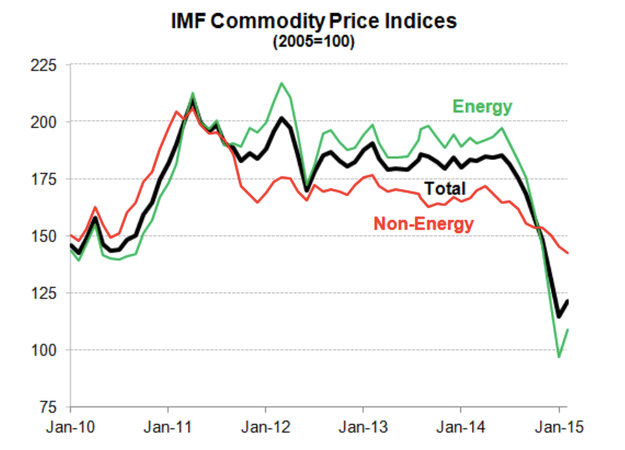
Commodity prices continue to decline 


The precipitous fall in iron ore prices ... 


Australia's largest export ... 


Employment outcomes fairly solid in Australia 


But predominantly pushed by public dominated sectors


Investment down ... 


Offshore funding growing again ... 


Saturday, July 18, 2015

Australia's China Dependence Compared

Australia is one of the most China dependent economies in the world. The impact of China's demand for exports has been largely positive for Australia in expanding Australia's export income, although it is important to remember that Australia's mining sector is 80 per cent foreign owned, which means that eventually most of the profits go overseas. Pity we don't have an effective tax regime to ensure that more of the gains of the resources owned collectively by Australians are returned to those same Australians.

Australia's position as the country most dependent on China for exports has been overtaken by Taiwan. 


Another way to assess China dependence is to consider exports to China as a percentage of GDP. Australia does not have a high level of exports as a percentage of GDP and therefore the impact of China on GDP is slightly less. Nevertheless, if we compare the situation in 2014 with last year, dependence has grown markedly


Australia is also an important destination for Chinese investment. 


Any slowdown or worse in China will have a direct impact on Australian exports and GDP. It will also negatively affect a lot of other countries that Australia exports to as well, particularly Japan and South Korea. 

Recently Joe Hockey said: 
The economy is not affected by what's happening in either Greece or China ... The Chinese stock market dropped 25 per cent in four weeks, but is now 18 per cent higher than its low point last Thursday. It is a very volatile market, [but] it's still 90 per cent higher than it was 12 months ago. ... As far I am concerned, and the Treasury is concerned, our budget forecasts for the Chinese economy remain unchanged. 
The evidence suggests, at least in the case of China, that Hockey's optimism might be misplaced.  

Sunday, March 15, 2015

Charts of the Week

The two booming components of the Australian economy. House and holes as one commentator calls himself. (from MacroBusiness)


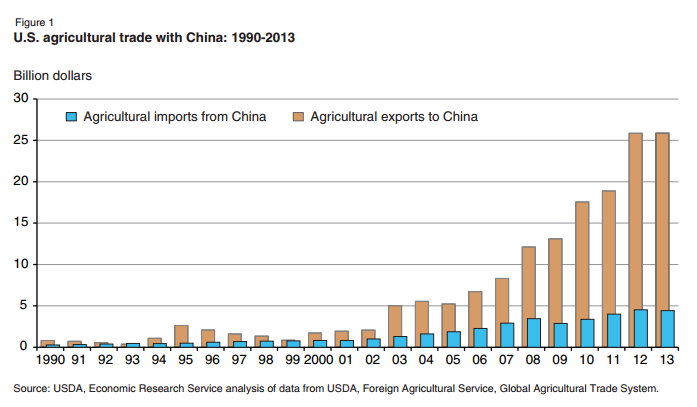
The following are a series of graphs on Chinese agricultural trade. Important because so many policy-makers and business people believe that Australia's next boom will centre around agricultural exports to China. If China continues to become wealthier, then opportunities for exports will grow. Other countries, of course, are keen to take advantage of this possibility. From the US Department of Agriculture. 


Finally a graphic on food spending at home and away. (from Max Roser)


Friday, November 28, 2014

Australia's Growing China Dependence: Do We Need a Plan B?

Australia's increasing economic interactions with China are seen by most as unequivocally beneficial. The putative growing middle classes of China and the rest of Asia will see Australia flourish over the next decade, according to most economic policy-makers and commentators. Joe Hockey recently argued:
China's middle-class of around 150 million people is expected to reach 1 billion in just 16 years. Over 30 per cent of India's population will also lift into the middle class at around the same time! That, in particular, is an amazing transformation given that two thirds of India's population currently has no access to basic services. This rising middle class of Asia wants what comes from Australia's farms and our gas fields. They want to come here as tourists, attend our universities and they need our financial sector to manage their wealth and plan their retirement. They want our quality of life with good housing, roads and transport, clean air and excellent quality health services. Their elderly want quality aged care services and their youth want hope that they can forge an even better quality of life.
Elsewhere Hockey has argued:
The bottom line is the world’s going to want commodities because of the emerging middle class, particularly in Asia but also in Africa and various other places … I don’t think there’s any commodities (downturn) — I think that’s market trash. I think we’ve got to deal with the reality of where the world’s going to be in the next 30 years. They’re going to want commodities.
The Reserve Bank's Alexandra Heath also contends:
Yet, even if the sustainable growth trajectory for the Chinese economy gradually declines over the medium term, the economy is much larger than it was and is still growing. This implies there will continue to be a huge appetite for commodities of many kinds. Some of this demand can be satisfied by local Chinese production, but given the competitiveness of Australian production in a number of commodities, China is likely to be a large market for Australian resource exports for some time to come. 
Finally the outgoing Treasury Secretary, Martin Parkinson, contends:
In this decade – and for the first time in 300 years – we will see the number of Asian middle-class consumers equal the number in Europe and North America. This middle class – which is expected to grow from around 500 million people in 2009 to around 3.2 billion by 2030 – is likely to increase its demand for a wide range of goods and services.
They could all be right and if you judged future opportunities based on past performance you'd be reasonably confident. But what if they're wrong? Is Australia prepared if the optimistic scenario doesn't eventuate? Do we need a plan B?

Australia is now the most China dependent economy in the world. Exports to China have grown from 8.5 per cent of the total ten years ago to 32.4 per cent today.


Interestingly, India's share has fallen over the last 10 years (remember that these are shares of a growing total and exports to India have grown despite their falling share of the total). Other has declined as well meaning less export diversity. 

According to Bloomberg Australia's exports to China as a percentage of total exports is now 37.02 per cent of the total. (It's possible they mean total merchandise exports i.e. excluding services exports). 


Let's take The Treasury's figures and consider Australia's export dependence on the top three destinations in 2004 and 2014. This has grown from 33.7 per cent (Japan 15.7, US 9.5 and China 8.5) to 54.3 per cent (China 32.4, Japan 15.2 and South Korea 6.7). Top 5 has grown from 47.7 to 62.8 per cent. 


More worryingly, not only is Australia now more China dependent, but so is most of the rest of Asia. This means that Australia's exports to Japan and South Korea (our second and third largest export destinations) will also be impacted by a China slowdown or worse. 

Let us hope that the dreamers are right about China's long-term progress and that the doomsayers are wrong. But remember also that all of this export growth to China occurred without a trade agreement. It's possible that the agreement will help to diversify Australia's export mix to China - more agriculture, more services - and not just leave us more vulnerable down the track as Australia becomes even more China dependent. 

This leads us to the big question: do we need a Plan B? And what would that be? It should involve active policy efforts to diversify the economy away from a reliance on resources and selling and buying houses from each other. Policy-makers need to reconsider industry policy and think of ways to develop new industries rather than just support old ones in ad hoc ways. Encouraging the development of renewable technologies should be a no-brainer for Australia, but the Abbott government seems to have done everything possible to undermine such developments. 

Both good and bad things can come from political processes but we cannot remove politics from the equation. It is worth remembering that Australia is a wealthy and relatively equal country because of political interventions, not despite them, as many economists would have us believe. Australia needs to utilise its luck to lessen its vulnerabilities.

If we all believe that China will continue to grow rapidly over the next 20 years, then most policy-makers will believe there's no reason to change tack before its too late.


Wednesday, September 17, 2014

China's Proposed Import Bans on Thermal Coal: Not the Real Problem Facing Australia

The Chinese government has announced that it is going to limit certain coal imports from next year. The Sydney Morning Herald reports:
The Chinese government is to limit the use of imported coal with more than 16 per cent ash and 3 per cent sulphur from January 1, 2015 in a bid to improve air quality, especially in cities such as Beijing and around Shanghai.
According to one analyst: ''[Australian coal exports are] typically around 5500 kilocalories and 24-25 per cent ash. So we've got big problems.''

However, others are less concerned by the changes arguing that the impact on other coal exporters will be even greater.
The restrictions applied vary in stringency depending on geography ... The least stringent [restrictions] apply across the entire country and would not affect a single major Australian thermal coal exporter, all of whom would comfortably comply. However it is the most stringent which apply to the major economic zones of Beijing, Hubei, Tianjin, the Yangtze River Delta and the Pearl River Delta which are of the greatest relevance. These areas are on or close to the coast and therefore are the most prospective for Australian seaborne exported coal ... only 10% of Australian coal exports go to China, and the highly restricted region represents 42% of Chinese thermal coal imports further softening the blow. This means the amount of production likely to be affected is low.
What is clear is that we need some context to assess the impact of China's proposed restrictions and any potential damage to the Australian economy.

According to the Department of Foreign Affairs and Trade's Composition of Trade, in 2013, China was Australia’s largest export market, accounting for 31.9 per cent ($101.6 billion) of total exports of goods and services (an increase of 28.2 per cent on 2012); Japan was Australia’s second largest export market ($49.5 billion); the Republic of Korea was third largest market ($21.3 billion).

Major goods and services export markets


Coal is Australia's second biggest export, behind iron ore and in front of education related travel services.

According to another DFAT publication, from 2001 to 2011, "the value of coal exports rose from $12.5 billion in 2001 to $46.8 billion in 2011, a rise of almost 300 per cent."

Traditionally our biggest market for coal has been Japan, with China a much less significant market until recently. Between 2001 and 2011 Coal exports increased their share of exports to China but were still dwarfed by iron ore exports.


Since 2011, Chinese coal exports have more than doubled from $4.5 billion to $9.1 billion in 2013.

Australian Coal Exports 2013 


The point to note here is that China has traditionally mined a lot of coal itself, but in recent years Chinese production has been in decline with significant producers struggling.  An integral component of the restrictions, therefore, will be to encourage more Chinese coal production.

The most important point to note, however, is that there are two major forms of coal exports – thermal and metallurgical. Thermal coal is used mainly for electricity generation, whilst metallurgical coal is used in steel manufacture.

Metallurgical coal exports in 2012-13 were $22.4 billion and thermal coal exports were $16.2 billion. It is thermal coal exports that could be affected by China's bans.

Principal markets for resources and energy exports
in 2012–13 dollars


Source: BREE

The above graphs clearly show the rise in both metallurgical and thermal coal exports to China since the early 2000s, but China remains a significantly less important market than Japan for both.

A problem with the focus on the potential damage to Australian thermal coal exports from the Chinese bans is that it may miss the real problem for Australian exports over coming years. The coal sector in Australia has been in trouble for quite some time, with coal miners slashing their work forces in recent times.

One of the major vulnerabilities for Australia moving forward is the increase in the share of unprocessed raw materials exports, which have substantially increased their share of total exports since 2008 and even more so since the late 1990s.


The real danger for Australian coal exports would be similar restrictions on exports of thermal coal to Japan and South Korea. Let's face it if you want to do something about climate change and levels of pollution then restricting the growth of coal burning will be essential.

Despite the moves by the Chinese authorities, coal remains the second most important source of energy. Renewables have been growing rapidly in recent years, but their share is still depressingly low.


While coal consumption is declining in Europe and North America it is increasing markedly in the Asia-Pacific.


Source: Vox

Thermal coal burning is going to continue for quite some time yet and the Chinese restrictions will have considerably less impact than the growth slowdown in China and the decline in house building and infrastructure development.

China must lessen its investment share of GDP to rebalance its economy. It could do this in an orderly way over the next few years or it could resist the need to rebalance and face an eventual catastrophic rebalancing later in the decade. In other words, rebalancing away from investment towards consumption will occur, it just depends on when and how. Australia will be negatively affected either way.

What this means is that the decline in iron ore prices and export volumes will be way more important than a ban on thermal coal exports. Those concerned about this issue should be more worried by the general decline in commodity prices.


But it's not all gloom and doom for thermal coal. Given the Abbott government's hostility to developing solutions to climate change and to the advancement of the renewable energy sector, it's possible that coal miners may be able to expand their 75 per cent share of electricity production in Australia.