Saturday, January 15, 2011

The US Car Industry

The Economist often focuses on the US car market and industry. In recent times, they heavily bagged the US government bailouts of GM and Chrysler and then reluctantly admitted that they may have been wrong and the bailouts effective. In their latest report on the US market they note the recovery of the US industry and the re-entry of Volkswagen into the US market with the production of a new saloon, "which is to be built in a new factory in Tennessee".

They also note that the upheavel of 2008 allowed some considerable changes to the heavily unionised part fo US production (GM, Ford, Chrysler) to put it on a more even playing field with the foreign owned sector of US production.

The 2008 crash allowed Detroit to push through changes that had long been blocked by unions and timid management. Capacity was cut drastically: Ford alone closed 17 factories and reduced employee numbers by over 40%. GM ditched brands such as Hummer and Saturn to focus on Chevrolet, Buick and Cadillac, while Ford got rid of all brands except Ford and Lincoln. Health care for company pensioners, long a millstone, was transferred to union-run trusts. New workers can now be hired at lower rates than those ramped up by the United Auto Workers during the boom years. Alan Mulally, Ford’s chief executive, reckons his company can compete on price with factories opened in weakly unionised southern states by Japanese, South Korean and German carmakers. Ford may have made as much as $10 billion in profit last year.
The Big Three have changed, but their home market has changed even more. GM may still be the market leader; Ford’s trusty F-150 pickup is still the bestselling vehicle. But Detroit no longer dominates its backyard. For the Big Three now read the Magnificent Seven. Toyota, Honda and Nissan have been joined by Hyundai and its sister brand Kia in a fragmented market where seven manufacturers each have more than 5% of the market (see chart). And an eighth is trying to join the club.
The graphic below on US car sales shows that GM and Ford still lead, closely followed by Toyota, Honda, Chrysler and Nissan. The Koreans are making headway while Volkswagen and other European carmakers all see the US market as important but only make up at most 13 per cent.


One can only wonder what this left graphic will look like in 2020, with the entry of the Chinese into the market. The Chinese need to avoid the mistakes of Hyundai when it entered Western markets with low quality cars tarring later high quality models with the same brush. Despite doing well in all categories of service and quality for many years many people still see Hyundai as a 'cheap' model car. My mechanic told me when I was buying a new car "buy anything except a Korean car, they are hopeless". But according to quality surveys this doesn't seem to be the case.
 
After sales quality matters a lot with Toyota taking a big hit in recent years with several recalls battering its quality image.
 
It seems likely that the Chinese will dominate the lower cost segment of the market in coming years. Whether they will then easily be able to move up the quality ladder in subsequent years is more difficult to foretell. It is clear that Chinese authorities want to develop a strong car industry through acquisition of foreign companies, joint venture and increasingly local brands.
 
Getting cheap, efficient and long-running electric cars to market will also be a major battleground over the next 20 years and will probably be essential in the Chinese and Indian markets (as well as elsewhere in crowded developing countries.
 
Another problem as noted in another article in the Economist is over production:
The American rescues averted catastrophe, but they—along with continued European subsidies—have exacerbated the overcapacity that has dogged the sector for years. The car industry can produce 94m cars a year, against global demand of 64m. Unless that changes, it will never return to health.

Tuesday, January 4, 2011

Predictions of Doom 2

Nearly all posts about the potential for doom in the Australian economy revolve around housing, either directly or indirectly. The best writers on potential housing trauma are Leith van Onselen who writes a brilliant blog backed by reasoned argument and a myriad of data (some of which I had referred to in my book so I know it's right!!). Other excellent doomsters are David Llewellyn-Smith and Delusional Economics. All believe that Australian house prices are over-valued and that household debt is a real problem for Australia. If you are inclined towards bearish sentiments about housing then these writers will seriously make you worry. While the housing market is obviously very important I want to focus on some bigger picture variables that will undoubtedly affect not just the housing market but the wider Australian economy.

Now the point is no one really knows what will happen to the Australian economy this year but we do know what factors will matter. Former RBA governor Ian Macfarlane once argued that if you only had one variable to understand the Australian economy then the variable you would choose would be the international economy. But the problem with this simplistic (but reasonably accurate) scenario is that the variable itself has changed. In other words the international economy as a variable affecting Australia has changed. The part of the international economy that matters most for Australia is now China and Asian generally. It would have seemed absurd 10 years ago to have a US economy in severe crisis and the Australian economy to be experiencing a boom, but the Chinese economy has changed the global economy enormously.

But as I've written continually the real question for Australia is how the sub-variable China is affected by the wider variable of the international economy, which is still dominated by the Western economies, despite the rise of the developing world over the last 20 years or so. Can China continue to grow in 2011 if the US and Europe remain affected by financial woes and hamstrung by low growth. This is the so-called de-coupling debate.

I've written previously about decoupling. Indeed I wrote in January last year that:
2010 will provide some further evidence for the long-running debate over decoupling. The financial crisis bolstered the anti-decoupling case as world financial markets were universally shaken by events in the United States. Since this time, however, the decouplers' argument has looked more sound as some began to talk of a North Atlantic financial crisis rather than a GFC. Certainly, Asia did well in 2009 compared to what many thought lay ahead at the end of 2008. Govt stimulus in China has helped enormously, but even in China this can't go on forever.

No doubt we shall get further evidence about whether China and the rest of Asia is ultimately as export dependent as economists like Stephen Roach contend and whether the issue of final Western demand really does continue to matter.  
Well it looks like the 2010 evidence is that decoupling had some legs over the course of last year, but at the risk of taking liberties on extensions (and to mix the metaphor) I think that the jury is still out. 2011 will provide further evidence because recent US tax cuts notwithstanding, the impact of fiscal stimuli throughout the world will be further unwound and the need to pay off debts will continue. Debt really is the thing to watch in 2010, not just public debt as the media wants to focus on, but household debt as well, not to mention the seemingly forgotten problem of foreign debt.

As David Barbosa writes in the NYT (via Michael Pettis):
For nearly two years, China’s turbocharged economy has raced ahead with the aid of a huge government stimulus program and aggressive lending by state-run banks. But a growing number of economists now worry that China — the world’s fastest growing economy and a pillar of strength during the global financial crisis — could be stalled next year by soaring inflation, mounting government debt and asset bubbles.
Now this is a common theme of China bears but Pettis is even more bearish:
I have almost no doubt that during 2011 all the growth expectations are going to be revised sharply downward. By the end of next year, I suspect that the consensus will be that for the rest of the decade we should expect growth rates in the 6-7% range for China.
Do I believe these lower numbers? Not really. About a year and a half ago I wrote in a Financial Times article that, assuming consumption growth could be maintained at 8-9% a year, Chinese GDP growth would average 5-7% annually over the rest of the decade.
My prediction caused a lot of strong disagreement and accusations of being overly pessimistic, but the truth is I think I was being optimistic. If GDP growth slows so substantially, it seems to me that consumption growth of 8-9% will be very hard to maintain, so I would argue that we should be prepared for even lower average growth numbers, perhaps in the 3-5% range. But I do think the consensus next year will migrate down to the 6-7% range, even though next year’s growth should remain high – probably in the 9% range.
Barbosa argues that Chinese problems will have significant ramifications for the rest of the world economy (a reversal of the traditional Western-led 'coupling' or 'globalisation' argument).
A sharp slowdown in China, which is growing at an annual rate of about 10 percent, would be a serious blow to the global economy since China’s voracious demand for natural resources is helping to prop up growth in Asia and South America, even as the United States and the European Union struggle.
And because China is a major holder of United States Treasury debt and a major destination for American investment in recent years, any slowdown would also hurt American companies.
Pettis does not agree with Barbosa that a slowdown in China will be bad for the world or for the US:
I am not sure why Chinese holdings of USG bonds suggest that a Chinese slowdown will hurt US companies, but I have already explained why I do not think a sharp slowdown in Chinese growth is necessarily bad for the world. It will be very bad for commodity exporters – or at least non-food commodity exporters, since I think the demand for food from China will continue strong – but the overall effect on the rest of the world depends on the evolution of China’s trade balance. A contraction in the surplus creates net demand for the world, and so might even be marginally positive.
This marginally positive outcome won’t be evenly distributed, of course. Non-food commodity exporters will be badly hurt, while commodity importers and manufacturers will benefit.
I don’t even think such a rapid slowdown in Chinese growth will be bad for China. Again it depends on how it takes place. If there is a serious attempt at rebalancing the economy by raising wages, interest rates and the currency, China can manage a much slower GDP growth rate while still maintaining a fairly high growth rate in household income and consumption. I discussed this in more detail in an entry last month.
Non-food commodity exporters obviously means Australia (although we do export food as well).

Pettis then provides some notes on what is worth watching in 2011. Wisely he does not call them predictions.
First, although I do not believe inflation [in China] is going to be as big a problem as many think (I believe the Chinese financial system has a built-in inflation-stabilization mechanism – see my November 18 entry), if I am wrong and inflation continues to rise, this will create a real problem for monetary policy.
Second, debt levels are worryingly high and are starting to act as a serious constraint on the rebalancing process. My friend Victor Shih at Northwestern University has done great work in trying to figure out the government balance sheet, and he worries, correctly, in my opinion, that it is becoming increasingly difficult for the PBoC to raise interest rates without creating a great deal of financial distress in government-related entities. Even the PBoC balance sheet is a real problem. How can they raise RMB interest rates without running a huge negative carry?
Third, the trade constraints are going to get worse, not better. Ashoka Mody and Franziska Ohnsorge have a very interesting piece on Vox that suggests that we shouldn’t count too heavily on consumption growth in the developed world to boost global demand. That means we are going to spend the next few years fighting over anemic demand growth, and we will be apportioning that demand via trade disputes.
Fourth, although GDP growth rates next year will be very high to see off the current leadership, I am pretty sure that by the end of the year there will be much more concern about the rebalancing process and what that will mean for growth rates. In order to get those high growth rates, I don’t think we need to take the 2011 lending quota too seriously. Whatever it is, it will be breached.
Another China-focused economist is Andy Xie who argues:
By the middle of 2011, most analysts may declare that the world has finally put the financial crisis behind.
The reality is quite different. The global economy is kept afloat by massive monetary and fiscal stimulus around the world. The main problem in the global economy – high costs and declining competitiveness in the developed world, and inflation plus asset bubbles in the developing world continue unabated. Either inflation in the developing world or unsustainable sovereign debt in the developed world will spark the next crisis.
...
The most likely candidates to trigger the next global crisis are the U.S.'s sovereign debt or China's inflation. When one goes down first, the other can prolong its economic cycle. China may have won the last race. To win the next one, China must tackle its inflation problem, which is ultimately a political and structural issue, in 2011. If China does, the U.S. will again be the cause for the next global crisis. China will suffer from declining exports but benefit from lower oil prices.
On the other hand, if China has a hard landing, the U.S.'s trade deficit can drop dramatically, maybe by 50 percent, due to lower import prices. It would boost the dollar's value and bring down the U.S.'s treasury yield. The U.S. can have lower financing costs and lower expenditures. The combination allows the U.S. to enjoy a period of good growth.
One could describe the global economy as a race between the U.S. and China, to see who goes down first.
This coming year is China's opportunity.
The best way for China to deal with inflation, according to Xie, is to address its property bubble.
China's inflation problem stems from the country's rapid monetary growth in the past decade. That is due to the need to finance a vast property sector, which is, in turn, to generate fiscal revenues for local governments to finance their vast expenditure programs. Unless something is done to limit local government expenditure, China's inflation problem is likely to get out of control.
The government now recognizes inflation as the country's main challenge. It has raised interest rates once, deposit reserve ratios several times, and announced its intention to introduce price controls. The barrage of unconventional measures is due to the belief that China's economy is different from others and the conventional measure of raising interest rates may not be effective or necessary. The reluctance to change the price of money and the willingness to change the price of goods and services has not worked well so far.
...
The ineffectiveness of the recent measures casts doubts on the government's sincerity in fighting inflation. The constant and marginal policy announcements could be interpreted that the inflation fighting is now largely a propaganda job. Such perceptions could spark popular panic, which would cause the household sector to hoard goods like rice and cooking oil. When the masses flee from holding money, a full blown crisis will unfold.
So at the beginning of 2011, we are in a similar position to the start of 2010. Debates about China will produce much heat in Australia, the real question is whether they'll produce any light. For what it's worth I think that economic liberal commentators have too much faith in the Chinese Communist leadership to manage the Chinese economy without booms and busts. While China will probably continue to grow rapidly over the medium term, the belief that it can continue to grow uninterrupted by poor policy decisions and the reality of economic cycles is pure fantasy.

I also have no doubt that by this time next year we'll have a clearer position on the debates about globalisation and decoupling and about the ability of Australia to profit from a long-term mining boom.

Thursday, December 16, 2010

Predictions of Doom 1

This one from Eisuke Sakakibara via William Pesek.  Sakakibara argues that “the world is set for a long-term structural slump reminiscent of the 1870s” meaning that he thinks that there will be a return to recession in 2011 lasting until 2018.

Pesek argues:
recent data in the US and Japan and financial turbulence in Europe suggest a fresh global recession is a distinct possibility in 2011. If that happens, what levers are realistically available to revive demand? Interest rates are already at, or close to, zero. That leaves increased government spending as the only real way to stabilize things.

The trouble is, there’s little support for opening the fiscal floodgates in a meaningful way.

One reason is that there’s already loads of public debt out there.
What worries lots of doomsters is that the world might be heading for 1937 again where Roosevelt and many others felt the recession was over and relaxed only for the US economy to go backwards the following year.

As with my previous post a real question for coming years is how long China can continue to grow without expanding demand for its exports from the US and Europe.
If Sakakibara is right, the global economy is in deep trouble. He envisions a broad slowdown that might drag on for seven to eight years. China can live a couple of years without US and European growth, but eight?

To head it off, governments need to up spending. And, for the most part, they aren’t. Yet the US can, and should, borrow more. To do that, it just needs to become a bit more Japanese, says Richard Duncan, author of the “The Corruption of Capitalism.”

There’s a single reason why Japan’s 10-year bond yields are below 1.3 per cent and Asia’s No. 2 economy isn’t being downgraded. Since about 95 per cent of Japan’s debt is held domestically, there’s no risk of capital flight. Japan borrows from its companies and people, an arrangement that’s roughly the mirror image of the US.
The problem for the US on the other hand is the extent of financial vulnerability due to foreign holdings of its bonds.
That so many Treasuries are held in China and elsewhere makes the US highly vulnerable. Duncan, chief economist at Blackhorse Asset Management in Singapore, says the US needs another FDR-like New Deal to restore growth and competitiveness. Funding one means greater borrowing and the way to do it is by tapping private-sector cash, Japan-style.

Such suggestions are likely to fall with a mighty thud on Capitol Hill, which is moving in the opposite direction. Lawmakers calling for Ben Bernanke’s head forget why the Fed chairman is taking US monetary policy into uncharted territory. It’s because Congress failed to pump enough money into the economy in the first place.

Japan is a cautionary tale. On the surface, the 4.5 per cent annualized increase in third-quarter gross domestic product looked promising. The detail, however, showed that deflation is worsening no matter how many yen the Bank of Japan churns into the economy. This is anything but a typical recession, and world leaders are too distracted to see it.

In the US, the focus is on China’s currency. While a stronger yuan would be in the best interests of the global economy, it’s not the answer to all the US problems. Japan is even more obsessed with exchange rates. And Europe is linearly focused on convincing investors that the euro zone won’t unravel.

In our time of currency fixation, perhaps a guy called Mr. Yen is the ideal messenger. Too bad his message is one of economic gloom as far as the eye can see. Perhaps even to 2018.
For a more local prediction of possible doom see one of my favourite bloggers Leith van Onselen, who highlights China's empty cities and what they might mean for Chinese demand for Australian resources when the Chinese have to EVENTUALLY stop building stuff no one is buying.

Wednesday, December 15, 2010

The fall and rise of world trade

The IMF's Finance and Development Journal is a good source of information and data on the world economy. And despite what some on the Left might think it's fairly balanced as well.

The latest edition provides some data on the fall and rise of exports of the top 10 exporters and provides some info on why Australia has done better than many other countries.


Before the crisis - from 2000-08 - China's exports grew by 700 per cent.

But as the graph shows, its exports dropped substantially during 2008-09. For the top 10 exporters, which account for 50 per cent of world trade, exports dropped by 34 percent between October 2008 and March 2009. But by "the second quarter of 2010, the top 10 exporters had recovered 55 percent of their decline during the crisis."

Indeed, China's exports have nearly recovered their 2008 peak.

Perhaps of more interest for Australia is the import side of the equation, which shows that China's imports have surpassed their 2008 peak. The US, however, stuck as it is in its financially induced mire has recovered, but still has a long way to go before it regains its 2008 peak.

The real question is whether this disparity will eventually matter for the world economy and for China (and Asia) in particular, i.e. can China's trade continue to boom if the US and Europe continue to lag with imports. Overall the recovery in imports of the top 10 has been substantial. According to the IMF:
During 2000–08, the top 10 importers—who bought about 50 percent of world imports—increased their foreign purchases by 51 percent, with the United States the clear leader. As with exports, the financial crisis caused a significant drop in imports of 35 percent during the same six-month period—October 2008 to March 2009. But there was a similar sharp rebound in imports. By the second quarter of 2010, the top 10 importers had recovered 58 percent of the crisis-induced decline.
Another interesting visual from this graph illustrates that the US has once again surpassed Germany as the second biggest exporter with the German export recovery faltering slightly in early 2010.

Thursday, December 2, 2010

Keep on Booming

I don't know about you, but whenever I read headlines like "20 year boom", my bullsh-t detector comes on hard and fast. While there can be no doubt about the current status of the boom as one of the biggest in Australia's history, the real question is whether it is going to be sustained into the future. While I think the Australian economy is travelling fairly well at the moment, I just don't have the faith that many seem to have in the projections of endless prosperity.

The last week or so has seen the Head of Treasury and the Reserve Bank Governor both talk about the possibility of a long-term China boom. Students of the Australian political economy wanting a snapshot of official thinking could do far worse than review the recent words of Ken Henry and Glenn Stevens.

So what did Australia's two most important economic bureaucrats actually say?

Henry was at a Senate Hearing into the government's mining tax and the exchange went like this (my emphasis in bold):
Senator HUTCHINS—Can I ask you to give a view about the uneven growth across the economy at the moment.

Dr Henry—It is quite uneven. Certainly there are some sectors of the economy that are growing very strongly and we would expect to see them continue to grow as strongly over the next several years. There are other sectors of the economy that are being affected, particularly by the high exchange rate, who are finding conditions more difficult. There are businesses also that if not affected by the high exchange rate are feeling the impact of rising interest rates and the dampening effect that those rising interest rates are having on demand. So there is some dampening of demand evident in the Australian economy currently. We would expect to see those trends continue for some time—for quite possibly several years.

So it is likely that we will see an Australian economy characterised by unprecedentedly strong rates of growth in some sectors of the economy, particularly in mining, mining investment and mining related construction activity, with other sectors of the economy growing somewhat slower than their historical trend rates of growth as the economy’s factors of production, principally labour but also capital, move from the slower growing sectors to the faster growing sectors of the economy. In this uneven pattern of growth the Australian economy is being restructured, if you like. There is a period of structural change that the Australian economy is going through. I have said publicly on a couple of occasions recently that the external shock to which the Australian economy is adjusting, and by that I am referring to historically high commodity prices and the high terms of trade that come with those historically high commodity prices, will quite possibly prove to be the largest external shock ever to hit the Australian economy, and it is causing quite a deal of structural change. To date, not a lot of that structural change has occurred—some has—but over the few years ahead, we should expect to see quite significant structural change in the Australian economy.
Senator HUTCHINS—So the non-mining sectors appear to need some sort of assistance — not assistance, but maybe they need to be recognised?

Dr Henry—It is not clear that assistance is what is required. After all, what could appear to be assistance to a particular sector that is finding the going a bit tough could translate into even higher interest rates and an even higher exchange rate and could make life even more difficult for those sectors that are struggling now and that would not be in receipt of assistance. I think it is important to recognise that the pattern of growth will definitely be uneven in the next few years and recognise the challenge that poses for the conduct of both macroeconomic and structural policies. It has to be recognised, but you have to be careful that in constructing any form of assistance you do not actually make the problem worse.

Senator HUTCHINS—Would cutting company tax be of assistance to these non-mining sectors?

Dr Henry—Yes, and it is one of the reasons—it is not the only reason—the tax review document recommended a cut in the company tax rate. Another reason was to reduce the cost of capital in Australia in order to provide a more attractive destination for investment. That was a long-term view that was being taken in the tax review. Another reason for the tax review recommending a cut in the company tax rate, in association with a resource super profits tax, was to rebalance the pattern of growth somewhat to provide a lower cost of capital for those sectors of the economy that are feeling the pressure that is being exerted by this very rapidly growing mining sector of the economy.

Senator HUTCHINS—One concern that has been expressed to the committee has been about this so-called Dutch disease, which you may have heard Professor Garnaut comment on in our hearing on Friday. What appropriate measures should be taken? Should they be similar to the measures taken by Norway? Are there other areas that should be explored or are we going down the right track at the moment?

Dr Henry—I have not had the advantage of seeing Professor Garnaut’s comments that he made to this committee on Friday. I think I can anticipate what he would have said in respect of Dutch disease and that is actually what I was referring to earlier when I was referring to the strength of the Australian dollar and the pressure that is putting on other sectors of the economy, particularly the trade exposed sectors of the economy. As to policy responses to so-called Dutch disease, without addressing particular policies I would say that in general terms it might be helpful to reflect on whether the increase in the exchange rate is considered to be only temporary or whether the increase in the exchange rate might reflect a medium-term or even a long-term change in Australia’s terms of trade. Typically the Dutch disease label attaches to instances in which the appreciation of the exchange rate is considered to be temporary but the economic effects of that appreciation are long lasting.

I think it would be sensible on this occasion to contemplate the prospect that there has been a structural change in our terms of trade not a short-lived change in our terms of trade and that that structural change in our terms of trade will have to be associated with any change in the structure of the Australian economy. If that is the case then in general terms, again without talking about a particular policy option, policy would do better to focus on what could be done in order to support the structural change that is going on in the economy in a way that does least damage to people’s lives. That might mean, for example, avoiding temptation to offer support to a particular business which, with these terms of trade, does not really have a long-term future in the Australian economy but to focus instead on programs that would support the transition of workers from that business to other businesses in the Australian economy which do have a longterm future with the sorts of terms of trade that we are confronting. That is a generalisation, I am conscious of that and you asked me about particular policies, but I would not want to at this stage get into arguing the merits of particular policies. I am happy to talk about policy approaches, but I would not want to get into a discussion of the merits of particular options.
The gist of Henry's Senate statement is that the boom will be structural rather than cyclical, which would mean considerable adjustment for Australians as capital and labour move away from other sectors of the economy towards mining. (This is a bit of a problem given mining's low employment to output ratio) It's also a non-too-subtle, even if indirect suggestion that Australia should not offer assistance to the manufacturing sector!

Australia's terms of trade are approaching the highest ever level as this excellent graph from RBA Governor Glenn Stevens' speech "The Challenge of Prosperity" shows. (For those interested I published an article in the Griffith Review entitled "The Politics of Prosperity" dealing with similar themes ... for a similar article but with graphs and tables see "Between Luck and Vulnerability")


I've spent a good deal of the year trying to explain to students in my Globalisation, the Asia-Pacific and Australia class the importance of the terms of trade. Indeed, I asked them in their exam why it mattered. I told them that if they fell asleep Rip van Winkle style for 20 years and wanted to get an immediate picture of the state of the Australian economy one of the best things they could do would be to call: "Get me the terms of trade!!"

It is worthwhile defining the terms of trade because it it is a fundamental measure of boom and gloom. The terms of trade is an index-measure ratio of the average price level of exports to the average price level of imports. It effectively reflects the capacity of a given quantity of exports to pay for a given quantity of imports, and provides an important indication of the strengths and weaknesses of the economic structure. A rising or falling terms of trade indicates the possibility of improving or declining living standards, because if what we sell earns relatively more than what we buy, we will be relatively wealthier. Because the terms of trade is a ratio, increases can be a result of export prices increasing at a greater rate than import prices, or export prices increasing while import prices are declining, or export prices declining at a slower rate than import prices. Of course, a rising terms of trade doesn’t stop us from buying more things than we sell, which we have made a habit of for much of our history! Improvements in the terms of trade are not reflected in GDP figures, but improvements do contribute significantly to increases in national disposable income.

Why it is important is, as usual, lucidly explained by the Governor.
You may have noticed the Reserve Bank saying a lot about the terms of trade in the past few years. Before I describe the chart, why is it important?
Our terms of trade have a big bearing on national income. In economic commentary, there is typically a very strong focus on GDP – the value of production – as a summary of national material progress. There is also quite rightly an emphasis on lifting productivity – real GDP per hour worked – as the source of our growth of material living standards.
For open economies, though, our standard of living is affected not just by the physical output we can obtain from our resources of labour and capital, but also by the purchasing power of that output over things we want to have from the rest of the world. This is what the terms of trade is measuring. It is the relative price of our export basket in terms of imports. At the extreme, if the economy were open to the extent that we exported all our production and imported all our consumption, then the price of exports relative to imports would determine our living standards entirely, for any given level of productivity per hour worked. As it is, Australia is not that open, and not as open as many smaller economies, but it is considerably more open than the really large economies like the United States, the euro area or Japan. So the terms of trade matter.
When the terms of trade are high, the international purchasing power of our exports is high. To put it in very (over-) simplified terms, five years ago, a ship load of iron ore was worth about the same as about 2,200 flat screen television sets. Today it is worth about 22,000 flat-screen TV sets– partly due to TV prices falling but more due to the price of iron ore rising by a factor of six. This is of course a trivialised example – we do not want to use the proceeds of exports entirely to purchase TV sets. But the general point is that high terms of trade, all other things equal, will raise living standards, while low terms of trade will reduce them.
He then argues that there are 3 key features of the long-term chart of the terms of trade.
The first is the degree of variability in the terms of trade through the middle parts of the 20th century, from about World War I to the aftermath of the Korean War. This was, of course, a period of considerable instability in the global economy, with the attempt to return to the Gold Standard after the ‘Great War’, followed by the 1930s depression, the Second World War, the post war expansion and then the Korean War. I might add that, in those days, with the attempt to maintain a fixed exchange rate, these swings were very disruptive to the economy. Typically, a rise in export incomes would result in a rise in money and credit, a boom in economic activity and a rise in inflation. Then the terms of trade would fall back and the whole process would go into a rather painful reverse. The advent of the flexible exchange rate in the early 1980s made a great difference in managing these episodes.
The second feature is the downward trend in the terms of trade, particularly noticeable from the early 1950s to about the mid 1980s. This was the period of resource price pessimism, the ‘Prebisch Singer hypothesis’ and so on, which held that primary products would tend to decline in price relative to manufactured products. The latter part of this period was the one in which the realisation became widespread that the (apparently) easy gains in living standards of the post-war boom were gone, and in which pessimism about Australia's economic future was probably at its most intense. It was also the period when, under strong political leadership backed by a highly capable bureaucracy and an economically literate media, our determination to press on with various productivity-increasing reforms was greatest. That these two phenomena occurred together was probably not entirely a coincidence.
The third feature is the current level of the terms of trade relative to everything but the all-time peaks over the past century. Measured on a five-year moving average basis, and assuming (as we do) some decline in the terms of trade over the next few years from this year's forecast peak, the terms of trade are as high as anything we have seen since Federation.
To give some perspective on how important this is, let me offer one back-of-the-envelope calculation. The export sector is about one-fifth of the economy. The terms of trade are at present about 60 per cent higher than their average level for the 20th century, and about 80 per cent higher than the outcome would have been had they been on the 100-year trend line. This means that about 12–15 per cent of GDP in additional income is available to this country's producers and/or consumers, each year, compared with what would have occurred under the average or trend set of relative prices over the preceding 100 years (all other things equal). That will continue each year, while the terms of trade remain at this level.
Of course, part of this income accrues to those foreign investors who own substantial stakes in the mineral sector. In this sense, the current boom is a little different from the early-1950s one where most of the income went first to Australian farmers. Nonetheless, a good proportion accrues to local shareholders and employees, and to governments via various taxes. A non-trivial part of it is available to consumers as higher purchasing power over imports, as a result of the high exchange rate.
... On all the indications available, we are living through an event that occurs maybe once or twice in a century.
Stevens then moves onto what should be done. This, he argues, depends on whether the higher income that accrues from a higher terms of trade is long lasting or fleeting.
If the rise in income is only temporary, it would be desirable not to raise national consumption by very much. Instead, it would make sense to allow the income gain to flow into a higher stock of saving, which would then be available to fund future consumption (including through periods of temporarily weak terms of trade, which undoubtedly will occur in the future). Moreover, it would probably not make sense for there to be a big increase in investment in resource extraction if that investment could be profitable only at temporarily very high prices (and which could come at the cost of reduced investment in other areas).
If the change is likely to be persistent, then income is likely to be seen as permanently higher. Households and most likely governments will probably see their way clear to lift their consumption permanently, both of traded and non-traded goods and services. Structural economic adjustment will also occur as the sectors whose output prices have risen, now being more profitable, will seek to expand, in the process attracting productive resources – labour and capital – away from other sectors whose output will decline as a share of GDP. Australia's floating exchange rate, which tends to rise in line with the increase in the terms of trade, helps the reallocation of labour and capital by giving price signals to the production sector. The higher exchange rate also speeds the spread of the income gains from the terms of trade rise to sectors other than the resources sector, by directly increasing their purchasing power over imports. The resulting rise in imports spills demand for tradable goods and services abroad, which helps to reduce domestic inflation.
All sounds hunky dory, but there is of course a sting in the tale as I summarised in an earlier post.
What most of the boomers forget is that price increases encourage supply increases, which then lead to oversupply and falling prices. This is the nature of the commodity cycle. No one knows this better that economist Bob Gregory, who adapting ideas about the so-called "Dutch Disease" - the negative impact resource booms can have on manufacturing sectors largely through a temporary rise in the exchange rate - to Australian conditions in the mid 1970s and which was then designated the "Gregory Thesis".
Gregory's major concern (as Henry argues above in relation to the Dutch Disease) is with a temporary rise in the exchange rate. This is a problem because the rise in the exchange rate may be long enough to force businesses in other sectors of the economy to the wall so that in the wash-up, resource demand is not sustained and important sectors of the economy are then diminished. In contrast, a sustained rise in the terms of trade will lead inevitably to a change in the structure of the economy as investment and people shift into mining and associated industries. This may still cause problems in the future as the economy becomes less diverse and less able to deal with an eventual collapse in the terms of trade.

As Stevens notes in relation to structural change:
It is easy, of course, to speak in the abstract of ‘reallocation of productive resources’, but this means that some businesses and incomes become relatively smaller; jobs growth in some areas slows even as in others it picks up. Some regions struggle more than others. Some sources of government revenue are adversely affected even as other sources see an improvement. This process will be seen, not unreasonably, as costly by those adversely affected, even though the overall outcome is that the country as a whole is considerably better off. (It is also obvious that, if the terms of trade change really is only temporary, it may not be worth paying these adjustment costs from the perspective of the overall economy.) The policy challenge for governments will be whether to help these sectors resist change, or to help them adapt to it.
In other words, interpretation of the sustainability of the current boom matters a lot!

Stevens argues we could try to keep the structure of the economy the same and resist changes, but correctly points out that would be stupid. We wouldn't want an economy dominated by agriculture as it was in the immediate post-war period and for a most of the time before that (gold booms notwithstanding). Remember the fate of wool, which was for so long our most important export and that now is not even in the top 25!

So if the terms of trade do remain fairly high for a lengthy period, the task is going to be to facilitate structural adjustment so as to make it occur in as low cost a way as possible. But that ought to be feasible given that overall income is considerably higher.
Of course we cannot know whether the terms of trade will be high for a long period. History certainly would counsel caution in this respect. We do know that supply of various resources is set to increase significantly over the years ahead and not just from Australian sources. It is for this reason that we assume some fall in commodity prices over the next several years. The assumption underlying the Bank's forecasts published a few weeks ago is that iron ore prices fall by up to about 30 per cent over the next several years. Even if they do, the terms of trade will remain quite high by the standards of the past 100 years in the near term.
Is that assumed fall realistic? There is no way of knowing. Larger falls have happened before. In fact they have been the norm. On the other hand, experienced people seem to be saying that something very important – unprecedented even – is occurring in the emergence of very large countries like China and India. If the steel intensity of China's GDP stays where it is already, and China's growth rate remains at 7 or 8 per cent for some years to come, which appears to be the intention of Chinese policy-makers, then the demand for iron ore and metallurgical coal will rise a long way over the next couple of decades. If India's steel intensity goes the same way as most other countries have, that will add further. Even with allowance for supply responses by other producers and considerably lower prices than we see today, that seems to point to a prominent role for the resources sector, broadly defined, over a longish horizon.
So the most prudent assumption to make might be that the terms of trade will be persistently higher than they used to be, by enough that we will need to accommodate structural change in the economy, but not by so much that we shouldn't seek to save the bulk of the surge in national income occurring in the next year or two, at least until it becomes clearer what the long run prospects for national income might be.
Stevens then explains that Australians are indeed currently saving more than they have for quite some time (hence the poor retail figures out today). "The net saving rate is now seen at some 9–10 per cent of income over the past year or two, up from about −1 per cent five years ago." There's nothing like a crisis to make people more cautious, especially given the fact that Australian households are more indebted than most other countries in the world and certainly vastly more than they ever have been in history.

Stevens speech makes clear that Australia and much of the rest of the world economy are increasingly dependent on China. Why this is not seen as more of a problem never ceases to amaze me! The assumption appears to be that China's growth will continue onward and upward and that India will join China and then surpass as it is better suited demographically for longer-term growth (i.e. more young people).

Given China's growing importance for the much of the world economy and certainly for Asia, there are also increasing indirect effects of Chinese growth on Australia. Our second biggest export market is, like us, more and more tied into Chinese growth. As Rintaro Tamaki, Japan's Vice-Minister of Finance for International Affairs, said: "We are not suffering from excess Chinese imports. We have a complementary relationship. We export parts and China re-exports the assembled products. So when China's exports increase, Japan's exports to China also increase." What this also means is that when China's exports decline, Japan's exports will decline helping to exacerbate the impact of a China slowdown on Australia. The same goes for South Korea as well, which also is increasingly tied into Chinese growth.

Now I don't want to sound too much like a negative vibe merchant here. While Australia remains vulnerable to changes in international demand and to international financial supply (just as it has done throughout its history), the most likely scenario for Australia over the next 20 years is, unsurprisingly, a variable (but higher) terms of trade, meaning a variable national income. Stevens thinks this too:
In the longer term, the economy's increased exposure to large emerging economies like China and India (these two now accounting for over a quarter of exports) – assuming that continues – may also pose important questions. If these and other emerging economies continue to grow strongly on average, but also, as with every other country, still have business cycles, the result may be the Australian export sector, and therefore the Australian economy, having a potential path of expansion characterised by faster average growth in income, but with more variability. That possibility has been noted by some observers. It is worth recording that such concentration would hardly be unprecedented – think about the dominance of Japan in Australia's trade in the 1970s and 1980s, or the dominance of the United Kingdom in an earlier era. Nonetheless, the degree of concentration could be higher than we have seen in the past decade or more, which was a time of considerable stability for the Australian economy overall.

Its probable that China and India will continue to grow rapidly for the next few years and at a slowing rate over the medium term, but it is unlikely that this growth path will be smooth. Capitalism generally means booms and busts. To think that growth will be smooth shows an enormous faith in the ability of the Chinese Communist Party to manage China's state capitalist economy. There is a beautiful irony in the faith that many economic liberals have in Communist economic managment skills! The thing that I think is unlikely is a 20 year boom, which implies no busts. For this to occur would mean that Australian history holds no lessons for Australia whatsoever. It would also mean that economics would have finally trumped politics. If I was a gambling man (and I am) I wouldn't bet my house on it (fortunately I don't own a house). There are just too many potential intervening variables for Chinese and Indian growth to be smooth! Maybe it's because I'm a poli sci major, but ultimately politics rules.


Given the likeliness of variability what should Australian policy-makers do? One solution would be to simply accept variability and deal with the fall out. Indeed this is probably the most likely outcome given the seeming inability of recent Australian governments to think beyond the short term.

But trying to save some of the income would be a better solution, using the proceeds of the boom to fireproof the Australian economy into the future. This would be a good solution regardless of whether the boom is temporary or more long-lasting or a series of boom-busts.

One of the ways of doing this would be to create a sovereign wealth fund like Norway has, which would mean the proceeds of the boom would be invested offshore. The foreign investment out of Australia achieved by a SWF would also help to slow the rise in the Australian dollar from a booming economy and would provide a store of savings for when the terms of trade were lower.

Stevens expresses the case slightly more esoterically:
Another approach would be to reflect the higher income variability in our saving and portfolio behaviour rather than our spending behaviour. We could seek to smooth our consumption – responding less to rises or falls in income with changes in spending and allowing the effects to be reflected in fluctuations in saving. In the most ambitious version of this approach, we could seek to hold those savings in assets that provided some sort of natural hedge against the variability of trading partners, or whose returns were at least were uncorrelated with them. Of course, such assets might be hard to find – the international choice of quality assets with reasonable returns these days is a good deal more limited than it used to be.
It is possible that this behaviour might be managed through the decisions of private savers. There might also be a case for some of it occurring through the public finances. That would mean accepting considerably larger cyclical variation in the budget position, and especially considerably larger surpluses in the upswings of future cycles, than those to which we have been accustomed in the past. There would also be issues of governance and management of any net asset positions accumulated by the government as part of such an approach, including whether it should be, as some have suggested, in a stabilisation fund of some sort. [He means here a SWF].
Of course if the China boom turns to a bust in the short- to medium-term then I get the feeling all talk of SWFs will be soon forgotten. Let's hope that we keep debating whether it'd be a good idea.

Wednesday, November 24, 2010

Rethinking World Trade

In a recent speech, rather dully titled "Globalization of the Industrial Production Chains and Measuring International Trade in Value Added", the Director General of the World Trade Organisation Pascal Lamy made some points that I've been talking about with students in my course Political Economy of East Asia (a title I want to change to "Power in East Asia" to get more students!).* Lamy is concerned that traditional trade statistics skew the real picture of international trade, particularly the bias towards the country where the final product is shipped from, even if it is simply assembled there. He uses the example of the iPOD to make his case.
What we call “Made in China” is indeed assembled in China, but what makes up the commercial value of the product comes from the numerous countries that preceded its assembly in China in the global value chain, from its design to the manufacture of the different components and the organization of the logistical support to the chain as a whole. ... If we continue, in this context, to base our economic policy decisions on incomplete statistics, our analyses could be flawed and lead us to the wrong solutions.
For instance, every time an iPod is imported to the United States, the totality of its declared customs value (150 dollars) is ascribed as if it were an import from China, contributing a bit more to the trade imbalance between the two countries. But if we look at the national origin of the added value incorporated in the final product, we note that a significant share corresponds to reimportation by the US, and the rest to the bilateral balance with Japan or Korea which should be allocated according to their contribution to that added value. In fact, according to American researchers, less than 10 of the 150 dollars actually come from China, and all the rest is just re exportation. In the circumstances, a re evaluation of the yuan — a topic which is very much in vogue these days — would only have a modest impact on the sales price of the final product and would probably not restore the competitiveness of competing products manufactured elsewhere.
Similarly, the statistical bias created by attributing the full commercial value to the last country of origin can pervert the political debate on the origin of the imbalances and lead to misguided, and hence counter-productive, decisions. Reverting to the symbolic case of the bilateral deficit between China and the United States, a series of estimates based on true domestic content cuts the deficit by half, if not more.
He then goes on to make an important point about the US trade deficit with Asia rather than particular countries.
This impression is confirmed by other figures, if we accept to “debilateralize” them: if we look at the US trade deficit with Asia rather than its bilateral deficit with China, we note a remarkable stability over the past 25 years at something like 2 to 3 per cent of the United States’
Increased trade with China has replaced trade with other parts of Asia, but this hasn't necessarily been as negative for the rest of Asia as this simple statement might imply. This is because the rest of Asia has also increased its exports with China, developing what is an increasingly important global production structure.

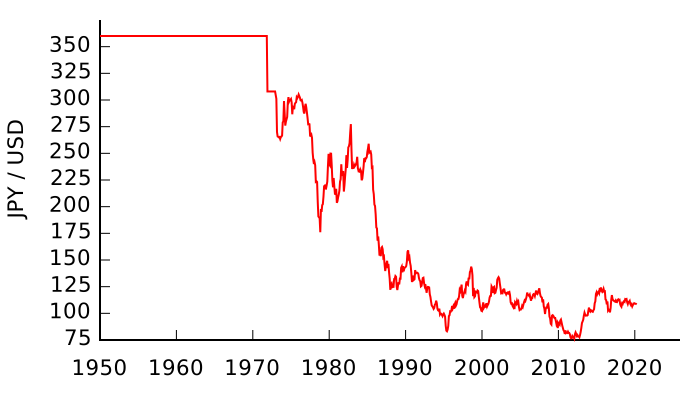
One of the remarkable facts that proponents of the argument that a higher Yuan will rebalance US-China trade need to think about is in relation to US trade with Japan. Though the Yen strengthened remarkably against the Dollar, from 360 yen to the dollar in the 1970s to as low as 80 to the Dollar in the mid-1990s, the trade deficit with Japan just kept on increasing.

File:JPY-USD 1950-.svg
JPY-USD Exchange Rate
http://en.wikipedia.org/wiki/File:JPY-USD_1950-.svg

For a  discussion on currency issues see Yipang Huang "A Currency War the US Cannot Win". (See also Martin Wolf "Why America is Going to Win the Global Currency Battle".)

Huang makes the point that:
Experts who are interested in Plaza II should first study carefully the experiences of the original Plaza Accord. The yen/dollar rate dropped from 250 in early 1985 to 150 in early 1988 and further to about 80 in mid-1995. But Japan’s current-account surpluses did not disappear.
Likewise, the real effective exchange rate of the US dollar fluctuated during the past three decades, but the US current-account deficits continued to climb, especially during the ten years preceding the global crisis. If the Plaza Accord did not achieve its original goal, why all of a sudden people became interested in this old idea again?

Now Lamy's brief is to encourage world trade liberalisation and so he has an agenda here, but it's worth thinking about his analysis, especially in relation to employment.
As for the impact on employment — understandably a rather sensitive issue in these times of economic crisis — once again the result can be surprising. Reverting to the case of the iPod, another study by the same authors estimates that on a global scale, its manufacture accounted for 41,000 jobs in 2006 of which 14,000 were located in the United States, 6,000 of them professional posts. Since American workers are more qualified and better paid, they earned more than 750 million dollars, while only 320 million less than half — went to workers abroad.
In this example, case studies have shown that the innovating country earns most of the profits; but traditional statistics tend to focus on the last link of the chain, the one which ultimately earns the least. Don’t get me wrong, I am not saying that this is always the case and that relocations always create more jobs than they destroy. ...
I simply wanted to highlight the paradoxes and the misunderstandings that arise when new phenomena are measured using old methods. Statistical survey experts know very well that “if you ask the wrong person, you will get the wrong answer”. Similarly, if you analyse a phenomenon using the wrong “measurements”, you will reach the wrong conclusions.
What Lamy proposes is a new research agenda to rethink the analysis of world trade.


*The political economy of East Asia course is part of the Bachelor of Asian Studies and Bachelor of International Relations at Griffith University.