Showing posts with label taxation. Show all posts
Tuesday, April 14, 2015
Thursday, May 23, 2013
The US Economy: Profits Up, Taxes Down
This from The Economist fairly much speaks for itself ...
Too many companies are legally avoiding paying tax, with Apple and Google serious offenders. This is despite the US having one of the highest nominal rate of corporate taxation.
According to one analyst (using OECD data):
As Stephen Rattner argues:
Too many companies are legally avoiding paying tax, with Apple and Google serious offenders. This is despite the US having one of the highest nominal rate of corporate taxation.
According to one analyst (using OECD data):
In 2011, national statutory corporate tax rates among the thirty-four members of the OECD will range from 8.5 percent in Switzerland to 35 percent in the United States. When sub-national taxes are added, the United States has the second-highest statutory combined corporate tax rate – 39.2 percent – after Japan’s rate of 39.5 percent.
Despite having the highest national statutory rate, the United States raises less revenue from its corporate tax than do the other members of the OECD on average. In fact, federal corporate income taxes raise little revenue compared with other federal taxes; roughly comprising 11.6% of total federal tax revenues.
Corporations, like individuals, can and do use tax breaks to lower their tax burdens and, as a result, the effective tax rate is lower than the top rate.Despite this she then goes on to argue that because of world-wide taxation of US companies, US corporate taxes are punishing. Astonishing that analysts can seemingly maintain their opinions in the face of facts!
As Stephen Rattner argues:
As muddled and broken as the individual income tax system may be, the rules under which the government collects corporate levies are far more loophole-ridden and counterproductive.
That’s not entirely Washington’s fault. Unlike individuals, multinational corporations can shuttle profits — and sometimes even their headquarters — around the globe in search of the jurisdiction willing to cut them the best deal on taxes (and often other economic incentives).
Much of this occurs under the guise of “transfer pricing,” the terms under which one subsidiary of a multinational sells products to another subsidiary. The goal is to generate as high a share of profit as possible in the lowest-taxed jurisdictions.
A study by the Congressional Research Service found that subsidiaries of United States corporations operating in the top five tax havens (the Netherlands, Ireland, Bermuda, Switzerland and Luxembourg) generated 43 percent of their foreign profits in those countries in 2008, but had only 4 percent of their foreign employees and 7 percent of their foreign investment located there.
As a consequence, the effective corporate tax rate in the United States fell to 17.8 percent in 2012 from 42.5 percent in 1960, according to the Federal Reserve Bank of St. Louis. ...
Happily, the gaming of the tax system is becoming a global concern, with an action plan coming from the Organization for Economic Cooperation and Development in July. The O.E.C.D. should work toward taxing business profits where they actually occur, not where they’ve been shifted by some tax adviser.
Monday, April 15, 2013
Tax Rates, Cheap Dates and Ciggies
The top marginal tax rate and the point at which it kicks in matter most when considering income taxes. Also important is the fact that the rate is marginal meaning you don't pay this rate for all your income, but for the income above a certain threshhold.
CNN Money has a great chart on top tax rates and the level they kick in. (h/t Leith van Onselen)
Once again let's be clear, Australians are not highly taxed.
While we're not highly taxed, the cost of living in Australia is at the top of the global scale. Deutsche Bank has a cheap date index, which ranks Australia at the top of the scale.
This cheap date would be considerably more expensive if you and your date were to smoke Marlboros.
CNN Money has a great chart on top tax rates and the level they kick in. (h/t Leith van Onselen)
Once again let's be clear, Australians are not highly taxed.
While we're not highly taxed, the cost of living in Australia is at the top of the global scale. Deutsche Bank has a cheap date index, which ranks Australia at the top of the scale.
This cheap date would be considerably more expensive if you and your date were to smoke Marlboros.
Tuesday, October 25, 2011
Why is the Gillard government so timid about the mining tax?
BIS Shrapnel has recently conducted a report (see here for coverage) that contends that the mining investment boom will continue for the next 5 years with total investment reaching $375 billion.
That's a lot of money. So why do we still not have a mining tax?
One can imagine the possibility that by the time the mining tax is ready to come in, the boom will be (temporarily perhaps) over, putting pressure on the government to abandon it. This could be the case even though a profits-based tax would be better for the miners than a volume-based tax during a downturn in prices. It's certainly not better for them when profits are high, but that's the whole point. The resources are non-renewable and the profits made from selling them overseas should be more equitably shared.
We can only imagine what could have been achieved if we had had a profits-based mining tax for several years, not only in terms of productive government expenditure in infrastructure, but in the ability to reduce taxation for those industries facing difficulties in the patchwork economy.
Warnings by the mining sector about the negative impact of the carbon tax and the potential mining tax on future investment are bunkum.
That's a lot of money. So why do we still not have a mining tax?
One can imagine the possibility that by the time the mining tax is ready to come in, the boom will be (temporarily perhaps) over, putting pressure on the government to abandon it. This could be the case even though a profits-based tax would be better for the miners than a volume-based tax during a downturn in prices. It's certainly not better for them when profits are high, but that's the whole point. The resources are non-renewable and the profits made from selling them overseas should be more equitably shared.
We can only imagine what could have been achieved if we had had a profits-based mining tax for several years, not only in terms of productive government expenditure in infrastructure, but in the ability to reduce taxation for those industries facing difficulties in the patchwork economy.
Warnings by the mining sector about the negative impact of the carbon tax and the potential mining tax on future investment are bunkum.
Monday, August 22, 2011
US Inequality in a Nutshell
The difficulties of doing something about inequality in the United States are numerous, but as Paul Krugman once said the explanations for inequality are more sociological than economic. Globalisation or economic openness are not responsible even if they provide persuasive arguments to explain why rising inequality is inevitable.
If governments want to do something about inequality they could, but they would require popular support to do so. At what point does rising inequality in the US cause a rethink amongst the population that political interventions are required to lower inequality instead of increasing it?
Unfortunately for egalitarians, the economic crisis has led to a right-wing populist backlash against government, rather than a left-wing populist backlash against corporations and the wealthy.
One of the richest men in the world Warren Buffett has written an excellent article in the NYT called "Stop Coddling the Super-Rich".
Buffett wonders why the rich haven't shared in the necessary sacrifices required to deal with the economic crisis.
OUR leaders have asked for “shared sacrifice.” But when they did the asking, they spared me. I checked with my mega-rich friends to learn what pain they were expecting. They, too, were left untouched.
The most appalling fact is that the rich get these benefits at the expense of middle class and poor workers.While the poor and middle class fight for us in Afghanistan, and while most Americans struggle to make ends meet, we mega-rich continue to get our extraordinary tax breaks. Some of us are investment managers who earn billions from our daily labors but are allowed to classify our income as “carried interest,” thereby getting a bargain 15 percent tax rate. Others own stock index futures for 10 minutes and have 60 percent of their gain taxed at 15 percent, as if they’d been long-term investors.
Buffett argues that higher taxes would not stop investment as many corporations and financiers argue.Last year my federal tax bill — the income tax I paid, as well as payroll taxes paid by me and on my behalf — was $6,938,744. That sounds like a lot of money. But what I paid was only 17.4 percent of my taxable income — and that’s actually a lower percentage than was paid by any of the other 20 people in our office. Their tax burdens ranged from 33 percent to 41 percent and averaged 36 percent.
Back in the 1980s and 1990s, tax rates for the rich were far higher, and my percentage rate was in the middle of the pack. According to a theory I sometimes hear, I should have thrown a fit and refused to invest because of the elevated tax rates on capital gains and dividends.
I didn’t refuse, nor did others. I have worked with investors for 60 years and I have yet to see anyone — not even when capital gains rates were 39.9 percent in 1976-77 — shy away from a sensible investment because of the tax rate on the potential gain. People invest to make money, and potential taxes have never scared them off. And to those who argue that higher rates hurt job creation, I would note that a net of nearly 40 million jobs were added between 1980 and 2000. You know what’s happened since then: lower tax rates and far lower job creation.
And it's gotten worse over time.
Since 1992, the I.R.S. has compiled data from the returns of the 400 Americans reporting the largest income. In 1992, the top 400 had aggregate taxable income of $16.9 billion and paid federal taxes of 29.2 percent on that sum. In 2008, the aggregate income of the highest 400 had soared to $90.9 billion — a staggering $227.4 million on average — but the rate paid had fallen to 21.5 percent.
Buffett's solution is to tax those earning over $1,000,000 a year at a higher rate.
Job one for the 12 is to pare down some future promises that even a rich America can’t fulfill. Big money must be saved here. The 12 should then turn to the issue of revenues. I would leave rates for 99.7 percent of taxpayers unchanged and continue the current 2-percentage-point reduction in the employee contribution to the payroll tax. This cut helps the poor and the middle class, who need every break they can get.
But for those making more than $1 million — there were 236,883 such households in 2009 — I would raise rates immediately on taxable income in excess of $1 million, including, of course, dividends and capital gains. And for those who make $10 million or more — there were 8,274 in 2009 — I would suggest an additional increase in rate.
My friends and I have been coddled long enough by a billionaire-friendly Congress. It’s time for our government to get serious about shared sacrifice.
The problems with taxation go much deeper than this, but Buffett's plan would make a good start.
Sunday, February 6, 2011
The Australian Economy: A Deficit of Long-Term Thinking?
The flood levy has caused most of the usual suspects on debts and deficits to come out and spruke their position, whether it's "increasing taxes is always bad" or "deficits are not really a problem for Australia". While my sympathies definitely lie with the latter rather than the former, I can't help but feel that we should have been building a rather large fiscal surplus over the past 20 years 'without a recession'.
There have been only three crosses into contraction since the recovery from the early 1990s recession. This is a remarkable turnaround from the situation between 1974 and 1992 when we had three recessions and 2 other downturns. Australia has had a remarkable turnaround since the early 1990s from the seemingly terminal decline of the 1970s and 1980s.
The reasonable fiscal position of the federal government in 2008-09 made a big difference for Australia's ability to ride out the GFC and more importantly not suffer the public debt problems that the Europeans and Americans are now faced with.
But let's not forget the continuing problem of private debt in Australia. As the following graphs clearly show, Australia remains vulnerable to changes in international financial supply.
After a little dip during the GFC, Australians have returned to the unprecedented debt levels of 2007-08. The question that always need to be asked is just how high can debt go? The answer will have a lot to do with external conditions. In an expanding global economy with Asian flourishing, many Australians could probably push their debt out even further. But if this occurs a day of reckoning will eventually come. A growth slowdown in Asia because of a political shock or just the effects of boom and bust may slow growth in Australia causing rising unemployment, more defaults on debts and so on.
The other issue is the graph on the right, which shows the percentage of annual income paid in interest. Now if the Reserve Bank of Australia (RBA) were to increase interest rates because of inflationary fears and you can bet they will if there is even the faintest whiff of price pressure, the pressure on household finances will increase proportionally. The pain of Queensland households has helped to reduce the pain of households in the rest of Australia.
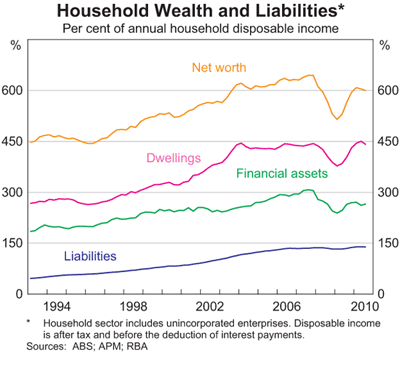
As the following graph shows, household net worth went down considerably during the GFC, while liabilities stayed relatively flat. While dwellings wealth has recovered financial assets have quite a deal to go before they get to pre-crisis levels.
The safe path would be for governments to encourage gradual deleveraging of households (and the private economy in general). Also important is a decreased reliance on foreign funding, perhaps through an increase in the super levy to 12 per cent as mooted in the Rudd government's aborted 2010 tax plans.
If we turn to inflation we can see why the RBA believes that price pressures almost got away from them before the GFC and why it now has a bias towards tightening. As the RBA governor said recently it's been rare that the RBA believes that it tightened too soon.
The high Australian dollar has also helped things on the inflation front. The following graph shows tradable and non-tradables inflation. Tradeables are those goods and services which can be exported or imported, while non tradables are not subject to export competition).
Tradable inflation has helped to keep overall inflation much lower and a higher exchange rate helps this as it makes the costs of imports lower.
There is no doubt that the Australian economy has performed remarkably since the early 1990s. This amazing overall performance (it's important to remember that not everyone has benefited) has been accentuated by the fact that the economy came through the GFC with little long-lasting damage when compared to most of Europe and the United States.
The following graphs on commodity prices make it entirely clear just how big a boost resource exports have given the Australian economy. Base metal prices have done well, but have some way to go before they match their peak, while rural goods have surpassed their previous highs.
Overall, however, commodity prices have matched their previous peak before the GFC and as the terms of trade shows are now approaching the post-war high associated with wool demand created by the Korean War.
The terms of trade is an index-measure ratio of the average price level of exports to the average price level of imports. It effectively reflects the capacity of a given quantity of exports to pay for a given quantity of imports, and provides an important indication of the strengths and weaknesses of the economic structure. A rising or falling terms of trade indicates the possibility of improving or declining living standards, because if what we sell earns relatively more than what we buy, we will be relatively wealthier. Because the terms of trade is a ratio, increases can be a result of export prices increasing at a greater rate than import prices, or export prices increasing while import prices are declining, or export prices declining at a slower rate than import prices. Of course, a rising terms of trade doesn’t stop us from buying more things than we sell, which we have made a habit of for much of our history! Improvements in the terms of trade are not reflected in GDP figures, but improvements do contribute significantly to increases in national disposable income.
While going into deficit was a necessary move by the Rudd government, the real question is whether the fiscal balance should have been in better shape before the crisis, given the mining boom and the long period of growth before the global financial crisis (GFC). Given Australia's recovery from the downturn and the increase in export prices the Gillard government certainly should be aiming to get a large surplus together sooner rather than later.
Being critical of the pro-deficit position is not an argument for less infrastructure spending, but for increased tax on super profits, especially in the mining sector, but perhaps also in the banking sector. Remember that Australia's mineral resources (whether you think we should be mining them or not) are non-renewable. Once they're gone, they're gone forever. They should be seen as the property of future generations as well as the present generation of Australians. Using taxes from mining profits to build infrastructure or to fund research into renewable energy sources makes sense on an inter-generational basis and would contribute to higher standards of living across the Australian population now and into the future.
If we look at GDP growth since the early 1990s it makes it even clearer that we should have built up a big surplus over time.
The reasonable fiscal position of the federal government in 2008-09 made a big difference for Australia's ability to ride out the GFC and more importantly not suffer the public debt problems that the Europeans and Americans are now faced with.
But let's not forget the continuing problem of private debt in Australia. As the following graphs clearly show, Australia remains vulnerable to changes in international financial supply.
After a little dip during the GFC, Australians have returned to the unprecedented debt levels of 2007-08. The question that always need to be asked is just how high can debt go? The answer will have a lot to do with external conditions. In an expanding global economy with Asian flourishing, many Australians could probably push their debt out even further. But if this occurs a day of reckoning will eventually come. A growth slowdown in Asia because of a political shock or just the effects of boom and bust may slow growth in Australia causing rising unemployment, more defaults on debts and so on.
The other issue is the graph on the right, which shows the percentage of annual income paid in interest. Now if the Reserve Bank of Australia (RBA) were to increase interest rates because of inflationary fears and you can bet they will if there is even the faintest whiff of price pressure, the pressure on household finances will increase proportionally. The pain of Queensland households has helped to reduce the pain of households in the rest of Australia.
As the following graph shows, household net worth went down considerably during the GFC, while liabilities stayed relatively flat. While dwellings wealth has recovered financial assets have quite a deal to go before they get to pre-crisis levels.
The safe path would be for governments to encourage gradual deleveraging of households (and the private economy in general). Also important is a decreased reliance on foreign funding, perhaps through an increase in the super levy to 12 per cent as mooted in the Rudd government's aborted 2010 tax plans.
If we turn to inflation we can see why the RBA believes that price pressures almost got away from them before the GFC and why it now has a bias towards tightening. As the RBA governor said recently it's been rare that the RBA believes that it tightened too soon.
The high Australian dollar has also helped things on the inflation front. The following graph shows tradable and non-tradables inflation. Tradeables are those goods and services which can be exported or imported, while non tradables are not subject to export competition).
Tradable inflation has helped to keep overall inflation much lower and a higher exchange rate helps this as it makes the costs of imports lower.
There is no doubt that the Australian economy has performed remarkably since the early 1990s. This amazing overall performance (it's important to remember that not everyone has benefited) has been accentuated by the fact that the economy came through the GFC with little long-lasting damage when compared to most of Europe and the United States.
The following graphs on commodity prices make it entirely clear just how big a boost resource exports have given the Australian economy. Base metal prices have done well, but have some way to go before they match their peak, while rural goods have surpassed their previous highs.
Australia's two biggest exports iron ore and coal have increased enormously in value since a long period of stasis before 2000. China's increased steel use has been very good for Australia, but just how long prices can stay at these levels must be exercising the minds of miners in Australia. It should also be a subject of considerable concern for government in Australia given the 'untaxed' super-profits being made by our majority foreign-owned mining sector.
The terms of trade is an index-measure ratio of the average price level of exports to the average price level of imports. It effectively reflects the capacity of a given quantity of exports to pay for a given quantity of imports, and provides an important indication of the strengths and weaknesses of the economic structure. A rising or falling terms of trade indicates the possibility of improving or declining living standards, because if what we sell earns relatively more than what we buy, we will be relatively wealthier. Because the terms of trade is a ratio, increases can be a result of export prices increasing at a greater rate than import prices, or export prices increasing while import prices are declining, or export prices declining at a slower rate than import prices. Of course, a rising terms of trade doesn’t stop us from buying more things than we sell, which we have made a habit of for much of our history! Improvements in the terms of trade are not reflected in GDP figures, but improvements do contribute significantly to increases in national disposable income.
One thing that studying history has helped reinforce in my head is that good times don't last forever and that the history of the Australian economy is a history of boom and bust as the graph of the terms of trade makes clear. From the peak of 1950 until the late 1990s the terms of trade had been on a 50 year downward trend. It would be extremely optimistic to believe that we began a 50 year upward trend 10 years ago. But maybe I'm just being too negative!
All graphs from the RBA Chart Pack
Monday, June 7, 2010
Great video on the mining tax
Just think if the opponents of changes to better societies for more people had their way, we'd still have feudalism!!
This country is a successful, rich country because we've redistributed wealth gleaned from our natural resources across Australian society, rather than let a wealthy few nationals and foreigners commandeer them like in Nigeria etc.
http://www.youtube.com/watch?v=H4PcQfz0MfU
This country is a successful, rich country because we've redistributed wealth gleaned from our natural resources across Australian society, rather than let a wealthy few nationals and foreigners commandeer them like in Nigeria etc.
http://www.youtube.com/watch?v=H4PcQfz0MfU
Subscribe to:
Posts (Atom)