Showing posts with label Australian banks. Show all posts
Monday, November 2, 2015
Tuesday, January 21, 2014
A New Sustainable Housing Boom?
Bank lending is on the increase again and the housing market is back in boom territory. My prediction last year was that the housing market would boom and then crash. The question is how long this play will take to work itself out. Too long a delay means the prediction is almost worthless. My guess is that the boom will continue over most of 2014 before crashing in 2015 as the economy tanks due to declining demand from China and the difficulty of increasing credit as a percentage of disposable income.
From the RBA:
The renewed boom has been associated with increasing concerns about housing affordability for younger buyers. According to a report in The Australian, the wealthy account for a growing percentage of housing stock, with "the top 20 per cent of income earners owning 36 per cent of Australian homes".
Another question is whether increased home lending is 'crowding out' business lending. To answer this we would need to understand whether the problem is one of supply (the banks) or demand (small business). I'm guessing that if banks can make easy money lending for houses it decreases their willingness to lend to risky small business.
One simple solution that would help affordability and possible crowding out: get rid of negative gearing.
From Leith van Onselen at Macro Business:
While it is clear that the mining boom has ended, my conjecture is that a new housing boom is unlikely to have long legs. This view is reinforced by the high levels of household debt as a percentage of disposable income. One possible mitigating factor could be foreign purchases of Australian houses. Although there are restrictions on foreigners buying houses in Australia, these seem to be regularly bypassed by foreign investors through a variety of means. According to Martin North:
Australia has benefited from a virtuous circle as the credit boom interacted with the mining boom. This is likely to turn into a vicious circle over coming years as commodity prices, particularly iron ore prices, decline over coming years.
Australia has been lucky in the timing of various booms - credit, consumption, housing and mining - over the past 10-15 years and who knows what new factor could intervene to damn all predictions and continue the luck.
The major factor affecting Australia given our growing export dependence will be the trajectory and form of Chinese growth. A less investment intensive Chinese growth model will lead to lower demand for resources and have negative effects on Australia.
The left field factor that I think will be very important over coming years is the fossil fuel revolution that has already had significant impact in the United States, putting it on the path to energy independence.
Rising prices and new technologies have made previously economically nonviable sources of supply viable. These technologies will eventually have an impact throughout the world, lessening the prices Australia receives for gas. Increased demand increases prices, which in turn increases supply, which eventually leads to lower prices. We are approaching this stage for many of our key resources. What Australia needs is continuing and sustained demand to balance lower prices with increased export volumes. Over the longer term, lower prices mean that further supply is less viable and the cycle begins again. However, given the sustained nature of this commodity super cycle and the massive increase in supply it has encouraged, it is likely that it will be a while before there is a new investment boom, especially given Australia's status a high cost country.
While it might seem a long shot to connect these factors to the housing market, lower prices for Australian resources, particularly gas, could lower Australian incomes and expose high levels of indebtedness.
The saving grace for households (as the chart above shows) has been low interest rates leading to a lower ratio of interest paid to disposable income. Given the low level of inflation and the uncertain prospects for the world and Australian economies, low interest rates are likely to continue for a while.
The major reason for the absence of a crash in the Australian property market has been the simple fact that we've avoided a recession and thus avoided the development of a negative spiral where increasing unemployment leads to declining demand and increased difficulty in households meeting debt repayments, which leads to further declines in spending and further declines in demand. And so on.
From the RBA:
The renewed boom has been associated with increasing concerns about housing affordability for younger buyers. According to a report in The Australian, the wealthy account for a growing percentage of housing stock, with "the top 20 per cent of income earners owning 36 per cent of Australian homes".
Another question is whether increased home lending is 'crowding out' business lending. To answer this we would need to understand whether the problem is one of supply (the banks) or demand (small business). I'm guessing that if banks can make easy money lending for houses it decreases their willingness to lend to risky small business.
One simple solution that would help affordability and possible crowding out: get rid of negative gearing.
While it is clear that the mining boom has ended, my conjecture is that a new housing boom is unlikely to have long legs. This view is reinforced by the high levels of household debt as a percentage of disposable income. One possible mitigating factor could be foreign purchases of Australian houses. Although there are restrictions on foreigners buying houses in Australia, these seem to be regularly bypassed by foreign investors through a variety of means. According to Martin North:
One factor which is driving the residential property market, especially in the major centres of Sydney, Melbourne and Perth is a rise in overseas purchasers. They may be Australian residents, overseas purchasers buying property for investment through an approved development, or locals acting for overseas purchasers, who are attracted by the sustained house price growth and relative economic stability. China is often identified as a major source for potential purchasers.The ratio of debt to income increased enormously over the 1990s and 2000s and it is hard to imagine it repeating these increases over the next 10 years. A similar level of growth would see household debt to income increase to well over 200 per cent. (Such a ratio is possible, however, as The Netherlands shows, but it does set a country up for an inevitable rebalance as debt becomes unsustainable.)
Australia has benefited from a virtuous circle as the credit boom interacted with the mining boom. This is likely to turn into a vicious circle over coming years as commodity prices, particularly iron ore prices, decline over coming years.
Australia has been lucky in the timing of various booms - credit, consumption, housing and mining - over the past 10-15 years and who knows what new factor could intervene to damn all predictions and continue the luck.
The major factor affecting Australia given our growing export dependence will be the trajectory and form of Chinese growth. A less investment intensive Chinese growth model will lead to lower demand for resources and have negative effects on Australia.
The left field factor that I think will be very important over coming years is the fossil fuel revolution that has already had significant impact in the United States, putting it on the path to energy independence.
Rising prices and new technologies have made previously economically nonviable sources of supply viable. These technologies will eventually have an impact throughout the world, lessening the prices Australia receives for gas. Increased demand increases prices, which in turn increases supply, which eventually leads to lower prices. We are approaching this stage for many of our key resources. What Australia needs is continuing and sustained demand to balance lower prices with increased export volumes. Over the longer term, lower prices mean that further supply is less viable and the cycle begins again. However, given the sustained nature of this commodity super cycle and the massive increase in supply it has encouraged, it is likely that it will be a while before there is a new investment boom, especially given Australia's status a high cost country.
While it might seem a long shot to connect these factors to the housing market, lower prices for Australian resources, particularly gas, could lower Australian incomes and expose high levels of indebtedness.
The saving grace for households (as the chart above shows) has been low interest rates leading to a lower ratio of interest paid to disposable income. Given the low level of inflation and the uncertain prospects for the world and Australian economies, low interest rates are likely to continue for a while.
The major reason for the absence of a crash in the Australian property market has been the simple fact that we've avoided a recession and thus avoided the development of a negative spiral where increasing unemployment leads to declining demand and increased difficulty in households meeting debt repayments, which leads to further declines in spending and further declines in demand. And so on.
Tuesday, April 2, 2013
Financialisation and Globalisation: Permament Reverse or Cyclical Downturn?
Introduction
One of the major markers of globalisation since the 1970s has been the incredible expansion of the financial sector - a phenomenon known as financialisation. The financial sector expanded in virtually every country in the world. Since this time the process of financialisation (defined as the expansion of both domestic and global finance) has been been in retreat as has financial globalisation (defined by cross-border financial flows only).
The global crisis, not surprisingly, has been primarily responsible and it will take quite some time for capital flows to recover, especially if the European financial crisis deepens. The expansion of credit/debt has stalled and the excesses of pre-crisis finance continue to be worked out of the system, Over the medium-term, even in the absence of another systemic financial crisis, it is likely that financialisation will be restricted by global deleveraging as excessive indebtedness is worked out of the world economy.
Nevertheless, wariness about financial instability will continue to be challenged by financial innovation and the possibilities for profits in new financial products. Despite arguments that the global financial crisis showed the need for better regulation of financial markets, it is not clear that this view has overcome the arguments of financial interests for few substantial changes to regulation. Financialisation continues to progress in developing countries and financial globalisation will recover as the world economy recovers.
The issue for the future is whether a financialised world political economy is inherently prone to a cycle of crisis, retreat, recovery, stability, excesses, crisis. While it is possible to argue that financialisation has reached a high point in many developed economies, it is likely that developing countries will become even more important global financial players in coming years - both as recipients and investors.
In Australia, the financial sector has grown rapidly since financial liberalisation in the 1980s. The cyclical downturn in the financial sector has not been as extreme and Australian banks are in rude health compared to banks in other developed economies. The solid performance of the Australian financial system has been helped by the government's willingness to support the financial system during the crisis and the avoidance of recession. The household sector remains highly indebted and foreign debt remains at highest ever levels. Any renewed expansion of credit will increase Australia's medium-term financial vulnerability. Policy-makers should be aiming to foster a period of consolidation in the Australian financial markets and the property sector.
Financialisation and Financial Globalisation
According to McKinsey, global financial assets increased from about US$12 trillion in 1980 to US$206 trillion in 2007. Financial depth (defined as financial assets as a percentage of GDP) increased from 120 per cent to 355 per cent over the same period. By 2012, financial assets had increased to $225 trillion, but compared to world GDP they had declined by 43 per cent (54 per cent if government debt is excluded). Declines have occurred in both developed and developing countries. Developing countries are significantly less financialised than developed countries with financial depth of 157 per cent compared to 408 per cent. China's financial depth (226 per cent) is considerably lower than that of the United States (463 per cent - down 37 per cent from 2007 up to mid 2012), Japan (453 per cent) and Western Europe (369 per cent) , with India (148 per cent) lower still.Finance progressively detached itself from the 'real' economy with just over a quarter of the rise in financial depth between 1995 and 2007 related to households and non-financial corporations. This is astounding given the extensive growth of mortgage markets in virtually all developed economies.
These figure above relate to the growth of finance generally, but if we consider cross-border movements of capital (an integral component of globalisation alongside trade) it is clear that the process has gone backwards since the crisis, declining substantially since 2007 from $11.8 trillion to around $4.6 trillion in 2012.
Most of the fall (70 percent) is accounted for by Western Europe - a substantial reversal of financial integration as European banks have retreated from cross-border lending. Central banks have become more important in cross border flows in Europe, accounting for over 50 percent of capital flows. Cross-border flows have fallen from 20 per cent of global GDP in 2007 to 6 per cent in 2012, a remarkable decline.
Capital flows involving developing countries have rallied since the debacle of 2008-09. Developing countries have increased their share of cross-border flows from 5 per cent in 2000 to 32 per cent in 2012. More capital flowed out of developing countries than flowed in - US$1.8 trillion compared to US$1.5 trillion.
Financial globalisation (i.e. cross-border financialisation) is still extensive with around 30 per cent of global equities and bonds owned by foreigners (54 percent for Europe, 23 per cent for North America and 9.4 per cent for China).
Australia
Australia, of course, has been a willing participant in the process of financialisation. A recent speech by Malcolm Edey, Assistant Governor (Financial System) at the Reserve Bank of Australia, reveals the extent of the financialisation of the Australian economy up to 2007 and its retreat after the crisis.Edey points out that credit to GDP "increased from around 50 per cent in the mid 1980s to around 160 per cent in 2007". Total banking system assets "rose from around 50 to around 200 per cent of GDP" and "foreign exchange turnover increased by a factor of more than 30 in nominal dollar terms over that quarter-century, when the nominal economy itself expanded only by a factor of 4½.
The process of financial liberalisation began in Australia in the late 1970s and accelerated through the mid-1980s. Although many people seem to have forgotten Australia had a serious financial crisis in the late 1980s to early 1990s, which ironically may have helped us in the global financial crisis as banks remained more cautious through the 1990s and early 2000s.
The graph below shows just how much Australian financial sector assets have increased over the past 25 years.
The Australian banking sector avoided the excesses of some banking systems such as Ireland, Iceland, the United Kingdom and France among others. US problems lay outside of an extensive build up in banking assets.
The wealth management sector has also expanded since the 1980s, although much of that has to do with a new 'regulation' of enforcing superannuation payments for all Australians in work - hardly de-regulation. As Edey points out:
Funds under management (principally in superannuation and life offices) expanded from around 30 to around 130 per cent of GDP between 1985 and 2007, broadly matching the growth rate seen in the deposit and loan sector. And, of course, there has been a huge growth in services related to asset and risk management, including securities and derivatives trading.Both managed funds and securitisation took a big hit from the financial crisis, but all sectors have been affected, reversing the process of financialisation. Continuing woes in Europe are likely to see many investors less amenable to risk. Although this can change rapidly as investors often seem to have short memories. The recent rise of the share market would be worrying many of those who sold out of equities and encouraging many to get back in, which will further inflate the share market, possibly setting it up for a large correction down the line.
Another impact of liberalisation has been the decline in interest rate margins. This is despite the fact that the Australian banking sector is dominated by the big 4 banks. While it is easy to point to the costs of liberalisation in terms of the tendency towards crisis, it is important to remember that easier access to credit has benefits as well.
As Edey points out the post-liberalisation financial system
changed profoundly in other ways than just size. One was in its degree of openness to competition and in the nature of that competition. The post-Campbell reforms allowed market forces to work, and opened up the system to new competitors. ... Deregulation ended the artificial rationing of bank loans, making credit much more widely available ... the cost of financial intermediation came down very substantially. ...
The rationing that existed in the old regulated environment had encouraged banks to compete on a ‘whole of institution’ basis, rather than at the level of individual product lines. ... In this situation, wide interest margins were used to cross-subsidise payment services, and customer mobility was limited because loyalty to a bank was one of the critical factors in obtaining access to scarce loans.
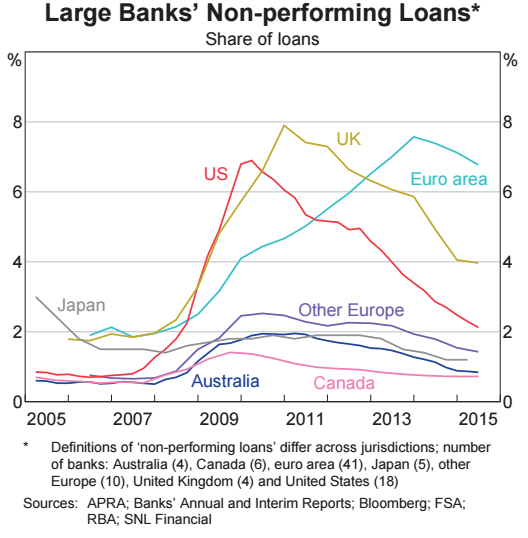
Deregulation changed that model by allowing innovators to compete separately for the most profitable lines of business. Cross-subsidies in the banking system were competed down, and this helped to drive the reduction in net interest margins.If given a choice between going back to the old system of regulated banks and credit or staying with the current system with all its problems, most would choose the latter, especially if it were explained that it would mean less access to credit. But this is obviously part of the problem too, greater willingness to extend credit during periods of asset price ebullience can lead to deteriorating lending standards increasing the possibilities of non-performing loans down the line. Thus far this has not occurred in Australia, with the excellent growth performance of the Australian economy providing a sound macroeconomic environment (low unemployment) and a cautious household sector increasing saving.
Banks have also remained extremely profitable, which has been reflected in their share prices.
Still household indebtedness remains close to pre-crisis highs, which makes households and the wider economy vulnerable to changing macroeconomic conditions and a decline in international financial supply. Housing-related debt accounts for 81.6 per cent of household interest payments to income and 90 per cent of debt to income. Interest payments as a percentage of disposable income have come down from their pre-crisis peak, but are still higher than they were in the late 1980s when mortgage rates reached 17 per cent! (see Table B21)
Competition in the banking sector until recently was mainly on the lending side of the equation, but as banks have sought alternative sources of funding, competition for deposits has increased. Banks have reduced their reliance on short-term debt and securitisation has also declined from a lower base.
The wholesale funding mix for banks has also shifted away slightly from overseas sources, but clearly the major change is away from short-term funding.
The high level of debt build-up from the 1990s to 2007 has stabilised in the post-crisis years. Australians have returned to saving. The share market has recovered and property continues to tread water.
Not surprisingly, credit growth in all sectors has been flat in recent years.
A renewed property boom runs the risk of reversing this trend, leading to a bigger adjustment down the track. Having built up their debt share so high households can only increase their leverage at the cost of higher vulnerability. This is one of the reasons the RBA needs to take care when regulating new lending products and lowering interest rates further, without compensating policies from the government to discourage housing speculation.
Australian households are now more connected to the financial sector, through higher levels of debt and forced saving through Australia's superannuation system. The Australian economy is also more connected to the global financial system. Banks and other corporates have increasingly turned to offshore sources for funding.
Currently, according to the RBA's Deputy Governor Guy Debelle, "domestic markets have benefited from strong international demand for Australian dollar assets. Local issuers continue to be viewed favourably by offshore investors looking to diversify credit exposures."
Extensive foreign liabilities mean that Australia will continue to remain vulnerable to changes in international financial sentiment, although it needs to be noted that Australia has recently passed a very severe test during the GFC. Many other countries have not been so lucky with stagnant growth and continuing financial trials.
Financialisation affects us all and it is policy that must determine the balance between the individual benefits of increased access to credit and the possibilities of financial instability. Australia's financial sector remains sound but an eventual recession will test the financial sector and its growth in Australia, especially if lending standards deteriorate over the next few years.
Conclusion
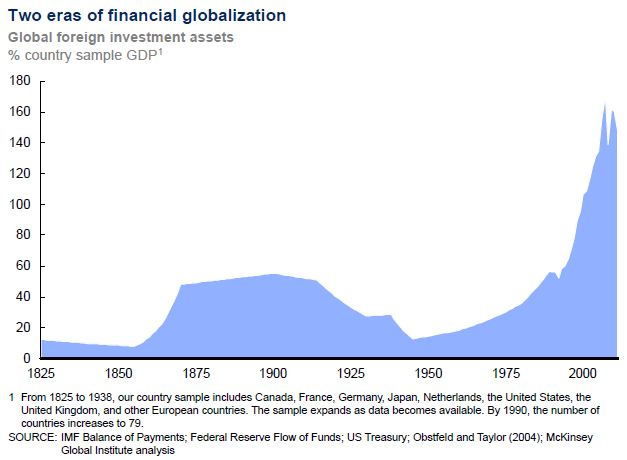
Financial globalisation has ebbed and flowed over the past couple of hundred years. The period before World War One is often called the golden age of capitalism but it ended in war and economic depression. It took a long time for financial flows to recover, but recover they did.
Despite some setbacks in recent years, the world economy remains highly globalised and financialised. In considering whether the current period is a permanent reversal or just a pause in the two distinct but related processes, requires detailed analysis of political processes in the major economies of the world. It seems unlikely that United States policy-makers will change their mind on the benefits of financial liberalisation and financialisation, but a prolonged period of economic stagnation could have an impact on this predilection.
Virtually the entire world adheres to a form of capitalism and while not all policy-makers in all countries are equally sanguine about globalisation, very few currently believe that the solution to development requires a full scale retreat into isolation.
This could change, however, if globalisation is blamed for growing inequality and political chaos. It may be the turn of developed countries to support alternatives to globalisation if economic crisis continues to affect growth and the distribution of wealth and income across societies. Democratic polities cannot necessarily be blamed for looking to more insular alternatives if increasing globalisation is associated with rising inequality and instability.
Tuesday, August 14, 2012
Yeah Naah: Reflections on the Current Condition of the Australian Economy
I love listening to football player interviews after a game. My favourite response is the phrase "yeah, naah". In other words, I understand what you're saying, but I'm not sure if you're right (or maybe I haven't understood the question or even know what my name is after that hit to the head in the final quarter).
While many might think it's a rather silly response I think it's a reasonable appraisal of many things in life, including that most interesting of topics: the Australian economy. Yeah we've been doing well, but naah I'm not sure it's going to last or that we've prepared properly for the inevitable downturn.
A recent speech by Reserve Bank Governor Glenn Stevens using the increasingly hackneyed phrase "the Lucky Country" attracted considerable attention in the Australian press. Reserve Bank governors like the rest of us, like to hedge their bets so while most comment focused on the Guv's optimism, some noted the warnings contained in the speech as well.
Better to cover all bases so that if a crisis comes the Guv can point to his notes of caution. If things continue to go well, then of course he can point to his overall regular message of optimism.
Before we consider Stevens yeah naah interpretation of the Australian economy, I want to begin with a few general observations.
- Australia has been lucky, but also relatively good on the issue of economic management since the mid-1980s. Lots of mistakes have been made but the direction and pace of change has been effective to sustain reforms.
- The Australian economy has not been in recession for 21 years - very few of my students have any concept of a sustained downturn in the economy. According to economist Chris Richardson this is a world record. Perhaps this is another reason why the government is doing poorly, "success fatigue".
- Seriously, though, some Australians aren't doing as well as others and, in an attempt to rectify this, the Gillard government has made some progress in redistributing income in Australia.The Howard government was also a big redistributor of income, mainly to families.
- Australia will be negatively affected if Chinese growth slows - both directly and indirectly through flow on effects to other Australian trading partners e.g. Japan will be hurt and so Australian exports to Japan will slow as well. And so on. This implies that both industrial and geographical diversification will serve Australia well over the longer-term.
- Part of any diversification strategy for the Australian economy doesn't just include manufacturing and services but agriculture as well. Foreign ownership of farm land is about 6% (1% of agricultural businesses are foreign owned and 11.3% of agricultural land is wholly or partly foreign owned, although more than half of this land was majority Australian owned). Developing the agricultural sector in Australia will require foreign investment, some of it from China. Why people worry so much about farming, but ignore the fact that mining is over 80 per cent foreign owned continues to surprise me. While you might be able to damage farmland through poor farming practices, foreign investors won't be shipping the land out, like they are with minerals, petroleum and gas. One thing is for sure, demand for agricultural goods is going to expand over coming years and Australia will need to manage these developments, especially through the next drought period.
- The European crisis is not going to end any time soon and will probably end up with financial upheaval as Greece and/or Spain eventually abandon the Euro.
- The United States is likely to recover sooner than Europe, but still has a way to go as necessary stimulus and tax restructuring is restricted by political machinations.
- Recovery from financially-induced recessions takes a long time as de-leveraging works its way through the global economy and as the 'paradox of thrift' has purchase in many advanced economies.
But let's get back to Australia. First Stevens canvasses the potential problems.
Rapid growth in Chinese demand for resources ... has been of great benefit to date, but what if the Chinese economy suffers a serious downturn? Another potential concern is dwelling prices ... A further theme is the focus on the funding position of Australian financial institutions, insofar as they raise significant amounts of money offshore. Could this be a weakness, in the event that market sentiment turns? ... It has long been a visceral fear among Australian officials and economists that global investors will suddenly take a dim view of us.
He then tells us we should welcome the sceptics and that some of their concerns might even be valid.
We should always be wary of the conventional wisdom being too easily accepted. We should never, ever, assume that ‘it couldn’t happen here’.
This new found openness to debate has been reflected in the RBA's recent concerns about the high value of the dollar. Sheesh, maybe, just maybe, there's a possibility that the RBA sees some validity in the idea of Dutch disease. Generally speeches from senior RBA and Treasury figures, not to mention that bastion of purist economic liberalism, the Productivity Commission, take the attitude of "get over it" or "welcome to the permanent future of never-ending Asian growth and mining largess".
Regular Gillard government critic Warwick McKibbin recently called for the RBA to intervene to decrease the value of the dollar and was himself criticised as an economic apostate.
But I digress. The Guv then considers a range of very pertinent questions that I've long been concerned about.
How much of the recent relatively good performance was due to luck? To what extent did we improve our luck by sensible policies, across a range of economic and financial fronts?
Are there signs of any of the things going wrong that people typically worry about?
And if there are, or were to be, such signs, could we do anything about it?
Despite these cautions, Stevens begins his analysis with three very relevant markers of Australia's above average performance. First up is GDP. As I argued recently in "Not Just Lucky, Good": "things could be worse. We could not be having a mining boom and we could have really bad economic policy-makers like those in the UK and Europe who believe that austerity is the solution to economic stagnation".
Great Britain might have won many more medals than us, but their economy is a basket case because the Conservatives have failed to read their history books and believe that cutting debt and public services is always the best solution to an economic crisis. I'm sure once the hoopla of the Olympics has died down, most Britons would rather have Australian economic conditions than British ones and would give up some of their medals for a better performing economy.
The good news is that it's not just in aggregate GDP growth that Australia has outperformed other developed economies but in GDP growth per capita and in unemployment rates.
Stevens' contention is that while there has been a bit of luck involved, there have also been some good policy decisions over the past 20 years or so, a view with which I would fully concur. But as any football player would note, the game ain't over til it's over. Unfortunately for this analogy, the economic game never ends.
The biggest immediate concern for Australia is a long-standing economic vulnerability - changes in international demand for our exports. These days that means mostly Asian and particularly Chinese demand.
Those of you that follow the global and domestic economic debate will be well aware that the big issue at the moment is the short to medium-term prospects of the Chinese economy. This debate matters a lot to Australians, because if China tanks, demand for our resources will also fall.
Particularly worrying is the decline in the price of iron ore. China accounts for 61.5 of global iron ore sales.
The latest Composition of Trade publication from DFAT lists Australia's main exports up to the end of 2011. Iron ore accounted for 20 per cent of all Australian exports. You don't have to be too smart to realise that a substantial price decline will have a big impact on Australian export income.
Generally over the last 5 years, resource exports have grown in importance at the expense of a more diversified export structure. Education 'exports' have fallen to fourth, now behind gold.
Stevens believes that China's slowing is a "a normal cyclical slowing, not a sudden slump of the kind that occurred in late 2008".
Others are not so sure that the problem is just cyclical. Michael Pettis, for example, argues in a recent (August the 6th) newsletter:
over the next three months we will see a rebound in Chinese GDP growth as investment expands. The leadership transition, after all, is in October, and no one in power wants to see the ten-year period under the leadership of President Hu and Premier Wen end with an economic whimper, especially after the very distressing political scandals we have lived through this year.
I don’t think, however, that any rebound or recovery will last more than one or two quarters, and even then it is going to be a very tedious and lop-sided recovery. ...
the only sure way to pump up the economy is for Beijing to encourage infrastructure spending at the local and municipal levels, a very inefficient kind of growth, and one which will probably spur even more real estate development. This pumps up unnecessary infrastructure investment, but little of the benefits end up with consumers or with the companies that serve them. Goosing infrastructure investment is, however, pretty much the only economic policy tool Beijing has ...
As I have outlined many times before on this blog, Pettis believes that there is severe pain ahead for China as it restructures its economy away from an investment-led economy to a more consumer-oriented economy. This transition is sometimes seen as a relatively straightforward transition, but it will create many losers amongst China's elite and will therefore no doubt be resisted by many of them.
Another reason for pessimism about China is the fact that the prospects for the export sector - a major source of Chinese growth - are also grim because of continuing global economic woes, with Europe particularly woeful.
Stevens is certainly amongst the optimists when it comes to China's prospects.
the Chinese authorities have been taking well-calibrated steps in the direction of easing macroeconomic policies, as their objectives for inflation look like being achieved and as the likelihood of slower global growth affecting China has increased. Prices for key commodities are lower than their peaks, but are actually still high.
So far, then, the ‘China story’ seems to be roughly on course. It is certainly true that we will feel the effects of the Chinese business cycle more in the future than we have been accustomed to in the past. That presents some challenges of economic analysis and management. But even so, it may be better to be exposed to a Chinese economy with a high average, even if variable, growth rate, than, say, to a Europe with a very low average growth rate that is apparently also still rather variable.
The last part of that analysis is definitely right. Let's say it again loud and clear: resources have not been a curse for Australia. They have made us richer, even if we could have done (and could do) a better job of distributing the benefits.
Another area where Stevens is a bit yeah, naah is on dwelling prices. Despite recent price falls, Australia has not had the bust that has occurred in many other developed countries.
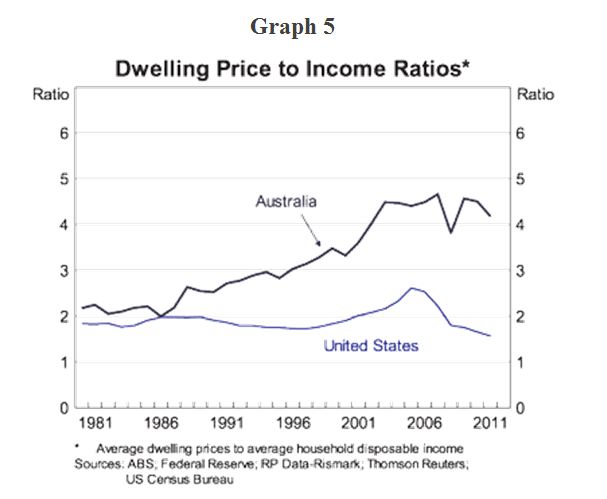
Scaled to measures of income, Australian dwelling prices on a national basis have in fact declined and are now about where they were in 2002. That is, housing has become more ‘affordable’. Four or five years ago we supposedly had a housing affordability ‘crisis’. Now it seems that the problem some people fear is that of housing becoming even more affordable.
He then considers whether house prices are still over valued. Making comparisons with long-term averages or overseas prices are fraught with danger and basically involve guesses.
arguments that appeal to historical averages for such ratios lose potency the longer the ratio stays high. In Australia's case the ratio of prices to income on a national basis has been apparently at a higher mean level – about 4 to 4½ – for about a decade now.
If we compare Australia and the United States, Stevens contends that:
it is hard to avoid the impression that gravity will inevitably exert its influence on Australian dwelling prices. But if we put these two lines on a chart with a number of other countries with which we might want to make comparisons, the picture is much less clear.
Stevens argues that it is the United States that is the "outlier" and that we have more in common with the rest of the developed economies.
Another reason that Stevens is confident about housing (and also therefore about the banks) is that arrears rates remain low. Debt repayments as a percentage of income have declined. There is also a high proportion of mortgagees ahead on their payments. This factor together with the low unemployment rate is certainly on the yeah side of our equation.
Anecdotally, however, I know a lot of public servants in Queensland who are worried about their mortgages and job security given the Newman government's mindless and arbitrary slashing of public sector jobs. If repeated by an Abbott government it could contribute to the naah side of the equation just at the time as the economy is hit by a China slowdown!
As an aside, upon coming to power, the Howard Government argued it was necessary to reduce the size of the Commonwealth bureaucracy, so it cut staff savagely from 143,226 in 1996 to 113,627 in 1999. But in the early 2000s, the size of the public service began to grow again, and by 2006 it had surpassed the level of 1996 to reach 146,384 personnel. This is despite the additional high levels of outsourcing of government work. Between 2005 and 2006 the public service increased by 13,000 or 9.6 per cent compared to 1.7 per cent for the national workforce. Howard was often accused of being an unrestrained neo-liberal, but he certainly didn’t believe in small government.
The second long-term vulnerability that Australia faces alongside the potential for a decline in demand is an interruption to financial supply. This is important because Australia has a high level of foreign debt and the banks a high exposure to foreign lenders.
Stevens acknowledges that the banks engaged too heavily in borrowing short, lending long in the lead up to the GFC, but argues that they have been effectively moving away from this model.
Stevens is also not worried at all about the current account deficit (CAD), a major worry of policy-makers in the 1980s and 1990s, but a non-issue for them since the 2000s.
while we have been told over the years how Australian banks were doing the country a favour by arranging the funding of the current account, they have stopped doing this over the past year without, apparently, any dramatic effects. As measured in the capital account statistics, there has been a net outflow of private debt funding over the past two years, offset roughly by increased inflow of foreign capital into government obligations. This has occurred with a net decline in government debt yields and a net rise in the exchange rate. The current account deficit has, in other words, been easily ‘funded’ without the assistance of banks borrowing abroad – in fact, while they have been net re-payers of funds borrowed earlier.
Not everyone agrees that the CAD cannot return as a key issue for the Australian economy, but it has definitely been removed from the forefront of the policy debate in recent years. Like many economic issues, concern will probably return as the deficit grows once again.
Stevens is also not particularly worried by our vulnerability to a decline in financial supply, although he doesn't dismiss it completely and nor should he. An Australian downturn together with another global credit crunch would be a very bad thing for a (private) debt exposed economy like Australia's.
Capital flows into Australia through foreign direct investment and more recently into Australian dollars generally have led to a higher dollar and a well funded current account deficit, but this too could change if new investment dries up and assessments about Australia's safe haven status become negative.
A financial collapse in Europe could lead to another global financial crisis, but Australia would have room to move on fiscal policy if the government (of whatever stripe) can overcome the negative politics of public debt increases.
The RBA, of course, still has room to move on interest rates, which would give households with mortgages more disposable income. If a credit crunch was mixed with a slowdown in China and rising unemployment then conditions would be tough in Australia, but still better than in most other developed economies.
A financial collapse in Europe could lead to another global financial crisis, but Australia would have room to move on fiscal policy if the government (of whatever stripe) can overcome the negative politics of public debt increases.
The RBA, of course, still has room to move on interest rates, which would give households with mortgages more disposable income. If a credit crunch was mixed with a slowdown in China and rising unemployment then conditions would be tough in Australia, but still better than in most other developed economies.
It's also possible that a worsening of the European situation could actually lead to an increase of capital flows to Australia, which wouldn't be a problem for the banks, but would be for manufacturing, domestic tourism and other trade exposed sectors of the economy through Dutch disease effects.
Stevens appears to have significant faith in the Chinese Communist Party to manage the Chinese economy and with the leadership transition pressures to keep the economy humming will be high. Nevertheless, the high investment, low consumption growth model is unsustainable over the longer-term and we have to hope those communists get it right.
Overall, Stevens is right to be more yeah than naah about the Australian economy, but we shouldn't lose sight of economic vulnerabilities both short and long-term. We need a flexible economy that remains diversified.
We also need to remember that the redistribution of resources and opportunity across Australian society is necessary to maintain popular support for a dynamic open economy.
Subscribe to:
Posts (Atom)