Showing posts with label Australia's dependence on China. Show all posts

Saturday, July 18, 2015

Australia's China Dependence Compared

Australia is one of the most China dependent economies in the world. The impact of China's demand for exports has been largely positive for Australia in expanding Australia's export income, although it is important to remember that Australia's mining sector is 80 per cent foreign owned, which means that eventually most of the profits go overseas. Pity we don't have an effective tax regime to ensure that more of the gains of the resources owned collectively by Australians are returned to those same Australians.

Australia's position as the country most dependent on China for exports has been overtaken by Taiwan. 


Another way to assess China dependence is to consider exports to China as a percentage of GDP. Australia does not have a high level of exports as a percentage of GDP and therefore the impact of China on GDP is slightly less. Nevertheless, if we compare the situation in 2014 with last year, dependence has grown markedly


Australia is also an important destination for Chinese investment. 


Any slowdown or worse in China will have a direct impact on Australian exports and GDP. It will also negatively affect a lot of other countries that Australia exports to as well, particularly Japan and South Korea. 

Recently Joe Hockey said
The economy is not affected by what's happening in either Greece or China ... The Chinese stock market dropped 25 per cent in four weeks, but is now 18 per cent higher than its low point last Thursday. It is a very volatile market, [but] it's still 90 per cent higher than it was 12 months ago. ... As far I am concerned, and the Treasury is concerned, our budget forecasts for the Chinese economy remain unchanged. 
The evidence suggests, at least in the case of China, that Hockey's optimism might be misplaced.  

Friday, November 28, 2014

Australia's Growing China Dependence: Do We Need a Plan B?

Australia's increasing economic interactions with China are seen by most as unequivocally beneficial. The putative growing middle classes of China and the rest of Asia will see Australia flourish over the next decade, according to most economic policy-makers and commentators. Joe Hockey recently argued:
China's middle-class of around 150 million people is expected to reach 1 billion in just 16 years. Over 30 per cent of India's population will also lift into the middle class at around the same time! That, in particular, is an amazing transformation given that two thirds of India's population currently has no access to basic services. This rising middle class of Asia wants what comes from Australia's farms and our gas fields. They want to come here as tourists, attend our universities and they need our financial sector to manage their wealth and plan their retirement. They want our quality of life with good housing, roads and transport, clean air and excellent quality health services. Their elderly want quality aged care services and their youth want hope that they can forge an even better quality of life.
Elsewhere Hockey has argued:
The bottom line is the world’s going to want commodities because of the emerging middle class, particularly in Asia but also in Africa and various other places … I don’t think there’s any commodities (downturn) — I think that’s market trash. I think we’ve got to deal with the reality of where the world’s going to be in the next 30 years. They’re going to want commodities.
The Reserve Bank's Alexandra Heath also contends:
Yet, even if the sustainable growth trajectory for the Chinese economy gradually declines over the medium term, the economy is much larger than it was and is still growing. This implies there will continue to be a huge appetite for commodities of many kinds. Some of this demand can be satisfied by local Chinese production, but given the competitiveness of Australian production in a number of commodities, China is likely to be a large market for Australian resource exports for some time to come. 
Finally the outgoing Treasury Secretary, Martin Parkinson, contends:
In this decade – and for the first time in 300 years – we will see the number of Asian middle-class consumers equal the number in Europe and North America. This middle class – which is expected to grow from around 500 million people in 2009 to around 3.2 billion by 2030 – is likely to increase its demand for a wide range of goods and services.
They could all be right and if you judged future opportunities based on past performance you'd be reasonably confident. But what if they're wrong? Is Australia prepared if the optimistic scenario doesn't eventuate? Do we need a plan B?

Australia is now the most China dependent economy in the world. Exports to China have grown from 8.5 per cent of the total ten years ago to 32.4 per cent today.


Interestingly, India's share has fallen over the last 10 years (remember that these are shares of a growing total and exports to India have grown despite their falling share of the total). Other has declined as well meaning less export diversity. 

According to Bloomberg Australia's exports to China as a percentage of total exports is now 37.02 per cent of the total. (It's possible they mean total merchandise exports i.e. excluding services exports). 


Let's take The Treasury's figures and consider Australia's export dependence on the top three destinations in 2004 and 2014. This has grown from 33.7 per cent (Japan 15.7, US 9.5 and China 8.5) to 54.3 per cent (China 32.4, Japan 15.2 and South Korea 6.7). Top 5 has grown from 47.7 to 62.8 per cent. 


More worryingly, not only is Australia now more China dependent, but so is most of the rest of Asia. This means that Australia's exports to Japan and South Korea (our second and third largest export destinations) will also be impacted by a China slowdown or worse. 

Let us hope that the dreamers are right about China's long-term progress and that the doomsayers are wrong. But remember also that all of this export growth to China occurred without a trade agreement. It's possible that the agreement will help to diversify Australia's export mix to China - more agriculture, more services - and not just leave us more vulnerable down the track as Australia becomes even more China dependent. 

This leads us to the big question: do we need a Plan B? And what would that be? It should involve active policy efforts to diversify the economy away from a reliance on resources and selling and buying houses from each other. Policy-makers need to reconsider industry policy and think of ways to develop new industries rather than just support old ones in ad hoc ways. Encouraging the development of renewable technologies should be a no-brainer for Australia, but the Abbott government seems to have done everything possible to undermine such developments. 

Both good and bad things can come from political processes but we cannot remove politics from the equation. It is worth remembering that Australia is a wealthy and relatively equal country because of political interventions, not despite them, as many economists would have us believe. Australia needs to utilise its luck to lessen its vulnerabilities.

If we all believe that China will continue to grow rapidly over the next 20 years, then most policy-makers will believe there's no reason to change tack before its too late.


Wednesday, September 17, 2014

China's Proposed Import Bans on Thermal Coal: Not the Real Problem Facing Australia

The Chinese government has announced that it is going to limit certain coal imports from next year. The Sydney Morning Herald reports:
The Chinese government is to limit the use of imported coal with more than 16 per cent ash and 3 per cent sulphur from January 1, 2015 in a bid to improve air quality, especially in cities such as Beijing and around Shanghai.
According to one analyst: ''[Australian coal exports are] typically around 5500 kilocalories and 24-25 per cent ash. So we've got big problems.''

However, others are less concerned by the changes arguing that the impact on other coal exporters will be even greater.
The restrictions applied vary in stringency depending on geography ... The least stringent [restrictions] apply across the entire country and would not affect a single major Australian thermal coal exporter, all of whom would comfortably comply. However it is the most stringent which apply to the major economic zones of Beijing, Hubei, Tianjin, the Yangtze River Delta and the Pearl River Delta which are of the greatest relevance. These areas are on or close to the coast and therefore are the most prospective for Australian seaborne exported coal ... only 10% of Australian coal exports go to China, and the highly restricted region represents 42% of Chinese thermal coal imports further softening the blow. This means the amount of production likely to be affected is low.
What is clear is that we need some context to assess the impact of China's proposed restrictions and any potential damage to the Australian economy.

According to the Department of Foreign Affairs and Trade's Composition of Trade, in 2013, China was Australia’s largest export market, accounting for 31.9 per cent ($101.6 billion) of total exports of goods and services (an increase of 28.2 per cent on 2012); Japan was Australia’s second largest export market ($49.5 billion); the Republic of Korea was third largest market ($21.3 billion).

Major goods and services export markets


Coal is Australia's second biggest export, behind iron ore and in front of education related travel services.

According to another DFAT publication, from 2001 to 2011, "the value of coal exports rose from $12.5 billion in 2001 to $46.8 billion in 2011, a rise of almost 300 per cent."

Traditionally our biggest market for coal has been Japan, with China a much less significant market until recently. Between 2001 and 2011 Coal exports increased their share of exports to China but were still dwarfed by iron ore exports.


Since 2011, Chinese coal exports have more than doubled from $4.5 billion to $9.1 billion in 2013.

Australian Coal Exports 2013 


The point to note here is that China has traditionally mined a lot of coal itself, but in recent years Chinese production has been in decline with significant producers struggling.  An integral component of the restrictions, therefore, will be to encourage more Chinese coal production.

The most important point to note, however, is that there are two major forms of coal exports – thermal and metallurgical. Thermal coal is used mainly for electricity generation, whilst metallurgical coal is used in steel manufacture.

Metallurgical coal exports in 2012-13 were $22.4 billion and thermal coal exports were $16.2 billion. It is thermal coal exports that could be affected by China's bans.

Principal markets for resources and energy exports
in 2012–13 dollars


Source: BREE

The above graphs clearly show the rise in both metallurgical and thermal coal exports to China since the early 2000s, but China remains a significantly less important market than Japan for both.

A problem with the focus on the potential damage to Australian thermal coal exports from the Chinese bans is that it may miss the real problem for Australian exports over coming years. The coal sector in Australia has been in trouble for quite some time, with coal miners slashing their work forces in recent times.

One of the major vulnerabilities for Australia moving forward is the increase in the share of unprocessed raw materials exports, which have substantially increased their share of total exports since 2008 and even more so since the late 1990s.


The real danger for Australian coal exports would be similar restrictions on exports of thermal coal to Japan and South Korea. Let's face it if you want to do something about climate change and levels of pollution then restricting the growth of coal burning will be essential.

Despite the moves by the Chinese authorities, coal remains the second most important source of energy. Renewables have been growing rapidly in recent years, but their share is still depressingly low.


While coal consumption is declining in Europe and North America it is increasing markedly in the Asia-Pacific.


Source: Vox

Thermal coal burning is going to continue for quite some time yet and the Chinese restrictions will have considerably less impact than the growth slowdown in China and the decline in house building and infrastructure development.

China must lessen its investment share of GDP to rebalance its economy. It could do this in an orderly way over the next few years or it could resist the need to rebalance and face an eventual catastrophic rebalancing later in the decade. In other words, rebalancing away from investment towards consumption will occur, it just depends on when and how. Australia will be negatively affected either way.

What this means is that the decline in iron ore prices and export volumes will be way more important than a ban on thermal coal exports. Those concerned about this issue should be more worried by the general decline in commodity prices.


But it's not all gloom and doom for thermal coal. Given the Abbott government's hostility to developing solutions to climate change and to the advancement of the renewable energy sector, it's possible that coal miners may be able to expand their 75 per cent share of electricity production in Australia.  

Wednesday, September 3, 2014

She'll Be Right Mate? Australia's Economic Future

Real GDP per Capita is an important measure of real aggregate progress. While it doesn't tell us anything about the distribution of growth, it does tell us how much an economy is growing per person so that it removes the impact of population growth and immigration. Remember that in a country with a rapidly growing population, growth can be, at least in part, a consequence of that population growth.

The Reserve Bank Governor Glenn Stevens recently gave a speech highlighting Australia's relatively good performance in comparison with other developed countries.

In comparison to the US, UK, Euro area, Canada, Japan and New Zealand. The graph measures performance since 2005 by making all countries equal (100 on the Index) at this point.

As the Governor notes, these figures don't tell us what's coming but he outlines three possible sources of future growth.
Which sectors would be available to lead such an expansion? In the broad, there are three. There are households, governments and firms. Let's think about each briefly.
Households being willing to increase their debt and lower the share of current income being saved was a striking feature of Australia's economic landscape from the early 1990s until just prior to the financial crisis. Consumption spending consistently rose faster than income and the ratio of debt to income went from about 60 per cent in 1993 to 150 per cent by 2006. Households are servicing that higher debt quite well – mortgages make up most of their debt and arrears are running at about one half of 1 per cent, which is low by global standards. But as I have argued before, it seems unlikely that household debt can rise like that again. Nor would it be desirable. So while we can expect that household consumption spending can grow in line with income, or maybe a little faster given the rise in net worth over the past two years, the odds are against households being a driver of strong growth the way they were a decade ago.
What about the government sector? Most governments in Australia are trying to strengthen their own balance sheets by containing the build-up in debt that has been occurring. Public final spending is scheduled, according to the stated intentions of federal and state governments, to be subdued over the next couple of years. In fact, it is forecast to record the most subdued growth for a long time. By and large then, the public sector is not in the phase of using its balance sheet to expand demand faster than normal. 
That leaves the business sector. ...
My conclusion would be that many businesses are in a position to play their part in the growth dynamic over time. The fact that in some areas outside of mining the level of gross fixed capital spending is barely above depreciation rates suggests that, over time, capital spending in those areas will have to increase. The forward estimates of non-mining business capital spending released recently do show a further upgrading of intentions. That won't offset the impending fall in mining investment and it would be good to see further, and more substantial, upgrades over time. But the available data suggest that things are at least heading in the right direction.
Stevens canvasses the external environment in the first part of the speech and it appears that he is fairly sanguine about future possibilities.
Overall then, the global environment remains ‘interesting’, with significant challenges, uncertainties and puzzles. All that said, from Australia's point of view, the world economy continues to grow, inflation remains contained, our terms of trade though falling remain high, and financial conditions are remarkably accommodative.
Our external environment is heavily shaped by China. China is our biggest export partner and it is our other biggest export partners' biggest export partner, which means that any Chinese growth slowdown or rebalance towards consumption will have a negative effect on us and indeed all of Asia.

As Stevens points out:
For Australia's particular group of trading partners, weighted by export shares, growth is running at about 4½ per cent, which is somewhat above the 30-year average. This strength reflects the continued increase in the weight of China as a destination for exports. Even though China is growing more slowly than it used to – at a mere 7½ per cent this year – the fact that its growth is so much stronger than most others combines with its increased weight to push up the weighted-average growth of our trading partner group. 
The determined pessimists among us [that's me!] will see the increased weight of China as a concern: what if something goes wrong and the Chinese economy experiences a sharp slowing in growth? In fact this is a question that could be put for most economies now – nearly 50 economies, including the United States, European Union, Japan, Russia and Canada, now have China as their number 1 or 2 trading partner. The full ramifications of the continuing rise in the weight of China's economy and, in time, its financial system in world affairs will be the topic for numerous lengthy books. But in short, the whole world is now more dependent on China than it was. 
For today, probably the most important point to note is that the near-term task of the Chinese authorities is to manage the desired slowing in credit growth and moderation in asset values. Housing prices are falling in many Chinese cities at present. This is not unprecedented – it is the third time in the past decade this has occurred. (Yes, house prices can fall, even in China.) This area – the asset price and credit nexus – is the one to watch, more than the monthly exports or PMIs and so on. 
Another pricing puzzle is exchange rates. Many in Australia have commented at length about the relatively high value of the Australian dollar against the US dollar. The Bank has made its views on this pretty clear and so I won't reiterate them today. But it's worth noting that many other countries have had a similar puzzle to ours – so the real question is why the US dollar has remained as low as it has.
Yes you read correctly. Nearly 50 countries have China as their number one or two trading partner.

What this means is that Australia is now more affected by Chinese conditions than ever before and what happens to the US dollar will affect the competitiveness of the tradable sector (exporters and import-competing firms).

We need China to keep growing strongly and for the US to increase growth so that the US dollar strengthens. The rest of the world economy also needs the US economy to increase its rate of growth.

Remember that measured by exchange rates the US is still the world's largest economy. The fact that about 70 per cent of the US economy is consumption means that the US remains the vital final destination of a whole lot of goods (and associated services) that have been initially traded between the countries of Asia (think the iPhone etc).

I have long thought that the decoupling of the overall Asian economy from Europe and North America could only be a temporary phenomena. China needs the developed world to keep buying Chinese goods (as does the rest of Asia) but, in turn, the developed world requires China to shift to higher levels of consumption.

In the absence of a shift towards higher consumption in China, it is doubtful whether Europe and North American economic policy-makers will be happy with enhanced export-led growth in China. A revitalised Chinese current account deficit will mean increased exports of Chinese capital and probably higher unemployment in the developed world.

Australians should hope that the world economy can rebalance and avoid the sort of recoupling of the Asian and developed world economies that would lead to an Asian growth slowdown.


Thursday, August 14, 2014

Importing Chinese Tourists as Exports

Australia has been exporting large quantities of resources to China in recent years. I would like to say it has transformed our economy, but in reality it has accentuated pre-existing attributes of the Australian economy. Indeed, although the policy framework shaping Australia's economic interactions has been transformed, Australia remains reliant on resources to pay our way in the world.

In the 1980s, Japanese demand for resources was followed by a significant increase in Japanese investment and tourists. This is now happening with China and the prospects for further increases in Chinese tourism are high. 

Our importing of Chinese nationals to visit Australia is registered in the national accounts as an export as is the spending of Chinese students. 

Alan Kohler canvasses the potential numbers:
In June about five Boeing 747 loads of seasonally adjusted Chinese tourists arrived in Australia every day. For the year to June, the total was 769,000 -- a record number -- and second only to New Zealanders. More importantly, Chinese tourists stay the longest and spend by far the most: $5.1 billion in the year to March, according to Tourism Australia data, or $7,343 each -- double what the Kiwis spend. 
Apparently only 5 per cent of Chinese actually own a passport so there is a fair bit of upside potential there, although it's important to note that most Chinese are still poor. Despite China's rapidly growing economy over recent years, overall China is still a poor country, ranking 82nd in the world for Gross National Income per Capita (measured in US dollars) according to the World Bank. This puts it just above Namibia, but below Iraq and Turkmenistan. Australia ranks third.

In the case of tourism, purchasing power parity rankings of economic weight (see here for explanation) have less purchase than exchange rate measures (local currencies converted to US Dollars) because going overseas requires you to convert your money and pay higher prices. I'm not sure that poor Chinese will be visiting expensive rich countries any time soon.  Of course, with a population as large as China's, this is not really the point as long as the middle class keeps expanding and decides to spend some of its new found wealth on coming to Australia.

According to The Economist: 
Nearly one in ten international tourists worldwide is now Chinese, with 97.3m outward-bound journeys from the country last year, of which around half were for leisure. Chinese tourists spend most in total ($129 billion in 2013, followed by Americans at $86 billion) and per tax-free transaction ($1,130 compared with $494 by Russians). More than 80% say that shopping is vital to their plans, compared with 56% of Middle Eastern tourists and 48% of Russians. They are expected to buy more luxury goods next year while abroad than tourists from all other countries combined.
Supposedly, the number of Chinese tourists will double by 2010 and their spending will triple, although there is no indication how these numbers were arrived at. It's China so anything I suppose is possible.

Tourism Australia reports that there were "6.6 million visitor arrivals for year ending June 2014, an increase of 7.9 per cent relative to the previous year". China ranked second behind New Zealand with the UNited Kingdom third.


The Australian Bureau of Statistics compares 2013-14 with 2003-04 to see how short-term visitor arrivals have changed. Seemingly, the Japanese are less interested than they once were in Australia.


New Zealand numbers have increased by over 30 per cent, but the number of Japanese visits has fallen from 718,600 to 323,700, a fall of 55 per cent. Chinese visits have increased by nearly 230 per cent, while Indian visits have increased by nearly 250 per cent.

It is not just short-term visitor numbers that interest Australian authorities. In recent years, Australia has introduced 'significant investor visas', which enable people to buy their way into Australia. According to a recent report, the scheme "has reaped a total $1.7 billion to date", awarding 343 residency visas as at the end July 31. The Abbott government accelerated the scheme after concerns that the program begun in 2012 was not attracting investors. Accordingly "six hundred and two additional applications had been made at July 31, and $3.05 billion in investment pledged in return

Australia has been in a good location to take advantage of Asia's booming economy, although we should be careful about assuming that these numbers will continue to expand, just because Japan and China have large populations. Australia will continue to depend on the economic growth of East Asian countries with China increasingly important for all countries in the region. A slowing China will affect all other countries in Asia and in turn have a negative affect on Australia.   

Tuesday, February 18, 2014

Australia's China Dependence and Whether India Could be the Next Big Thing

"No country will ever replace China at number one in economic importance to Australia". So says Geoff Raby, a former ambassador to China. One could imagine an Australian High Commissioner in the United Kingdom saying the same thing in the 1930s or perhaps even the 1950s. Perhaps they might have said it about Japan in the 1970s or 1980s. The difference, many point out, is that China is a considerably larger entity than the UK ever was. For a very long time - since the beginning of the industrial revolution - population size was not the most important variable for economic power. Now that China has unleashed its economic potential, however, the consensus seems to be that China will soon become (and remain) the world's largest economy.


As China becomes richer, optimists argue, it will demand more than just Australia's resources, moving onto tourism, education and business services. They might even buy environmental services form Australia if we could find a way to encourage the industry's development in Australia.

Whatever the future possibilities, China's growth hitherto has benefitted Australia significantly. As the chart below shows much better to have been China dependent since 2007 than dependent on 'growth' in Europe or the United States.


No doubt Australians could have benefited further if there were a decent mining tax regime on a Australia's 80 per cent foreign owned mining industry. But such good news comes with a little bit of bad news if you worry about the impact of the associated high exchange rate on other areas of the tradeable economy or the vulnerabilities that come with an over-reliance on resources and on a 'single' country. And reliant we are on both.

Australia is now the most China dependent economy in the world. This is mainly because Australian resources have helped to generate a Chinese growth rate of around 10 per cent a year for 30 years. For the mathematically inclined among you that means its economy has doubled in size every 7 and a bit years. If it could just keep doing this for another 10 years then Australia's economic vulnerabilities would surely be a thing of the past.

Indeed, our policy-makers appear to be true believers in the China dream. There is widespread faith in the economic policy skills of Chinese Communist Party leadership and their ability to keep managing their economy to benefit Australia. And why not I suppose. It's worked so far. I can't help but feel, however, that the CCP leadership has produced an economic structure of over-investment and under-consumption that will eventually have to rebalance. Picture a rubber band being stretched further and further. The question is really about when it snaps and who it recoils on most. Just because it hasn't broken yet doesn't mean it won't. Eventually.


These charts got me thinking: who could be our next great trading partner? India is often mooted as a likely candidate but the relationship has long been seen as either 'emerging' or 'underperforming'. Policy-makers and commentators like to talk about the 'potential' of the Australia-India relationship, before arguing that 'much needs to be done' and that the relationship shouldn't 'be taken for granted'.

For Australian exports to India to increase rapidly in the near future, India would need to embark on a massive infrastructure spend like China has done in recent years. There is considerable scope for infrastructure development in India, but not the funds nor the inclination. It's important to remember that China's long-running economic growth and export prowess provided the wherewithal for its amazing investment surge (that may now be on the wane).

The most recent trade data on Australia's exports to India have not been encouraging, with exports declining by 12.9 per cent. However, the trade relationship has improved markedly over the past ten or so years. Coal and gold exports have declined in recent years. Copper has increased from 2008-09, but dropped off last year. Vegetable exports have also increased and could be a future possibility for major growth. Service exports are an important source of growth in trade between Australia and India, especially education. According to DFAT: "there were 37,400 Indian students studying in Australia as at the end of March 2012: India was the second largest source country for overseas students in Australia, after China.

In 2012-13, Australia's biggest exports to India were:
  • Coal $4.75 billion
  • Gold $2.98 billion 
  • Copper ores & concentrates $1.12 
  • Education-related travel $1.2 billion
  • Vegetables $404 million

Major imports were:
  • Personal travel excl education $555 million
  • Medicaments (incl veterinary) $183 million
  • Passenger motor vehicles $180 million
  • Information technology $177 million
  • Pearls & gems $173 million
  • Jewellery $141 million


Australia was India's 31st most important export destination and the 14th largest source of imports in 2012-
13.

Our biggest overall export by far these days is iron ore and concentrates. In 2012-13 we exported nearly $42 billion worth to China. Australia only exports a relatively small amount of iron ore to India because it too has significant reserves of iron ore. In recent times, however, Indian iron ore production and exports have been negatively affected by a series of bans aimed at cracking down on illegal mining. This has been good news for Australian producers.

Australia ran a massive surplus with India of around $10 billion in 2012-13, down from over $14 billion in 2009-10. Total exports to India were $11.5 billion in 2012-13 compared to $78 billion for China. We run a surplus of $33.5 billion with China up from $2.3 billion in 2008-09. 

The following tables show recent key merchandise (goods) trade items with India and China. 


India is Australia's 7th most important destination for services exports. It is the 17th most important source of services imports. The trend over the last 5 years has been a decline of 8 per cent.


The latest trade in services publication covers transactions up to the end of 2012. The most important services export, education-related travel expenses fell from $3.01 billion in 2009 to $1.28 billion in 2012.


The graph below shows recent trends in Australia's key trade relationships as a point of comparison of Australia's trade with India. The dotted lines represent imports, the continuous lines are exports.


India might become Australia's most important trade relationship in the future, but it is unlikely to happen anytime soon. Despite recent economic growth and increasing trade, India remains a poor country with a low level of trade compared to China.

Continuing economic growth will be most important for the future of bilateral trade. Increasing wealth in India would translate into increased services exports, especially travel and education, and perhaps financial and business services. Increasing growth would also mean greater incentives to spend on infrastructure, which would benefit the Australian resources sector. There would also be an enlarged marker for Australia's agricultural producers. 

Wednesday, July 17, 2013

Chinese GDP and Trade: Bad News for Australia?

The charts below are from ANZ Research. There is good chart coverage of the latest stats on the Chinese economy. Here are a few that I think show some problems ahead for the Australian economy.

The first show the slowing of growth in the Chinese economy. Michael Pettis argues that the rebalancing of the Chinese economy will probably mean that growth will slow to between 3-4 per cent.  While some have argued that there is a social stability rate of growth above 6 per cent, if the consumption increases (due to rising wages and transfers) while investment declines it is likely that this slowing rate of overall growth will not necessarily be bad for Chinese workers.


Contrary to some perceptions that China is an export-led economy, it is actually an investment-led economy. This means that if investment declines, in the short-term at least, growth will slow, because consumption will not be able to take up the slack in the short-term. The rebalancing of the economy away from increasingly unproductive investment to consumption is unlikely to be quick or smooth. As the chart below shows, consumption actually declined in recent times.

As investment slows and consumption increases in China, Australia may eventually be able to take advantage of China's growing middle class, but it won't see levels of demand to match recent years' demand for resources.


Thursday, September 20, 2012

Michael Pettis on Chinese Rebalancing

From Michael Pettis's latest newsletter.

This is one of the best and simplest explanations of China's growth challenges ...

Pettis outlines three sources of China's competitiveness

1. undervalued currency
2. wage returns lower than productivity returns
3. artificially low interest rates

All show how households effectively subsidise China's growth miracle ...

All will need to change for the Chinese economy to rebalance and all account for why Pettis thinks that Chinese growth rates will decline in coming years from 2013 ...

These changes won't necessarily be bad for China, although there will be winners and losers. They will, however, be bad for Australia in the short-term.

The medium to longer-term situation depends on how well Australian businesses take advantage of rising household income in China.


All below is from the newsletter ...


The sources of China’s export competitiveness


If China’s trade balance improves because of a surge in foreign demand (which is pretty unlikely), this will almost certainly be good for the economy and will allow the rebalancing process to be less painful. But if Beijing takes steps to increase China’s competiveness abroad by artificially lowering costs domestically, including by depreciating the RMB, it will have no effect on overall growth for any given level of economic rebalancing.


Why not? Because there is a lot more to Chinese competitiveness than the undervalued exchange rate. There are in fact three main mechanisms that explain the relatively low price of Chinese exports abroad, all of which transfer income from Chinese households to subsidize Chinese producers, albeit in very different ways.   An undervalued currency spurs export competitiveness by subsidizing the local cost component for manufacturers. These implicit subsidies are effectively paid for by Chinese households in the form of artificially high prices for imported goods. Since all households, except perhaps subsistence farmers, are effectively net importers, an undervalued currency is a kind of consumption tax that effectively reduces the real value of their income.
The second mechanism, the difference between wage and productivity growth, does the same thing, but with a different set of winners and losers. Chinese workers’ wages have grown more slowly than productivity for all but the last two years of the past three decades, which means that until two years ago workers have received a steadily declining share of what they produce. Manufacturers benefit from this process because their wage payments are effectively subsidized, and of course the more labor-intensive production is, the greater the subsidy they implicitly receive.

The third mechanism, the most important, is artificially low interest rates, which in China have been set extremely low. These reduce household income by reducing the return households receive on bank deposits, and in China, because of legal constraints on investment alternatives, the bulk of savings is in the form of bank deposits. Artificially lowered interest rates, however, increase manufacturing competitiveness by lowering the cost of capital. Of course the more capital-intensive a manufacturer is the more it benefits.

All these subsidies goose economic growth by subsidizing producers, but they distribute the benefits in different ways. The greater the local production component, the higher the subsidy created by an undervalued currency. The more labor intensive the manufacturer, the greater the subsidy created by low wages. And finally the more capital intensive the producer, the more it benefits from artificially low interest rates.

The mechanisms also distribute the costs in different ways. An undervalued currency hurts households in proportion to the value of imports in their total consumption basket. Low wages hurt workers. Low interest rates hurt households in proportion to the amount of their savings as a share of income.

Because they boost economic growth at the expense of households, these three mechanisms cause the economy to grow much faster than household income. This is the root of China’s unbalanced economy – household income has grown so much more slowly than the economy that household consumption over the past three decades has collapsed as a share of GDP. Rebalancing in China means by definition, however, that the household consumption share of GDP must rise, and the only effective way to do this is by raising the household income share of GDP. Revaluing the currency is one way of doing so. It increases the real income of households by reducing the cost of imports, and it raises local production costs for manufacturers.

But it is not the only way. Raising Chinese wages increases household income too, while increasing labor costs for manufacturers. Finally, allowing interest rates to rise benefits households by increasing the return on savings, and it raises costs for capital-intensive manufacturers.

Domestic priorities


As China rebalances, by definition Chinese household income must rise as a share of total GDP. This is the important point that is often forgotten in the debate about Chinese competitiveness. In the aggregate, as China rebalances, the net impact of changes in all three mechanisms must result in reduced subsidies to Chinese manufacturers and so, at least initially, in reduced Chinese competiveness abroad.

If Beijing wants to rebalance, and it decides anyway to devalue the RMB, it just means that Beijing must raise wages or interest rates all the more in order to force a real increase in the growth rate of household income. Any improvement in Chinese export competitiveness achieved by devaluing the RMB, in other words, will be fully made up for by a deterioration in Chinese export competitiveness caused by rising wages or rising interest rates.

This is ultimately what rebalancing means. One way or another as China rebalances it will lose competiveness abroad because it must raise the cost of production in favor of household income. In exchange, however, China’s domestic market will become a bigger source of demand as Chinese households benefit from rebalancing. Over the long term Chinese growth will be much healthier and the risk of a Chinese debt crisis much reduced, but over the short term, unless there is an unlikely surge in global demand, China cannot both rebalance and improve its trade performance.

How China rebalances, then, will mainly reflect domestic priorities and political maneuvering.

If China revalues the currency, it will disproportionately help middle- and working-class urban households – for whom import costs tend to be important – and will disproportionately hurt manufacturers whose production costs are primarily local, e.g. most manufacturers who are not in the processing trade.

If China however chooses to raise wages, it will disproportionately help urban workers and farmers and will disproportionately hurt labor-intensive manufacturers, who tend mainly to be small and medium enterprises. And finally if China raises interest rates it will disproportionately help middle-class savers and disproportionately hurt large, capital-intensive manufacturers.

...
Which path China chooses to follow should be seen by the world primarily as something that affects the way the costs and benefits of rebalancing are distributed domestically. For the sake of more sustainable and equitable long-term growth, and in the interests of economic efficiency, it is almost certainly much better for China and the world if Beijing raises interest rates than if it revalues the RMB, but since raising interest rates is likely to be opposed by the very powerful groups that benefit from excessively cheap capital, Beijing may instead put more focus on raising wages, which comes mainly at the detriment of economically efficient but politically weak small and medium enterprises and service industries.


As the world turns

China urgently needs to rebalance its economy, both to avoid the risk of a domestic banking crisis and to reduce its excessive claim on global demand. How it chooses to do so, however, should not be constrained by too much focus on the value of the RMB. The exchange rate is only one of the mechanisms, and not even the most important, that will determine the price of Chinese goods abroad. It is domestic politics that will determine the form in which the rebalancing takes place, but as long as rebalancing occurs, the world should not overly emphasize the role of the currency.

Do not expect, in other words, that China will steal export share from the rest of the world while rebalancing its economy by depreciating the RMB. Increasing competiveness in export markets is not compatible with rebalancing. As China rebalances it has no choice but to reduce its export competitiveness. Even if Beijing devalues the RMB, this will not improve Chinese competitiveness abroad because Beijing will have to raise wages or interest rates all the more.

...

Saturday, August 25, 2012

Reasons (Not) to be Cheerful?

While I've been keen in recent months to accentuate the positives about the current performance of the Australian economy, I've been hedging my bets on the future of the Australian economy.

It shouldn't be in dispute that we've done well over the last 21 years and particularly since the global financial crisis.

One of the major factors in our success has been the continuing growth of the Chinese economy since the GFC, spurred by massive policy stimulus.

There are lots of people who have been warning of an end to the high growth rates in the Chinese economy for quite a few years now and I have written extensively about them over the same period. (here and here and here for example).

Increasingly, the view is that the Chinese authorities have been systematically understating the extent of the slowdown.

A recent report by the New York Times argued
The glut of everything from steel and household appliances to cars and apartments is hampering China’s efforts to emerge from a sharp economic slowdown. It has also produced a series of price wars and has led manufacturers to redouble efforts to export what they cannot sell at home.
The severity of China’s inventory overhang has been carefully masked by the blocking or adjusting of economic data by the Chinese government — all part of an effort to prop up confidence in the economy among business managers and investors.
...
Corporate hiring has slowed, and jobs are becoming less plentiful. Chinese exports, a mainstay of the economy for the last three decades, have almost stopped growing. Imports have also stalled, particularly for raw materials like iron ore for steel making, as industrialists have lost confidence that they will be able to sell if they keep factories running. Real estate prices have slid, although there have been hints that they might have bottomed out in July, and money has been leaving the country through legal and illegal channels.

As I've been arguing for quite some time, falls in iron ore exports will hit Australia particularly hard.


Although I would never offer anyone investment advice, I've shifted my super completely out of equities because I think things are about to turn down over the next 6-12 months, perhaps sooner.


Tuesday, August 14, 2012

Yeah Naah: Reflections on the Current Condition of the Australian Economy

I love listening to football player interviews after a game. My favourite response is the phrase "yeah, naah". In other words, I understand what you're saying, but I'm not sure if you're right (or maybe I haven't understood the question or even know what my name is after that hit to the head in the final quarter).

While many might think it's a rather silly response I think it's a reasonable appraisal of many things in life, including that most interesting of topics: the Australian economy. Yeah we've been doing well, but naah I'm not sure it's going to last or that we've prepared properly for the inevitable downturn.

A recent speech by Reserve Bank Governor Glenn Stevens using the increasingly hackneyed phrase "the Lucky Country" attracted considerable attention in the Australian press. Reserve Bank governors like the rest of us, like to hedge their bets so while most comment focused on the Guv's optimism, some noted the warnings contained in the speech as well.

Better to cover all bases so that if a crisis comes the Guv can point to his notes of caution. If things continue to go well, then of course he can point to his overall regular message of optimism.

Before we consider Stevens yeah naah interpretation of the Australian economy, I want to begin with a few general observations.
  • Australia has been lucky, but also relatively good on the issue of economic management since the mid-1980s. Lots of mistakes have been made but the direction and pace of change has been effective to sustain reforms.
  • The Australian economy has not been in recession for 21 years - very few of my students have any concept of a sustained downturn in the economy. According to economist Chris Richardson this is a world record. Perhaps this is another reason why the government is doing poorly, "success fatigue".
  • Seriously, though, some Australians aren't doing as well as others and, in an attempt to rectify this, the Gillard government has made some progress in redistributing income in Australia.The Howard government was also a big redistributor of income, mainly to families.
  • Australia will be negatively affected if Chinese growth slows - both directly and indirectly through flow on effects to other Australian trading partners e.g. Japan will be hurt and so Australian exports to Japan will slow as well. And so on. This implies that both industrial and geographical diversification will serve Australia well over the longer-term.
  • Part of any diversification strategy for the Australian economy doesn't just include manufacturing and services but agriculture as well. Foreign ownership of farm land is about 6% (1% of agricultural businesses are foreign owned and 11.3% of agricultural land is wholly or partly foreign owned, although more than half of this land was majority Australian owned). Developing the agricultural sector in Australia will require foreign investment, some of it from China.  Why people worry so much about farming, but ignore the fact that mining is over 80 per cent foreign owned continues to surprise me. While you might be able to damage farmland through poor farming practices, foreign investors won't be shipping the land out, like they are with minerals, petroleum and gas. One thing is for sure, demand for agricultural goods is going to expand over coming years and Australia will need to manage these developments, especially through the next drought period.
  • The European crisis is not going to end any time soon and will probably end up with financial upheaval as Greece and/or Spain eventually abandon the Euro.
  • The United States is likely to recover sooner than Europe, but still has a way to go as necessary stimulus and tax restructuring is restricted by political machinations.
  • Recovery from financially-induced recessions takes a long time as de-leveraging works its way through the global economy and as the 'paradox of thrift' has purchase in many advanced economies.
But let's get back to Australia. First Stevens canvasses the potential problems.
Rapid growth in Chinese demand for resources ... has been of great benefit to date, but what if the Chinese economy suffers a serious downturn? Another potential concern is dwelling prices ... A further theme is the focus on the funding position of Australian financial institutions, insofar as they raise significant amounts of money offshore. Could this be a weakness, in the event that market sentiment turns? ...  It has long been a visceral fear among Australian officials and economists that global investors will suddenly take a dim view of us. 
He then tells us we should welcome the sceptics and that some of their concerns might even be valid.
We should always be wary of the conventional wisdom being too easily accepted. We should never, ever, assume that ‘it couldn’t happen here’.
This new found openness to debate has been reflected in the RBA's recent concerns about the high value of the dollar. Sheesh, maybe, just maybe, there's a possibility that the RBA sees some validity in the idea of Dutch disease. Generally speeches from senior RBA and Treasury figures, not to mention that bastion of purist economic liberalism, the Productivity Commission, take the attitude of "get over it" or "welcome to the permanent future of never-ending Asian growth and mining largess".

Regular Gillard government critic Warwick McKibbin recently called for the RBA to intervene to decrease the value of the dollar and was himself criticised as an economic apostate.

But I digress. The Guv then considers a range of very pertinent questions that I've long been concerned about.
How much of the recent relatively good performance was due to luck? To what extent did we improve our luck by sensible policies, across a range of economic and financial fronts?
Are there signs of any of the things going wrong that people typically worry about?
And if there are, or were to be, such signs, could we do anything about it?
Despite these cautions, Stevens begins his analysis with three very relevant markers of Australia's above average performance. First up is GDP. As I argued recently in "Not Just Lucky, Good": "things could be worse. We could not be having a mining boom and we could have really bad economic policy-makers like those in the UK and Europe who believe that austerity is the solution to economic stagnation". 

Great Britain might have won many more medals than us, but their economy is a basket case because the Conservatives have failed to read their history books and believe that cutting debt and public services is always the best solution to an economic crisis. I'm sure once the hoopla of the Olympics has died down, most Britons would rather have Australian economic conditions than British ones and would give up some of their medals for a better performing economy.


The good news is that it's not just in aggregate GDP growth that Australia has outperformed other developed economies but in GDP growth per capita and in unemployment rates.


Stevens' contention is that while there has been a bit of luck involved, there have also been some good policy decisions over the past 20 years or so, a view with which I would fully concur. But as any football player would note, the game ain't over til it's over. Unfortunately for this analogy, the economic game never ends.

The biggest immediate concern for Australia is a long-standing economic vulnerability - changes in international demand for our exports. These days that means mostly Asian and particularly Chinese demand.

Those of you that follow the global and domestic economic debate will be well aware that the big issue at the moment is the short to medium-term prospects of the Chinese economy. This debate matters a lot to Australians, because if China tanks, demand for our resources will also fall.

Particularly worrying is the decline in the price of iron ore. China accounts for 61.5 of global iron ore sales.


The latest Composition of Trade publication from DFAT lists Australia's main exports up to the end of 2011. Iron ore accounted for 20 per cent of all Australian exports. You don't have to be too smart to realise that a substantial price decline will have a big impact on Australian export income.

Generally over the last 5 years, resource exports have grown in importance at the expense of a more diversified export structure. Education 'exports' have fallen to fourth, now behind gold.


Stevens believes that China's slowing is a "a normal cyclical slowing, not a sudden slump of the kind that occurred in late 2008".

The latest RBA Chart Pack provides an indication of this slowdown.


Others are not so sure that the problem is just cyclical. Michael Pettis, for example, argues in a recent (August the 6th) newsletter:
over the next three months we will see a rebound in Chinese GDP growth as investment expands. The leadership transition, after all, is in October, and no one in power wants to see the ten-year period under the leadership of President Hu and Premier Wen end with an economic whimper, especially after the very distressing political scandals we have lived through this year. 
I don’t think, however, that any rebound or recovery will last more than one or two quarters, and even then it is going to be a very tedious and lop-sided recovery. ...
the only sure way to pump up the economy is for Beijing to encourage infrastructure spending at the local and municipal levels, a very inefficient kind of growth, and one which will probably spur even more real estate development. This pumps up unnecessary infrastructure investment, but little of the benefits end up with consumers or with the companies that serve them. Goosing infrastructure investment is, however, pretty much the only economic policy tool Beijing has ...
As I have outlined many times before on this blog, Pettis believes that there is severe pain ahead for China as it restructures its economy away from an investment-led economy to a more consumer-oriented economy. This transition is sometimes seen as a relatively straightforward transition, but it will create many losers amongst China's elite and will therefore no doubt be resisted by many of them.

Another reason for pessimism about China is the fact that the prospects for the export sector - a major source of Chinese growth - are also grim because of continuing global economic woes, with Europe particularly woeful.

Stevens is certainly amongst the optimists when it comes to China's prospects.
the Chinese authorities have been taking well-calibrated steps in the direction of easing macroeconomic policies, as their objectives for inflation look like being achieved and as the likelihood of slower global growth affecting China has increased. Prices for key commodities are lower than their peaks, but are actually still high.
So far, then, the ‘China story’ seems to be roughly on course. It is certainly true that we will feel the effects of the Chinese business cycle more in the future than we have been accustomed to in the past. That presents some challenges of economic analysis and management. But even so, it may be better to be exposed to a Chinese economy with a high average, even if variable, growth rate, than, say, to a Europe with a very low average growth rate that is apparently also still rather variable.
The last part of that analysis is definitely right. Let's say it again loud and clear: resources have not been a curse for Australia. They have made us richer, even if we could have done (and could do) a better job of distributing the benefits.

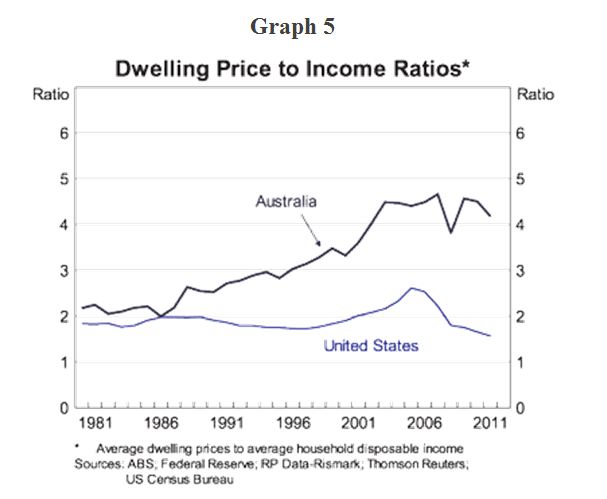
Another area where Stevens is a bit yeah, naah is on dwelling prices. Despite recent price falls, Australia has not had the bust that has occurred in many other developed countries.
Scaled to measures of income, Australian dwelling prices on a national basis have in fact declined and are now about where they were in 2002. That is, housing has become more ‘affordable’. Four or five years ago we supposedly had a housing affordability ‘crisis’. Now it seems that the problem some people fear is that of housing becoming even more affordable.
He then considers whether house prices are still over valued. Making comparisons with long-term averages or overseas prices are fraught with danger and basically involve guesses.
arguments that appeal to historical averages for such ratios lose potency the longer the ratio stays high. In Australia's case the ratio of prices to income on a national basis has been apparently at a higher mean level – about 4 to 4½ – for about a decade now.
If we compare Australia and the United States, Stevens contends that:
it is hard to avoid the impression that gravity will inevitably exert its influence on Australian dwelling prices. But if we put these two lines on a chart with a number of other countries with which we might want to make comparisons, the picture is much less clear.
Stevens argues that it is the United States that is the "outlier" and that we have more in common with the rest of the developed economies.


Another reason that Stevens is confident about housing (and also therefore about the banks) is that arrears rates remain low. Debt repayments as a percentage of income have declined. There is also a high proportion of mortgagees ahead on their payments. This factor together with the low unemployment rate is certainly on the yeah side of our equation.

Anecdotally, however, I know a lot of public servants in Queensland who are worried about their mortgages and job security given the Newman government's mindless and arbitrary slashing of public sector jobs. If repeated by an Abbott government it could contribute to the naah side of the equation just at the time as the economy is hit by a China slowdown! 

As an aside, upon coming to power, the Howard Government argued it was necessary to reduce the size of the Commonwealth bureaucracy, so it cut staff savagely from 143,226 in 1996 to 113,627 in 1999. But in the early 2000s, the size of the public service began to grow again, and by 2006 it had surpassed the level of 1996 to reach 146,384 personnel. This is despite the additional high levels of outsourcing of government work. Between 2005 and 2006 the public service increased by 13,000 or 9.6 per cent compared to 1.7 per cent for the national workforce. Howard was often accused of being an unrestrained neo-liberal, but he certainly didn’t believe in small government. 

The second long-term vulnerability that Australia faces alongside the potential for a decline in demand is an interruption to financial supply. This is important because Australia has a high level of foreign debt and the banks a high exposure to foreign lenders.

Stevens acknowledges that the banks engaged too heavily in borrowing short, lending long in the lead up to the GFC, but argues that they have been effectively moving away from this model. 


Stevens is also not worried at all about the current account deficit (CAD), a major worry of policy-makers in the 1980s and 1990s, but a non-issue for them since the 2000s.
while we have been told over the years how Australian banks were doing the country a favour by arranging the funding of the current account, they have stopped doing this over the past year without, apparently, any dramatic effects. As measured in the capital account statistics, there has been a net outflow of private debt funding over the past two years, offset roughly by increased inflow of foreign capital into government obligations. This has occurred with a net decline in government debt yields and a net rise in the exchange rate. The current account deficit has, in other words, been easily ‘funded’ without the assistance of banks borrowing abroad – in fact, while they have been net re-payers of funds borrowed earlier.

 
Not everyone agrees that the CAD cannot return as a key issue for the Australian economy, but it has definitely been removed from the forefront of the policy debate in recent years. Like many economic issues, concern will probably return as the deficit grows once again.


Stevens is also not particularly worried by our vulnerability to a decline in financial supply, although he doesn't dismiss it completely and nor should he. An Australian downturn together with another global credit crunch would be a very bad thing for a (private) debt exposed economy like Australia's.


Capital flows into Australia through foreign direct investment and more recently into Australian dollars generally have led to a higher dollar and a well funded current account deficit, but this too could change if new investment dries up and assessments about Australia's safe haven status become negative.

A financial collapse in Europe could lead to another global financial crisis, but Australia would have room to move on fiscal policy if the government (of whatever stripe) can overcome the negative politics of public debt increases.

The RBA, of course, still has room to move on interest rates, which would give households with mortgages more disposable income. If a credit crunch was mixed with a slowdown in China and rising unemployment then conditions would be tough in Australia, but still better than in most other developed economies.

It's also possible that a worsening of the European situation could actually lead to an increase of capital flows to Australia, which wouldn't be a problem for the banks, but would be for manufacturing, domestic tourism and other trade exposed sectors of the economy through Dutch disease effects.

Stevens appears to have significant faith in the Chinese Communist Party to manage the Chinese economy and with the leadership transition pressures to keep the economy humming will be high. Nevertheless, the high investment, low consumption growth model is unsustainable over the longer-term and we have to hope those communists get it right.


Overall, Stevens is right to be more yeah than naah about the Australian economy, but we shouldn't lose sight of economic vulnerabilities both short and long-term. We need a flexible economy that remains diversified.

We also need to remember that the redistribution of resources and opportunity across Australian society is necessary to maintain popular support for a dynamic open economy.