McKinsey has recently released an excellent summary of global finance. The authors present a positive picture of global finance despite the significant decline in global flows and the continuation of major financial risks, not all of which are related to cross-border flows.

The authors also point out some significant risks.
The authors argue that banks and regulators must respond to the changing dynamics of cross-border finance.
When considering the implications of these global changes, it is important to remember that the process of financialisation is not just related to cross-border flows, but to domestic financial systems as well. Domestic financial systems - admittedly with assistance from foreigners - have facilitated massive increases in household debt, which, in turn, have inflated property markets. While there was deleveraging in countries affected by the GFC - particularly Ireland - other countries - e.g the Netherlands have seen a reinvigoration of their housing markets, and while, household debt has fallen it is still 219.9 per cent of income.

Australia's ratio of household debt to income has increased significantly since the 1990s and after stabilizing for a period after the GFC, it has increased again to 193.7 (up from low point of 163.1 per cent in December 2008). Housing debt to income has increased from 112.0 in December 2008 to 136.4 per cent in June 2017. The saving grace for Australia thus far is that low interest rates have stabilised the interest paid to income ratio at about 8.7 per cent. While the next move in Australian interest rates will probably be down, a return to more normal monetary policy (i.e. higher interest rates) will increase financial pressures on households.
Household assets to income is up, but increased debt has spurred increased house prices. A fall in house prices will obviously lead to a decline in that ratio. People will feel poorer and just like everywhere else this has happened, consumption will fall. If it falls by a lot and unemployment increases, it is possible that this will lead to recession, higher unemployment, falling prices, further declines in consumption etc. Hyman Minsky provides a framework for understanding developing financial fragilities in the Australian economy and elsewhere:
It is clear that the growth of the property sector, as an outlet for investment, shares many of the characteristics of Ponzi finance. Investors utilising negative gearing provisions in the tax code – income tax deductions for property income losses – are less concerned whether their assets produce sufficient income to cover interest payments and costs and rely instead on capital gains. This enables the speculator to borrow more and more using inflated property values as collateral for further purchases. In a rising market investors and owner-occupiers can sell when necessary and utilise profits to buy another investment property or upscale, and continue the process of asset price inflation, increased indebtedness and unrealistic expectation of never-ending price increases. In Minsky’s framework, the longer the process goes on, the more likely it is that instability becomes endemic to the financial system.
Nevertheless, it seems clear also that external events can play a big role in creating inflection points, and in leading to shocks that undermine liquidity and confidence.
In a recently published paper, I argue the financialisation of the Australian economy has led to a cascading series of vulnerabilities in the Australian financial system. The vulnerabilities begin with the domination of banks in the financial system and the preponderance of the “big four” banks in the banking system. They are then exacerbated by the weight of real estate in the balance sheets of the big four. Underpinning the whole edifice is the sharp rise in household debt. Ultimately, the fate of the Australian financial sector – and the fate of the share market and the wider economy – sits precariously close to the precipice of over-inflated property markets and debt-ridden households. The debt-house-price-nexus in Australia is like a stretching rubber band. A stretched band can be relaxed gradually or it can be stretched further until, eventually, it breaks. The success of the Australian economy since the recession of the early 1990s, the profitability of the banks and the long-term rise in house prices has inevitably made investors and policy-makers complacent about these risks.
While it pays to analyse what is happening to financial globalisation, financialisation is a wider process emergent in both domestic and global arenas and, of course, in the linkages between financial systems.
If policy-makers and polities want to avoid a cycle of financial crises and the negative impacts of increasing financialisation on consumption and production, then finance is going to need to be more effectively regulated. While this would mean that global financial flows do not return to the heights of the pre-GFC world, does this matter?
With the development of cryptocurrencies, the time is ripe for a reconsideration of international international financial and monetary relations, with the aim of developing new international agreements to regulate global financial flows, imbalances and currencies.
Not likely, however.

After a decade of aftershocks from the seismic financial crisis of 2007, the landscape of global finance is much altered. Global cross-border capital flows—including lending, purchases of equities and bonds, and foreign direct investment—have shrunk by 65 percent since 2007, from $12.4 trillion to $4.3 trillion (Exhibit 1). Half of that decline reflects a sharp reduction in cross-border lending and other banking activities. But it would be wrong to conclude that financial globalization is over. New research from the McKinsey Global Institute, The new dynamics of financial globalization, concludes that what is emerging from the rubble is a more risk-sensitive, rational, and ultimately more resilient version of global financial integration.

The most dramatic change in the postcrisis global financial system has been in cross-border lending. Large European banks—particularly those in the eurozone—are leading the retreat from foreign markets. Foreign claims of eurozone banks (including loans, other foreign assets, and lending by foreign subsidiaries) have declined by $7.3 trillion, or 45 percent, since 2007 (Exhibit 2). Nearly half has occurred in intra-eurozone borrowing, with interbank lending declining the most. The foreign claims of Swiss, UK, and other European banks have fallen by $2.1 trillion. Several of the largest US banks are shifting their portfolios away from foreign business, too. ...
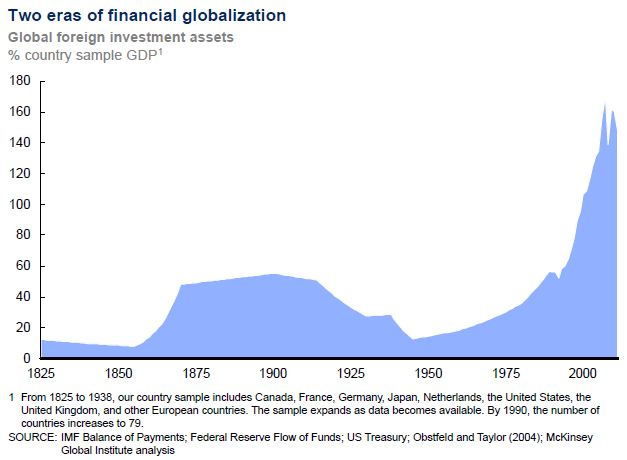
Despite the retrenchment of global banking, financial globalization continues. The global stock of foreign investment relative to GDP has changed little since 2007, standing at roughly 180 percent of world GDP. In absolute terms, total foreign investments have grown to $132 trillion in 2016, up from $103 trillion in 2007. More than one-quarter of equities around the world are owned by foreign investors, up from 17 percent in 2000. In global bond markets, 31 percent of bonds were owned by a foreign investor in 2016, up from 18 percent in 2000. Foreign lending and other investment is the only component of foreign investment assets and liabilities that has declined since the crisis.This shows the relative stability of FDI and how destabilising short term flows can be. Reversals of short term flows into equities and property markets can add to domestic 'Minskyian' financial instabilities.
While foreign investment stocks remain highly concentrated among a handful of advanced economies, more countries are participating. MGI’s Financial Connectedness Ranking (see the short version of the ranking in this downloadable poster) shows the total stock of foreign investment assets and liabilities for 100 countries, as well as their composition and growth. Advanced economies and international financial centers are the most highly integrated into the global system. The United States, Luxembourg, the United Kingdom, the Netherlands, and Germany top the ranking.
But developing countries are becoming more connected to global finance. Their share of total foreign investment assets has risen from 8 percent to 14 percent in the past decade. China’s rise in global finance is most notable; it rose from 16th place in 2005 to 8th in 2016. China’s total stock of foreign bank lending, foreign direct investment, and portfolio equity and bond investments reached $3.4 trillion in 2016, exceeding its $3.2 trillion of central bank foreign reserve assets—a notable shift.Nevertheless the authors have a positive story to tell.
The new era of financial globalization promises more stability, for several reasons.
- Foreign direct investment (FDI) and equity flows now command a much higher share of gross annual capital flows than before the crisis, from 36 percent before 2007 to 69 percent in 2016. This is good news for stability, since FDI is by far the least volatile type of capital flow and cross-border lending is the most volatile.
- Global current-, financial-, and capital-account imbalances have shrunk, from 2.5 percent of world GDP in 2007 to 1.7 percent in 2016. This reduces one potential spark that could ignite a financial crisis. Even more dramatic has been the decline in the very large US deficit and Chinese surplus. For the first time in a decade, developing countries have become net recipients of foreign capital flows.
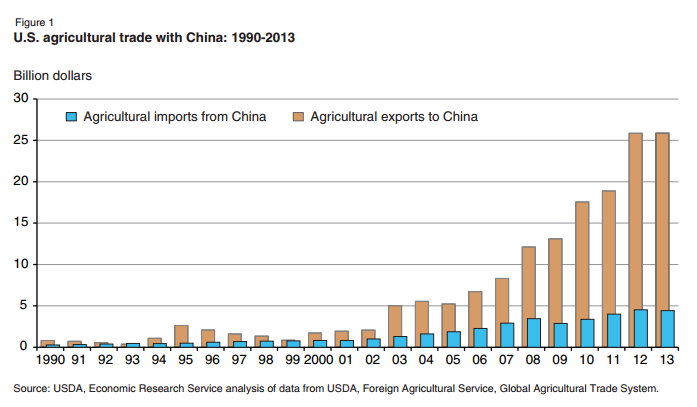
These are significant changes and the reduction of the imbalance between the US and China is important. However, a slowing Chinese economy may encourage Chinese policy-makers to reinvigorate Chinese mercantilism. This will no doubt anger the Trump Administration in the US, creating wider problems for the world economy and the integration of the US and Chinese economies.
- Banks around the world have larger capital and liquidity cushions to offset future losses. Most global banks have also built stronger risk-management capabilities.
The authors also point out some significant risks.
But potential risks also remain and are worth watching.
- Gross capital flows—particularly foreign lending—remain volatile. Over 60 percent of countries experience a large decline, surge, recovery, or reversal in foreign lending each year, creating volatility in exchange rates and making macroeconomic management more difficult. The median fluctuation for these countries is equivalent to 6.7 percent for developing countries and 10.8 percent for advanced economies.
- Equity-market valuations in some markets have reached new heights, which raises questions about whether a bubble could be emerging.
Clearly some efforts to ease volatility must involve restrictions of some sort. Countries can make individual decisions to try to restrict flows but an international framework or agreements between states would allow states to choose lower volatility. Super low interest rates have also inflated housing and property markets making the world economy vulnerable to the potential consequences of monetary policy normalisation. Finally, while the risks of financial contagion are enhanced by greater participation, what consequences could flow from a reinvigoration of global flows?
- With more countries participating in global finance, financial contagion remains a risk—especially for developing countries that lack deep, transparent, and liquid domestic financial markets.
The authors argue that banks and regulators must respond to the changing dynamics of cross-border finance.
Financial globalization is arguably healthier than it was before the crisis, but banks and regulators must remain vigilant and continue to adapt. In the future digital platforms, blockchain (PDF), and machine learning may transform financial markets and create new channels for cross-border capital flows. These technologies are enabling faster, lower-cost, and more efficient international transactions, and will further broaden participation in global finance to more firms, investors, and countries.
Banks and regulators must respond to several aspects of the new era.
- Banks. How long the ongoing retrenchment of European and US global banks persists is uncertain, but it is likely that it will continue—or at least not reverse—for the foreseeable future. Banks must continue to scrutinize their international strategies to ensure healthy long-term performance. This will entail focusing on corporate clients and countries in which they have significant market share, and shifting from subsidiary to branch structures when possible in order to optimize their capital. Banks must harness the new technologies across their global operations to increase efficiency, meet customer expectations, and capture new opportunities. Harnessing advanced analytics and machine learning algorithms to better understand risks in international markets could be a competitive edge.
Regulators must also not allow the non-bank sector to evade stabilising regulations or otherwise activity will just switch.
- Regulators. Given the dynamic changes in the way global finance is conducted, policy makers should continue refining regulation and supervision of financial markets. Regulators must continue to build systemic risk monitoring capabilities and ensure prompt reaction to changing market conditions. New tools for managing volatility in capital flows and in reducing capital- and financial- account imbalances are needed. In the eurozone, further development of the banking union and establishment of a capital markets union is warranted and could help promote a return to growing intraregional investments. Continued innovation in digital technologies requires favorable regulatory climate to allow experimentation, but also could create new market dynamics and risks.
When considering the implications of these global changes, it is important to remember that the process of financialisation is not just related to cross-border flows, but to domestic financial systems as well. Domestic financial systems - admittedly with assistance from foreigners - have facilitated massive increases in household debt, which, in turn, have inflated property markets. While there was deleveraging in countries affected by the GFC - particularly Ireland - other countries - e.g the Netherlands have seen a reinvigoration of their housing markets, and while, household debt has fallen it is still 219.9 per cent of income.

Australia's ratio of household debt to income has increased significantly since the 1990s and after stabilizing for a period after the GFC, it has increased again to 193.7 (up from low point of 163.1 per cent in December 2008). Housing debt to income has increased from 112.0 in December 2008 to 136.4 per cent in June 2017. The saving grace for Australia thus far is that low interest rates have stabilised the interest paid to income ratio at about 8.7 per cent. While the next move in Australian interest rates will probably be down, a return to more normal monetary policy (i.e. higher interest rates) will increase financial pressures on households.
The first theorem of the financial instability hypothesis is that the economy has financing regimes under which it is stable, and financing regimes in which it is unstable. The second theorem of the financial instability hypothesis is that over periods of prolonged prosperity, the economy transits from financial relations that make for a stable system to financial relations that make for an unstable system. In particular, over a protracted period of good times, capitalist economies tend to move from a financial structure dominated by hedge finance units to a structure in which there is large weight to units engaged in speculative and Ponzi finance. (Minsky 1992)Minsky highlights the dangers of what he calls Ponzi financing, wherein ‘cash flows from operations are not sufficient to fulfil either the repayment of principal or the interest due on outstanding debts by their cash flows from operations’. The only way to pay off principal or interest is to sell assets (ideally at a profit) or borrow more (in the hope that asset prices will continue to grow). According to Minsky, a heightened emphasis on speculative and Ponzi finance increases the risk of the financial system becoming a ‘deviation amplifying system’.
It is clear that the growth of the property sector, as an outlet for investment, shares many of the characteristics of Ponzi finance. Investors utilising negative gearing provisions in the tax code – income tax deductions for property income losses – are less concerned whether their assets produce sufficient income to cover interest payments and costs and rely instead on capital gains. This enables the speculator to borrow more and more using inflated property values as collateral for further purchases. In a rising market investors and owner-occupiers can sell when necessary and utilise profits to buy another investment property or upscale, and continue the process of asset price inflation, increased indebtedness and unrealistic expectation of never-ending price increases. In Minsky’s framework, the longer the process goes on, the more likely it is that instability becomes endemic to the financial system.
Eventually, there is a point of inflection where assessments
about future profits turn negative, revealing the precarious nature of the
whole edifice. Minsky (1992) argues that his hypothesis:
is a model of a capitalist economy which does not rely upon exogenous shocks to generate business cycles of varying severity. The hypothesis holds that business cycles of history are compounded out of (i) the internal dynamics of capitalist economies, and (ii) the system of interventions and regulations that are designed to keep the economy operating within reasonable bounds.
Nevertheless, it seems clear also that external events can play a big role in creating inflection points, and in leading to shocks that undermine liquidity and confidence.
In a recently published paper, I argue the financialisation of the Australian economy has led to a cascading series of vulnerabilities in the Australian financial system. The vulnerabilities begin with the domination of banks in the financial system and the preponderance of the “big four” banks in the banking system. They are then exacerbated by the weight of real estate in the balance sheets of the big four. Underpinning the whole edifice is the sharp rise in household debt. Ultimately, the fate of the Australian financial sector – and the fate of the share market and the wider economy – sits precariously close to the precipice of over-inflated property markets and debt-ridden households. The debt-house-price-nexus in Australia is like a stretching rubber band. A stretched band can be relaxed gradually or it can be stretched further until, eventually, it breaks. The success of the Australian economy since the recession of the early 1990s, the profitability of the banks and the long-term rise in house prices has inevitably made investors and policy-makers complacent about these risks.
***
While it pays to analyse what is happening to financial globalisation, financialisation is a wider process emergent in both domestic and global arenas and, of course, in the linkages between financial systems.
If policy-makers and polities want to avoid a cycle of financial crises and the negative impacts of increasing financialisation on consumption and production, then finance is going to need to be more effectively regulated. While this would mean that global financial flows do not return to the heights of the pre-GFC world, does this matter?
With the development of cryptocurrencies, the time is ripe for a reconsideration of international international financial and monetary relations, with the aim of developing new international agreements to regulate global financial flows, imbalances and currencies.
Not likely, however.