Sunday, November 6, 2011

Mining Investment, Foreign Ownership, Taxation and Redistribution

Recent arguments that the mining tax increases the risk of investing in Australia are absurd. As Clancy Yeats argues:
conflating Australia's situation with that of Greece is exactly what some in the business community are carelessly doing. How could this be so? I'm referring to that favourite catch-phrase lobbyists use when trying to undermine a policy they oppose: ''sovereign risk.''
This phrase has been used ad nauseam by business groups, miners in particular, in their fight against policies they don't like - none more so than the mining tax and carbon price. With mining tax legislation coming into Parliament this week, expect the shouting to continue.
For all the bluster, sovereign risk means something completely different. It refers to the risk of a radical change in the economic environment for an investor - think of the 50 per cent ''haircut'' Greece's creditors will wear.
Putting these rather large semantic differences aside, how has Australia's ''sovereign risk'' problem affected investment?
As figures published today show, the proposed changes have done little to stem the flow of mining cash flooding into the nation. Despite all the complaints about pricing carbon and taxing mining profits, the quarterly Deloitte Access Economics Investment Monitor shows the value of definite projects swelled by 51.3 per cent to $406.8 billion in the year to September.
Boardrooms may well have thought carefully about the new policies while considering these mammoth projects, but it didn't stop them. Nor has the tax threat stopped proposals for investments that may still come to fruition. The value of possible projects leapt by 31.8 per cent in the year, to $256.9 billion, today's report says.
All up, the total pool of investment under way or on the drawing board has reached a staggering $894.1 billion.
But if you want reassurance from a more august institution than the Sydney Morning Herald, let's compare some recent quotes from the Reserve Bank of Australia's recent Statement on Monetary Policy.
Mining investment grew strongly over the first half of the year. Since the August Statement, a final investment decision for the Wheatstone LNG project has been announced, lifting the total value of LNG projects currently underway or committed to around $146 billion. With work done already at high levels, mining investment is likely to increase to around 7 per cent of GDP over the next few years.
The second concerns the fate of other areas of the economy:
The high level of the exchange rate is having a contractionary effect on a number of non-mining industries, particularly manufacturing and some service industries, including tourism and education. Manufacturing and services exports remain well below their pre-crisis levels; exports of education related services have been particularly weak over the past year, partly reflecting tighter access to student visas.
It is interesting to note that despite the patchwork our two-speed economy thesis. manufacturing exports have grown again after the global recession.

Employment in manufacturing has also suffered significantly, although service sector employment has grown over the past year.


In terms of foreign ownership of the mining industry, the RBA argues it is about 80 per cent.
However, the foreign ownership share of the mining industry is also significantly higher than for other industries. Most estimates suggest that effective foreign ownership of current mining operations in Australia is around four-fifths, although this varies significantly by commodity and by individual mine. Accordingly, in the balance of payments much of the investment in this sector is treated as being financed from abroad. This includes retained earnings that accrue to foreign direct investors. In recent years, mining has accounted for a large share of the foreign investment inflows into Australia. Importantly, a number of committed LNG projects are wholly foreign-owned, which means much of the investment over the next few years will be funded entirely by offshore parent companies. This should see an increase in measured foreign direct investment flows into Australia.
This leads to a persistent net income deficit (component of the current account deficit).
Australia’s net income balance is the net sum of income flows associated with the stock of Australia’s debt and equity assets and liabilities. Australia has a persistent net income deficit due to the large stock of net foreign liabilities and because foreigners are estimated to consistently earn higher yields on their investments in Australia than Australian residents receive on their investments abroad. The mining sector mainly affects the net income deficit via the share of mining profits that accrue to foreign investors (through dividend payments and/or reinvested earnings on direct investment). While such data are not available by industry, total reinvested earnings on foreign direct investment have steadily increased as a share of GDP, in line with strong mining profits in recent years. Given the outlook for the mining sector, this trend is expected to continue.
Reinvested earnings are stated as a positive for foreign ownership of the mining sector, but of course profits do eventually flow out of the country.

This is one of the reasons why it makes good sense to tax them at a higher rate so that taxes for other sectors of the economy could be lowered and superannuation payments increased.

One of the arguments given for why we should tax the mining industry at a higher rate is the argument that it will deter investment (and re-investment).

As current and future plans make clear. This is pure bunkum. (I can think of a few other descriptions for this thesis, but I'll leave them for private conversations!).

Wednesday, November 2, 2011

Business Power and the Revitalisation of Rent-Seeking

Increasingly the best writer on economics in the major papers is Jessica Irvine. Going through my google news alerts I found this cracker of an article about rent-seeking and the negative effects of lobbying, especially in relation to the mining tax. It also covers pretty well why I favour freer trade over protectionism.

Some of the salient points of the article: 

Australia is in the grip of a rent-seeking epidemic and the rent-seekers are winning. Sure, seeking special protection and privileges from government for one's own industry is a long-standing tradition among Australian business. They used to seek tariffs on imported goods and other protectionist shelters. Today, they mostly seek ways to pay less tax.
The thing is, all government interventions in the economy create winners and losers. But often it is a small group of potential losers that have the self-interest and resources to mobilise against the changes, while the winners, for example the millions of consumers who benefit from lower import prices under trade liberalisation, are disparate and not as inclined to organise in favour of the change.
...
Every dollar spent on rent-seeking is a dollar less reinvested in expanding business or investing in new technology. So this new outbreak of rent-seeking not only duds taxpayers out of money, it threatens our future wages and living standards, too.
Rent-seekers have adapted cannily to the politics of the day. As politicians have moved to a poll-based ''we want what the people tell us they want'' credo, big business has begun to pour money into expensive advertising campaigns to sway popular opinion; witness the anti-mining tax and anti-carbon tax campaigns.
The mining industry's investment of $22 million for an advertising campaign to sway public opinion against raising an extra $60 billion in tax from highly-profitable mining companies is surely the most successful rent-seeking mission in Australian history.
Unions can rent-seek, too, seeking higher wages without offering higher productivity or government mandates that mining companies should use their services.
All this rent-seeking used to take place away from the public eye through hidden political donations and good old-fashioned long lunches. But today, thanks to new rules around donations and lobbyist registers, rent-seeking is increasingly played out in the public sphere, spearheaded by a proliferation of telegenic ''spokespeople'' working for business associations.
There's the Business Council of Australia, the Australian Chamber of Commerce and Industry, and the Australian Industry Group, as well as state-based business chambers. Each battles with the other for supremacy.
They are supplemented by a multitude of industry-specific associations. The retail industry is a good example. Retailers can be represented by the Australian National Retail Association, the National Retail Association, the Australian Retailers Association, the United Retail Federation, the National Independent Retailers Association or the Bulky Goods Retailers Association, to name but a few. And yes, they are all separate bodies.
...
Politicians and the media cop most of the blame these days for the dumbing down of the political debate. But let's not forget this entire industry of rent-seekers who are doing the best they can to muddy the waters of good public policy and confuse everyone.
Politicians need to wake up to the way they are being played. The public needs to switch on their rent-seeking bullshit-ometers when watching the next round of self-serving business advertising and learn to think: ''Well, they would say that, wouldn't they?'' And the media needs to rediscover its love of man bites dog tales and stop giving these guys a free kick. [listen up The Australian]
...
Australians have invented our unique brand of corporate rent-seekers, and far from standing up against them, we've often been complicit tools in their trade, shifting our opinion on public policies in response to their self-interested advertising campaigns.
When government thinks it's doing what the public wants, but what the public wants is in fact what big business wants it to want, we have a problem.

For more on rent-seeking see here.

And to finish off with a pertinent song by The Hiveshttp://en.wikipedia.org/wiki/Rent-seeking

Tuesday, November 1, 2011

Cartoons of the Week(s)


House prices

While mortgagees are likely to be happy about the 0.25 per cent cut in interest rates, they are less likely to be happy about the data released by the ABS today.

You can bet the media will be more focused on the cut than the decrease in house prices!


A 5 per cent fall in Brisbane - year on year - is particularly noteworthy with half of that fall coming in the last quarter.


Thursday, October 27, 2011

Some interesting data on China, India (and Australia)

Those wanting a good summary of India's development, especially in comparison to China and its impact on Australia should read

"India's long-term growth potential and the implications for Australia"

by Ben Ralston, Wilson Au-Yeung and Bill Brummitt

 Some of the graphs provide are excellent.

 Chart 1: Working age population as a proportion of population


This means that India is better set up demographically than China for the future. In countries like Australia there will be more old people to support and the retirement age will no doubt push out to 70 as people generally live longer. (My heart bleeds for those Greeks who believe that shifting the retirement age beyond 55 for "arduous" jobs represents severe sacrifice)

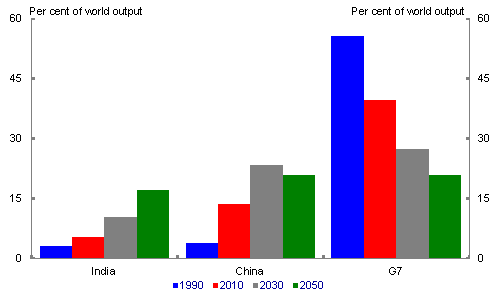
Chart 2: Long term projections — India, China and G7


Of course much could go wrong!!

Chart 3: GDP per capita as a proportion of the US


The interesting thing about this projection is that in the 1980s it was assumed that Japan would soon match US GDP per capita, which is an important indicator of real progress.

Chart 4: Population of India and China


Both countries it seems will need more girls if there are not to be a lot of young men without girlfriends and wives!

Chart 5: Participation rates for India and China


India still has a long way to go to encourage more workers to participate in the formal work sector. Changes in regulations will probably increase the participation rate in India in the future, providing further advantages for the Indian economy.

Chart 6: Australia’s exports of education services to India

The authors report that:
Currently around 11 million Indian students are pursuing higher education — but this
represents just 11 per cent of the nation’s 17-23 year olds. The level of unmet demand
for university places runs at around 4.7 million places each year.
Government policy is directed towards increasing the Gross Enrolment Ratio — the
ratio of actual students to potential students — to 25 per cent by 2022.
To supply the necessary places, India intends to set up around 1,500 new higher
education institutions, at least one central university in each state, and 14 new
innovation universities.
The opportunities for Australian universities, whether in terms of partnering with
Indian institutions during this growth phase or attracting more Indian international
students to Australia are clear.
In terms of vocational education and training, the scope of opportunity is also
impressive. The Australian Government has identified opportunities to increase the
delivery of Australian vocational education and training (VET) qualifications in India.
At present only 2-2.5 per cent of India’s population undertakes formal VET training.
However, it is estimated that some 500 million people will require training by 2022 —
over 21 times Australia’s population. The current capacity of the Indian VET system is
around 4.3 million training places.
The challenge for India is enormous and India recognises that it cannot achieve these
goals alone.
The scale of needs in India has seen our exports of education services to India
experience roughly a 28 fold increase in dollars spent over the 15 years to 2010.32 These
exports remain at very high levels and the whole trade is now on a much more
sustainable path after the Government’s series of visa reforms.
It seems that there will be more Australian academics in India in coming years!

While the opportunities that India's growth represents to Australia are huge, the education sector shows that things can go wrong. The breakneck expansion of the sector led to many shonky operators, especially in the VET sector. The high Australian dollar has probably also had a negative effect on Australia. Why study in Australia when you can study in the US more cheaply. 

House Prices


This is from the Australian (if you want to get a story on The Australian but don't want to pay, simply put the title into google and click on the link ... this will get you the full story).

Maybe one day I might even be able to buy a house in a suburb I would want to live in!

The real issue is whether prices will stagnate at this level for a while or continue to fall.

Meanwhile falling house prices no doubt make homeowners feel poorer, even if it doesn't really matter whether your home is worth 550k rather than 600k as long as you're not selling it.