Showing posts with label resource dependency. Show all posts

Wednesday, July 25, 2012

Chinese Property

The Chinese property market is probably more confusing than any other property market in the world.
Some reports argue that things have recovered whilst others suggest that the 'recovery' is a little blip, which can't stop the inevitable decline.

These things matter of course for us here in Australia, because of a little thing called steel (made of coal and iron ore) and a few other resources that we sell to the Chinese.

I am bearish about China over the short to medium term, but I know enough about China to be not certain of anything. 

So for those of you wanting to read a little more I recommend the following:

Where is everyone? The derelict majesty of Chinese ghost town built to house one million, but with less than 30,000 residents

This contains an old story but with some fabulous pictures. Unravelling the future of Ordos will be a fairly important indicator of what happens in China more widely.

For those wanting an analysis of more recent developments may I suggest:

What’s driving China’s real estate rally?

I'm guessing that we need to factor in Ordos into the overall equation, but like the Australian property market, looking at the aggregate picture may not always tell us a bout particular segments of the market.

The jury as they say is still out ...


Monday, June 11, 2012

Commodity Prices and Commodity Exporters

Catching up on some reading on the weekend I came across these fabulous graphics that put recent commodity price increases into context.  They come from chapter four of the latest World Economic Outlook from the IMF.

Source: IMF staff calculations.
Note: The real price index for a commodity group is the trade-weighted average of the
global U.S. dollar prices of the commodities in the group deflated by the U.S. consumer
price index and normalized to be 100 in 2005. 
The blue vertical lines indicate long cycle
peaks, and the red vertical lines indicate long cycle troughs. 
The exact dates of these turning points are as follows (where M = month). 
Energy: 1981:M1, 1998:M12, 2008:M7.
Metals: 1974:M4, 2001:M12, 2008:M6. 
Food: 1977:M4, 2001:M11, 2011:M2. 
Raw materials: 1973:M9, 2002:M1, 2011:M2. 


While energy prices peaked at a level higher than the peak of 1981, the recent peaks for metals, food and raw materials have gotten nowhere near the peaks of the 1970s. The note above shows the month and year of the various peaks.

The second graphic to come from the report shows the percentage that commodity exports account for in total exports and in GDP. 


What the graphics show is that Australia has an export structure that is closer to developing countries than other developed economies, which was seen as a bad thing in the1980s and 1990s, but is now seen as a good thing. Australia must be very close to becoming a red country rather than a pink country in the top graphic. 

BUT it also shows that we are NOT as dependent on commodity exports as many of these developed countries primarily because exports are less important for the Australian economy than for most countries in the world apart from Japan and the United States (and Europe if considered as one country!). 

Our economy is overwhelmingly made up of services. In fact according to the ABS services account for 80 per cent of the economy (remember construction is a service!)  (Services were once defined by The Economist as things that you can buy or sell, but can't drop on your foot - I'm sure that doesn't apply to construction). See here for a breakdown of the Australian economy.

Still we have become increasingly dependent on resource exports and that may be a problem as the IMF makes clear in a world where demand and prices for commodities could be on the wane.

Monday, June 4, 2012

Should Western Australia Secede?


Some West Australians or Western Australians as the rest of Australia calls them have always been a bit reluctant about being a part of the Commonwealth of Australia. WA was so late into the Commonwealth that the preamble to the Constitution doesn't actually mention it:
WHEREAS the people of New South Wales, Victoria, South Australia, Queensland, and Tasmania, humbly relying on the blessing of Almighty God, have agreed to unite in one indissoluble Federal Commonwealth under the Crown of the United Kingdom of Great Britain and Ireland, and under the Constitution hereby established:
Western Australians approved the draft constitution in a referendum held on 31 July 1900. As Thomas Musgrave notes:
A special provision - section 95 - had been inserted into the Constitution in order to address Western Australia’s concern over the abolition of the inter-colonial tariff. Section 95 permitted Western Australia, on condition that it entered the Federation as ‘an original State’, to maintain its inter-colonial tariff within the Federation for a period of five years, in a formula which decreased the tariff by twenty percent each successive year. A further economic inducement came in the promise of a transcontinental railway linking Western Australia to the eastern States.
Another major factor, however, was the threat of an internal secessionist movement based in the gold fields. This secessionist movement was not hostile to the other Eastern colonies, but to the isolationist views of established Western Australians. The WA gold rush led to a massive increase in the colony's population from 47,000 in 1890 to 179,000 in 1900. Depressed economic conditions in the rest of the country increased the attraction of going to WA. A phenomenon that is not being matched during the current boom, mainly because, despite the doomsayers, the rest of Australia is still doing relatively well as we will see below. The new settlers changed the political outlook of the state, challenging the isolationist views of the WA establishment. As Musgrave argues:
The Western Australian delegates who attended the constitutional conventions of 1891 and 1897-98 were drawn for the most part from the traditional elements of Western Australian society. Their approach to the notion of federation reflected the isolationist sentiments of their constituency. But these were not the sentiments of the goldrush settlers. When it became apparent that Western Australia might not join the proposed federation, the settlers formed the Eastern Goldfields Reform League. The Reform League began to agitate vigorously for the secession of the goldfields region from Western Australia and its integration into the Australian Federation. At this point the British Colonial Secretary, Joseph Chamberlain, intervened to pressure Western Australia into joining the Federation. On 27 April 1900, Chamberlain sent the acting Governor of Western Australia a telegram alluding to the secessionist movement in the goldfields and advising the Governor that in these circumstances it would be in the best interests of the colony to join the Federation. The loss of the goldfields would have been disastrous to Western Australia, both from an economic and a political viewpoint. Therefore, a Bill was hastily introduced into the Parliament of Western Australia providing for a referendum on the draft constitution.
So in the beginning, it was the miners who wanted to be a part of the Commonwealth and the 1900 equivalent of WA's cafe latte set that didn't want it (perhaps we could call them the sherry sipping set).

West Australians again tried to secede in 1933, when two-thirds of the electorate voted yes to the question:
Are you in favour of the State of Western Australia withdrawing from the Federal Commonwealth established under the Commonwealth of Australia Constitution Act (Imperial)?
 At the same referendum a majority voted no to the second question:
Are you in favour of a Convention of Representatives of equal number from each of the Australian states being summoned for the purpose of proposing such alterations in the Constitution of the Commonwealth as may appear to such Convention to be necessary?
Ironically, the party pushing for secession - the Nationalists - lost the election to the party opposing it - the Labor Party. Nevertheless, the Labor government sent a delegation to London in 1935, but the mission failed because a Select Committee of the British House of Commons argued that only the Commonwealth as a whole could decide on the issue of secession. According to Musgrave the Committee concluded, that
the petition was not receivable because Western Australia, as a State, was ‘not concerned with the subject-matter of the proposed legislation’ and because the Imperial Parliament did not have jurisdiction to enact the request ‘except upon the definite request of the Commonwealth of Australia conveying the clearly expressed wishes of the Australian people as a whole’.
In other words, by joining the Commonwealth, Western Australians had given up the right to make that decision unilaterally.

As Australia entered WWII the issue of secession faded into the background, but it has periodically returned as key West Australian players have periodically railed against Federation.

Mining magnate, Lang Hancock, the father of the world's richest woman Gina Rinehart founded the Westralian Secession Movement, but like many wealthy people in recent years perhaps thought his wealth would lead necessarily to popularity. (Australia has a proud history of wealthy people thinking that success in business should lead them to success in politics or the ownership of sporting clubs).

Ironically, given the current WA Premier's recent comments about his states closer relationship with Asia than with the rest of the country, Hancock was opposed to developing closer resource ties to China. In "A Condensed Case for Secession", Hancock 'wrote':
On May 28, 1973, a report appeared in one of our national mining journals regarding Dr Cairn’s visit to Red China. This indicated that the good doctor was giving some thought to inviting Chinese geologists to the Pilbara for prospecting expeditions. 
By what divine right has either of these two members of our Government the authority to hand out Australian lands, or to permit them access to our minerals? 
Such high handed acts by the Federal Government should not be tolerated by the people of WA. Who is going to protect them from such wild, irrational policies? 
Their first step should be to support and join the Westralian Secessionists, who intend “fielding” contestants for the Senate in 1977. This movement has no loyalty to any political party and has its State as the first and only consideration. 
How things change, while Hancock could accuse the Whitlam Labor government of betraying Australia by providing for Chinese investment in Australia, current WA politicians rail against 'racist' Easterners for not allowing Chinese state-owned enterprises freer reign to invest in WA mining infrastructure and development.
Currently some West Australians are feeling that the rest of Australia - "the East" - is dining out on their hard graft in producing Australia's export wealth. See here and here and here.And as we will see below there is some truth to this assertion.

It's not the first time that West Australia has come to Australia's rescue. As I wrote in The Vulnerable Country:
In the period from 1900 to 1914, increasing demand for Australia’s exports underpinned economic growth, the repayment of foreign debt and rising living standards. The recovery was not dependent on foreign investment and immigration, rather it was bolstered by gold discoveries in Coolgardie and Kalgoorlie, and Western Australian development generally
I imagine that some in WA would be a little uncomfortable with the current secessionist rhetoric, but others would support it wholeheartedly. (I can't find a properly conducted recent opinion poll on the issue and Newspoll assures me that they haven't done one, although they did offer to do one for me for a couple of grand.)

Supporters, however, should bear in mind that whilst their state is currently making sizeable contributions to the Commonwealth, over the longer-term this may not be the case. Western Australia might actually need the rest of Australia in the future to cover its shortcomings if the mining sector falters. Whilst a boom in mining is undoubtedly a good thing in a state where mining makes up 33 per cent of Gross State Product, it also means that a slump in mining would disproportionately affect the West.

It wasn't long ago, i.e. the 1980s and 1990s, that most policy-makers and economic commentators thought that Australia's future as a resource exporter was a recipe for becoming a third world economy. While that was obviously wrong for now, it may not be the case in 10, 20 or 30 years time. It's possible that as China's and India's resource intensive period of growth changes into the traditional pattern of intensive services growth that Western Australia will be more reliant on the Eastern states and the wonders of horizontal fiscal equity.

It's also possible that over the shorter term that growth stumbles in China and India will bring resource prices crashing or that the vast number of gas discoveries will actually lead to a gas glut and eventually lower prices. Note that it's possible not a certainty. We could still have a Boom Mark 3 as well! Indeed Japan's demands for gas will increase, but they are actively seeking alternative sources of supply, most importantly an end to the ban of gas exports from the United States. The difference between the US price and the world price for gas is enormous and a lifting of the ban would encourage even more fracking in the United States.

If one studies the history of capitalism, then even commodity super cycles like the current one come to an end. Major exports that many people believe will always be most important generally do not continue to be most important forever. Remember the fate wool, for so long Australia's major exporter and only Australia's 20th largest export in 2010-11.  Still there's some money to be made in the meantime.

Our analysis of the WA case for secession will be improved by not only speculating on the future, but by considering the recent past performance of  the Australian states.

An excellent article from the March Reserve Bank Bulletin analyses the recent economic performance of the states. Kathryn Davis, Kevin Lane and David Orsmond argue:
Spending has grown strongly in the resource-rich states in recent years, primarily reflecting very high levels of investment in the mining industry. However, the pace of growth in state production and developments in other economic indicators have been more uniform across the states. This reflects the high import content of mining investment as well as the flow-through of spending and income from the resource-rich states to the other states.
One of the ways to measure state economic performance is to analyse state final demand, which measures "the growth in consumption and investment spending by the household, business and government sectors combined"
.

Western Australia and Queensland have clearly outperformed the rest of Australia, but note that they also did considerably worse during the downturn as demand from China temporarily collapsed. While this might not worry West Australians (or Queenslanders) at the moment, it might in the future if the terms of trade collapses as it has done after all booms in Australian history (see here for explanation of the terms of trade)

Remember that this boom is different from many other booms in Australian history because it's both an investment and terms of trade (price) boom. This means that large amounts of capital have been invested in the mining sector at the same time as there have been massive increases in the prices of our major resource exports. 


The figures for iron ore are truly astounding, especially given the fact that they had been flat for a long period of time before 2003. The increase in demand for iron ore during the rise of Japan from the 1960s was not matched by the massive increases in prices that have occurred since 2003. Coal prices were also flat for a long period before 2004.


 Iron Ore Prices 1982-2012 USD

Source: Index Mundi

Source: ABARES


What has happened in recent years is a massive expansion of supply to match the increased demand for all kinds of resources. Simple supply and demand analysis would suggest to us that if supply increases at a faster rate than demand then prices will fall. And if supply increases significantly and demand falls significantly as well, then prices will fall, well, significantly. But we can hope that supply increases will be matched by increasing demand as China's Communist Party successfully manages to keep investing in infrastructure and as demand for Chinese exports continues to increase from revitalised US and European economies or that the CCP engineers a successful transition to a more domestically oriented economy or that India keeps growing rapidly or ... You get the picture. Lots could go wrong. As ABARES predicts (in the graph above) prices for steel making raw materials (Australia's two biggest exports) are likely to decrease over coming years.

Getting back to our assessment of the states, Davis, Lane and Orsmond point out that investment spending has been a large source of growth in the resource states: "In 2011, business investment in the resource-rich states was exceptionally strong, increasing by 28 per cent in Western Australia and 58 per cent in Queensland."

This accounted for a large percentage of demand growth. Much of this investment spending, however, was used to purchase imports and "part of the mining investment (and operational) spending undertaken in Western Australia and Queensland is met by production in other states, not just for inputs such as parts but also for a range of professional services, such as accounting and consulting services. As a consequence, up until now at least, the differences in the growth of production across states has been narrower than the differences in the growth of total spending."


Resource investment, particularly gas investment is particularly import intensive as the chart below shows.


Consumption growth has been strongest in WA, partly because of increased investment, partly because of increased incomes and partly because of increases in WA's population. The overseas migration rate could be about to get even larger with new projects demanding foreign labour to compensate for the relatively small amounts of interstate migration to WA. It is worth noting the massive interstate migration to Queensland in the 2000s has also slowed considerably over the last few years. I'm also intrigued by the considerable increase in interstate migration to Tasmania in the first half of the 2000s.


The authors note that the differences in state production have been less than many would imagine.
Gross state product (GSP) measures the level of state production by adjusting spending for both interstate and overseas trade. However, GSP is published only annually; the most recent data are for 2010/11, which is before the surge in mining investment in the second half of 2011. Nevertheless, the GSP data indicate that while production in Western Australia and Queensland has grown faster than in the other states since the onset of the resources boom in the mid 2000s, the differences have narrowed markedly in recent years. 


The authors also provide some excellent tables at the end of the article on the relative size of the states, growth rates and industry shares. 


In terms of state growth rates WA and QLD are the clear leaders with SA and Tasmania the clear laggards, although the differences in GSP per capita are less significant. 


The big anomaly in terms of industry shares is of course the 33 per cent of WA production accounted for by mining, compared to 9 per cent for Australia. Construction has also been more important for WA than the other states and Australia as a whole. Financial and business services dominate in NSW and Victoria.


In terms of exports, WA clearly dominates. According to DFAT, WA accounted for 40 per cent of exports in 2010-11, followed by QLD and NSW with 19.5 and 19.1 per cent respectively.


NSW dominated imports in 2010-11 accounting for 38 per cent, followed by Victoria with 26 per cent. WA ran a clear trade surplus accounting for only 12.8 per cent of imports.

While WA has been increasing its dominance since 2005-06,  it only took over as the largest state exporter in 2002-03. (See here on p. 4) Its lead has increased markedly, however, during Booms Mark 1 and 2, but its possible that with a slowing or end to the boom that it will be drawn back to the pack in coming years.


So WA has some significant evidence to back its case that it carries the rest of the country, with the exception perhaps of Queensland, but the rest of the East is also not doing as badly as some in WA seem to think (see here also). Remember that exports only accounted  for 21.2 per cent of GDP in 2011, down from 22.7 in 2009.

So in sum do I think WA should secede from the rest of Australia? The answer is no, but I would say that wouldn't I, given that I am after all from 'the East' - a South Australian living in Queensland (although as a Queenslander I am a contributor to national wealth and as an academic I am involved in Australia's third biggest export.)

All the discussion is probably moot anyway because a change to the Constitution requires a majority of Australian voters and a majority of voters in a majority of states. The East is unlikely to let the West go, but the Commonwealth might have to do a better job of maintaining good relations with the WA government and avoid cutting by too much the amount of WA's own GST revenue that it gives back to West Australians. It might also have to re-consider the issue of state mining royalties.


Friday, May 4, 2012

Some More Figures on Commodity Prices

In its May 2012 Statement on Monetary Policy, the RBA included this graph on the price declines of individual commodities.


The analysis of recent developments is less gloomy, although the year-on-year declines are considerable.
The [commodity price] index remains at a historically high level, but is around 9 per cent lower than its peak in mid 2011. In general, commodity prices have been supported by the gradual pick-up in global economic activity since the start of the year, though increases in some prices have been partially retraced over April. Spot prices for iron ore and base metals have all increased, while spot prices for both thermal and coking coal have declined in recent months, largely reflecting increased supply. Australia’s terms of trade are estimated to have declined further in the March quarter, as average export prices for bulk commodities continue to decline gradually from their September 2011 peak.

 What happens to prices will largely depend on Chinese demand and the prognosis on that is generally not a confident one by most commentators.

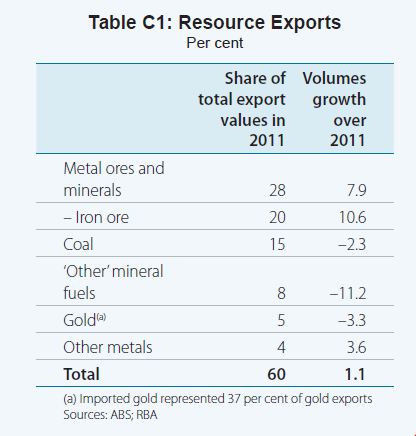
The RBA discusses Australia's resource exports. In relation to iron ore, the depth of Australia's dependence on China is revealed:
Iron ore is Australia’s most significant export, accounting for around 20 per cent of total export values in 2011. The primary destination of Australia’s iron ore exports is China, which accounted for around 70 per cent of iron ore export volumes in 2011, while Japan and Korea imported most of the remaining 30 per cent. Iron ore volumes grew by 10½ per cent over 2011, which is slightly slower than the average annual pace of growth over the past decade. In early 2011, iron ore export volume fell owing to production disruptions from a higher than average number of cyclones in the north of Western Australia. However, iron ore export volumes recovered strongly over the rest of the year to reach new highs, reflecting expansions in the capacity of mines and rail as well as some improvements in the utilisation of port facilities.


Saturday, October 2, 2010

Projections of Australia in 2050

.
Projections of the future are of course fraught. There is always the possibility that black swan or game-changing events will make projections based on current knowledge irrelevant. Think the Internet. It has changed all our lives in recent times in a way unimaginable in the 1980s. While a few futurists might have imagined such a system, its impact on our social and work lives has been truly transformational. Think also about the impact on public finances of retired workers living longer as health outcomes improved over the post-war period. In earlier times many retirees died much sooner in their retirement thus placing much less of a burden on public provision?

Issues of population ageing and health expenses are major concerns for all developed countries with extensive public pension and health systems. In Australia the shift to compulsory super and the development of the future fund will help future fiscal burdens but many policy-makers and commentators continue to worry about the costs of ageing.
For those of you wanting a snapshot of Australian policy thinking on the subject then the various Intergenerational Reports (IGRs) are important reading.

Recently Treasury Secretary Ken Henry gave a speech discussing the latest IGR from January 2010.

As Henry puts it:
Some important stats are worth considering:
[T]he IGR is an analytical tool, based on assumptions and projections. It does not forecast where we think we will be, or should be, in 40 years time. Rather, it takes current economic and demographic trends, and current government policies and policy settings, and projects forward the implications of a continuation of those trends, policies and settings. While many people focus on the ‘point’ projections contained in the report, and how they compare with previous IGR ‘point’ projections, it would be safer to focus on the broad path of the pressures outlined in the report.


We currently have a population of around 22 million people with about 13½ per cent of those (less than 3 million) aged 65 and older.
By 2050, the population is projected to grow to nearly 36 million people with nearly 23 per cent of the population (more than 8 million) aged 65 plus.

[T]here will be only 2.7 people of working age to support each Australian aged 65 years or over by 2050, compared with 5 working age people per aged person today, and 7.5 in 1970.
But …

this is just one way to think about dependency. For example, unpublished projections indicate that for every adult without employment — excluding fully self-funded retirees — there will be only 1.8 people in employment in 2049-50, a fall from 2 currently.
This is a modest deterioration when compared against the ratios presented in the IGR. However, regardless of how dependency is measured, an ageing population is expected to lead to a deterioration in dependency ratios, with adverse implications for economic growth.
Over the long term what matters for economic growth is as the IGR makes clear, the Three Ps population, participation and productivity.
As Henry points out the proportion of working age people (those aged 15 or more), average hours worked by people of working age, and average output per hour worked determines real GDP growth per capita.  

Henry talks about the transitions in "prime working age", but this may change over time. It's likely that people will work til later than 65 in the future - some like me who will do so because they will want to and others who will have to to maintain their lifestyles.

Overall, however, the IGR and Henry argue that the main driver of growth will be productivity.

The proportion of the population of working age has risen steadily over the past 40 years — from 71 per cent to 81 per cent — and is projected to rise even further over the next 40 years — to 83 per cent. But among those of working age, the proportion in the age bracket with the highest rates of labour force participation — that is, aged 15 to 64 — is set to fall substantially — from 83 per cent today to about 73 per cent in 2050.
As this proportion falls, average rates of labour force participation will also fall. Ignoring productivity growth rates for the moment, that fall in labour force participation drives a projection of slowing rates of growth in GDP per capita.
Even with strong population growth, GDP growth will also slow. Thus, we project average annual GDP growth of 2.7 per cent over the next 40 years compared with 3.3 per cent over the previous 40 years.
Real GDP per capita is projected to average 1.5 per cent growth over the next 40 years compared with 1.9 per cent over the past 40 years.

In aggregate, the impacts of population and participation will be largely offsetting, leaving productivity as the major driver of future growth in real GDP per person over the next 40 years.
Henry then considers the implications for government spending:

We are projecting that nominal government spending per capita will grow at a faster rate than nominal GDP per capita, so that over the next 40 years government spending will exceed revenue by about 2¾ per cent of GDP — excluding interest payable on additional public debt.
In other words action needs to be taken now according to this framework:

Fiscal sustainability is a key theme of IGRs. Near-term, budget settings can have a substantial influence on the projected path of public finances over even a long period of time. Thus, the 2010 IGR demonstrates that by returning the budget to surplus in 2012-13 and committing to maintain a 2 per cent annual cap on real spending growth for some years, the medium-term fiscal strategy will make a significant contribution to addressing longer-term fiscal challenges.
This is not to say that, in light of the medium-term fiscal strategy, an ageing population no longer presents a threat to fiscal sustainability. Rather, what it demonstrates is that adjustments made now can reduce the need for larger adjustments later.
Spending on health is likely to increase substantially from 4 per cent to 7.1 per cent in 2050. Pensions and aged care will also increase.
The IGR projects total spending to increase to 27.1 per cent of GDP in 2049-50, around 4¾ percentage points higher than its projected low point in 2015-16. In today’s terms, that’s the equivalent of adding around $60 billion a year to government spending. Around two-thirds of the projected increase in spending over the next 40 years is related to health; reflecting pressures from ageing, increasing community expectations and the funding of new technologies. Growth in spending on age-related pensions (Chart 2) and aged care is also significant, both as a proportion of GDP and in real spending per person.
Just to show how fraught projections are note the differences between the 2007 IGR and the 2010 version.
Growing and ageing populations will have a big impact on Australia and it is likely that increases in immigration will be necessary as will increased infrastructure spending and city planning. But let's not kid ourselves that we really have any idea what the future will hold. Remaining a flexible, dynamic and equitable country that avoids historical vulnerabilities of resource and debt dependence will help Australia to deal with any black swan events in the future.

Monday, June 7, 2010

Great video on the mining tax

Just think if the opponents of changes to better societies for more people had their way, we'd still have feudalism!!

This country is a successful, rich country because we've redistributed wealth gleaned from our natural resources across Australian society, rather than let a wealthy few nationals and foreigners commandeer them like in Nigeria etc.

http://www.youtube.com/watch?v=H4PcQfz0MfU

Wednesday, November 18, 2009

Growth in Asia and its Effect on Australia

Asia will be a long-term benefactor of Australian prosperity according to virtually all Australian economic policy-makers and commentators. Some like RBA governor Glenn Stevens and Treasury Secretary Ken Henry argue that there will be some problem associated with this ‘politics of prosperity’ but generally they do not consider it possible that either growth in Asia could slow or that demand for Australian resources could be negatively affected by increases in supply from elsewhere or technological changes. So-called ‘black swan’ events – war, terrorism, political unrest, environmental or natural catastrophe are not considered at all and I suppose that’s fair enough at one level. We can’t spend our entire lives preparing for the worst of all cases.

Probably the best coverage of the assumption that ‘Asian non-drama’ will be beneficial for Australia comes from Philip Lowe Assistant Governor (Economic) with the RBA. (See Philip Lowe (2009) “The Growth of Asia and Some Implications for Australia”, Talk to Citi Australia Inaugural Australian Investment Conference, Sydney, 19 October <http://www.rba.gov.au/Speeches/2009/sp-ag-191009.pdf>.)

Lowe begins by pointing out that Australia has done better than virtually any other developed country in the world, noting that Australia is the only country to not record a decline in exports. This good performance he argues was shaped by prescient monetary and fiscal policy, the “healthy state of the banking system” and “Australia’s trade links with Asia”.

His main concern he argues is with “medium-term structural issues”.

My central theme is that there are reasonable grounds for optimism about the prospects for the Australian economy over the decade ahead. There are a number of reasons for this, but the one that I would like to discuss today is our growing trade links with Asia.
Economic weight has shifted to Asia and because much of Asia is in a developmental mode it will require considerable resource development. When starting from a low base growth can be very rapid indeed.

Asia’s share of world GDP was only 7 per cent of GDP in 1990 (at market exchange rates, more if we use purchasing power parity – see my book Chapter 3 for explanation). This increased to around 15 per cent by 2008. Growth in East Asia has averaged 7 per cent a year during this period compared to 2 per cent for the developed world.

As far as industrial production goes Asia has done even better, especially China. In 1990 China’s share of industrial production was 2 per cent, in 2008 the figure was 13 per cent.

Lowe summarises the situation thus:

The general picture here is pretty clear: there has been very strong growth in Asia, with the economies of the region now accounting for a significant share of world output. And looking forward, there is a high probability that this will continue over the years ahead. As an illustration of the ongoing shift, recent growth projections from the IMF suggest that by 2014, the total amount of fixed asset investment in the developing world – much of which will occur in Asia – will be the same as that in the advanced economies (Graph 4). This would be a remarkable change from the situation just a decade ago when the level of investment in the developing world was only one third of that in the developed world. The change that is going on here reflects the subdued prospects for many of the advanced economies, the high pace of growth in Asia, and the current high rates of investment in many Asian countries.
Note that the assumption here is that what has happened over the past few years is expected to continue and the graph below is an estimate beyond 2008.


But the real issue here is the extent to which growth and investment in Asia is dependent on growth in the developed world. As Lowe notes demand in developed economies is likely to be weak over coming years because of the high level of indebtedness among households. (This is also true of Australia, where the debt to disposable income ratios is about 160 per cent. This is the highest ever by a long shot.). But it is not just households that are indebted, now because of the global recession governments are increasingly indebted as well. Lowe notes that: “net public-sector debt to GDP for the G7 countries is likely to exceed 90 per cent within a few years, an outcome that has not previously been seen outside of periods of war”. (See the previous post on public debt)


This takes us back to the debate about ‘decoupling’ that was seemingly won by the anti-decouplers during the financial crisis and the early stages of the global recession. Basically, the de-coupling thesis argued that Asia and Europe (but particularly China) would be less affected by events in the US economy and financial system. The anti-decouplers correctly pointed out that Asia was negatively affected by the greatest collapse of trade since the Great Depression. Indeed for a time, there seemed to be some suggestion that the export-led model was dead. European financial markets were devastated by the flow on effects of US developments (particularly the UK) and exporters like Germany were severely affected by the collapse of world trade as well. The de-couplers, however, now claim some vindication given China’s amazing growth performance built on the back of one of the biggest government stimulus packages of all time. As they say, the jury is still out. But the major question is what will happen when governments remove monetary and fiscal stimulus.

These are short-to-medium-term concerns, Lowe's main concerns are the medium-to-long-term implications of developments in Asia. He tries to navigate a middle-way in the de-coupling debate:

Slower growth in the advanced economies will inevitably weigh on growth in Asia. The business cycles of the major regions of the world are clearly interconnected, and the ups and downs in one part of the world have an effect in other parts of the world.

But importantly this is not the end of the story. These interconnections do not mean that Asia must inevitably experience a marked reduction in its medium-term growth trajectory. As we have seen recently, the region has the capability to grow strongly through domestic, not external, demand. This really should not come as a surprise.

After all, the US economy, with a few hundred million people, has grown for many decades largely on the back of domestic, rather than foreign, demand. There is no reason that the approximately 3½ billion people in Asia cannot do the same. It ultimately comes down to the policy choices that are made.
The last paragraph is a big call and consumption in Asia (China) is unlikely to match that of the West, particularly the United States, anytime soon. A chart presented by David Gruen from Treasury in a presentation entitled “Global Imbalances: How much adjustment will we see?” (at the In the Zone Conference at the University of Western Australia on 9 November 2009), shows why this is a problematic assumption.


US consumption accounts for about 18 per cent of global GDP, Chinese consumption is less than 3 per cent at market exchange rates.

Lowe acknowledges that there are long-term structural issues that need to be addressed in China and the rest of Asia for sustained increases in domestic demand to occur.


Here, there is a reasonably broad consensus as to the types of policy steps that could be made over the medium term, although the specifics clearly differ from country to country. One possibility is continuing liberalisation of the services sector, which has the potential to grow strongly in many countries in the region. Another is reform of retirement incomes policies to give people more confidence that they will have sufficient income in their old age. A third possibility is further development of the financial sector so that savings can be most efficiently allocated to those who can make best use of them.

These are all rather long-term structural issues but gradual progress on these fronts can help form the basis for sustainable growth in domestic demand over the medium term in many of the countries of the region. There is also considerable scope for high levels of infrastructure investment in many of these countries, and the process of technology convergence has much further to run. And many of the countries of Asia are devoting increasing resources to education to improve the average productivity of their workforces.
Lowe then turns to the impact on Australia and notes that our 4 biggest merchandise export markets (i.e. not including services exports such as education and travel services – the third and fifth biggest exports) are all in Asia. The graphic is particularly revealing about the rise of China’s share.


The shift towards Asia has undoubtedly been a benefit during the global recession. As Lowe acknowledges:
Despite global trade falling by nearly 20 per cent over the past year, the volume of Australian exports stayed broadly flat over this period. The strong recovery in China saw demand for raw materials rebound strongly, and Australian producers were able to respond quickly. A number of other commodity exporting countries whose major customers are in Europe and North America have, until very recently, had less favourable experiences.
Growth in Asia has helped commodity prices to stay high despite the worst global economic downturn since the Great Depression. Many commentators including myself thought that commodity prices would have collapsed further (and they still might) but the fact that they haven’t has been a bonus for Australia. Most commentators, including those in the mining sector itself, now believe that the boom will continue onwards and upwards, making a mockery of historical precedents for collapses in prices.

Lowe then turns to investment pointing out, as have Henry and Stevens in recent times, that Australia is a high investment country. In the past year, investment has reached 17 per cent of GDP – the highest on record. Almost a third of it has, not surprisingly, been in the resources sector. Australia’s growing capital stock during a global recession is a remarkable performance.

According to estimates based on ABS data, mining investment was the equivalent of almost 5 per cent of GDP over the past year, a record by a large margin. While we had booms in the mining sector in the late 1960s and the early 1980s, these look relatively small compared with the current one. Over the past couple of years, we have had particularly high rates of investment in both the iron ore and coal industries and this is now starting to show up in export volumes. For example, the volume of iron ore exports has risen by around a third over the past two years, as new mine and port capacity has come on stream, and further increases are likely.


Lowe argues that this high level of investment will continue, given the huge deals on LNG made recently for long-term supply contracts for China, Japan and India.
Such developments make the sort of shrill commentary from some business journalists that Australia needs to alter the discretionary elements of its foreign investment review process or suffer the consequences seem rather ridiculous. Australia should continue to review large-scale investments in its resource assets to make sure that they produce the greatest gain for the Australian people.

Australia’s prospects are undoubtedly better than virtually all other developed countries at the moment. But we still need to think about how to reduce our vulnerability to a downturn in commodities.

Friday, October 23, 2009

China and India at the End of the Rainbow

Two contributions to the long-tern economic policy debate in the last week are must reads for those interested in Australia’s political economy. The first contribution came from Treasury Secretary Ken Henry and the second from BHP Billiton Chairman Don Argus.

The first from Henry, The Shape of Things to Come: Long Run Forces Affecting the Australian Economy in Coming Decades provides a wide-ranging contribution on Australia’s future. Henry discusses (1) population ageing; (2) climate change adaptation and the prospect of climate change mitigation; (3) the information and communications technology revolution; and (4) the impact on Australia's terms-of-trade of the re-emergence, as global economic powers, of China and India.

No one could accuse our key economic policy figures Henry, Stevens, Rudd and Swan of not being big thinkers (and with the exception of Swan all have a fairly high opinion of their own brilliance).

Henry’s mid-week comment to a Senate estimates hearing received many headlines.

It now appears the impact of the global financial crisis on the Chinese economy and the Indian economy hasn't been nearly as large as many feared … It seems that's likely to support relatively high commodity prices, that is prices for Australian export commodities, for a considerable period of time, quite possibly for some decades.
The second from Argus mulled over China’s foreign investment in Australia. Like many people Argus is worried about the Chinese state’s ownership of what he calls our “endowment assets”. I’ve tried to find a transcript but there’s not one available yet although audio is available. Barry Fitzgerald and Mathew Murphy report on the speech in The Age

“Mr Argus suggested at the Melbourne Mining Club luncheon that one response from the Federal Government could be to allow foreigners to acquire ''green fields'' or early stage resource projects, but only on the basis that half of the project is floated off to Australian investors, say, 15 years later.
Mr Argus has long raised concerns about the lack of policy on the ability of state-owned enterprises and sovereign wealth funds to buy up the resource endowment of a host nation without there being reciprocal investment rights. His 50 per cent, 15-year suggestion is his ''lateral'' response.
''We can't get complacent from a competitive point of view because we have had a good run with China,'' Mr Argus said. ''China is now going out and branching out to try and lock in resources themselves.'' He emphasised that he was not anti-Chinese investment or anti-foreign investment ''because Australia does need foreign investment''.
But he does not want Australia to end up like Canada, where foreigners have replaced local owners of the resources industry. ''Canadian investors certainly don't have the same holdings in their endowment assets that they might have had 10 years ago,'' he said.
As far as I know the Australian mining industry is already majority foreign owned, but it’s likely, as Argus suggests, to get even more so in the future without a strategic approach from Australia’s policy-makers.

Ultimately, what matters is that the benefits of Australia’s resources go to their owners – the Australian people, with obviously suitable compensation for those risking their capital and using their endeavour. Australians should be wary about the need to always act quickly to ensure continuing investment. I for one think the Foreign Investment Review Board provides for necessary review of important investment issues for Australia’s future. Let’s not forget that China does not believe in open slather in its own industries, particularly in its mining sector. The argument that Chian will be offended by a strategic approach is laughable. Indeed, anything but a strategic, discriminating approach is likely to invoke derision amongst Chinese authorities.

The thing that interests me most in both posts, however, is the unflinching assumption that China’s growth will necessarily continue onwards and upwards, seemingly without any faltering at all. Over the medium term, there is indeed much to be confident about. China and India have huge growth potential and both, while having grown significantly in recent years are still poor countries (their GDP per capitas are very low).

The major issue is whether commodity prices will stay high or whether they will revert to the long-term trend decline that has been going on for the last 150 years. (For weights see The Economist and here)


It’s possible that China and India’s rise will reverse this trend for the foreseeable future. But even if Asia continues to expand without major reversals or periods of stagnation, it’s likely that resource prices will decline as their supply increases. And it’s possible that technological change will undermine demand as happened to Australian’s pre-eminent export until the 1950s – wool. One only has to think about the impact of the Internet and mobile phones to realise how technology came change the game very quickly indeed. Mobiles in particular have changed communication in countries without the old telephone infrastructure in ways that was impossible to imagine even a few years ago.

There is also the problem of climate change that may make even more urgent the need to find replacement technolgies for resource intensive development.

For some more coverage on Henry's optimism in comparison to the pessimism of Ross Garnaut see Tim Colebatch "Balance of Power".