Showing posts with label Coal. Show all posts
Friday, November 20, 2015
Wednesday, September 17, 2014
China's Proposed Import Bans on Thermal Coal: Not the Real Problem Facing Australia
The Chinese government has announced that it is going to limit certain coal imports from next year. The Sydney Morning Herald reports:
However, others are less concerned by the changes arguing that the impact on other coal exporters will be even greater.
According to the Department of Foreign Affairs and Trade's Composition of Trade, in 2013, China was Australia’s largest export market, accounting for 31.9 per cent ($101.6 billion) of total exports of goods and services (an increase of 28.2 per cent on 2012); Japan was Australia’s second largest export market ($49.5 billion); the Republic of Korea was third largest market ($21.3 billion).
Coal is Australia's second biggest export, behind iron ore and in front of education related travel services.
According to another DFAT publication, from 2001 to 2011, "the value of coal exports rose from $12.5 billion in 2001 to $46.8 billion in 2011, a rise of almost 300 per cent."
Traditionally our biggest market for coal has been Japan, with China a much less significant market until recently. Between 2001 and 2011 Coal exports increased their share of exports to China but were still dwarfed by iron ore exports.
Since 2011, Chinese coal exports have more than doubled from $4.5 billion to $9.1 billion in 2013.
The point to note here is that China has traditionally mined a lot of coal itself, but in recent years Chinese production has been in decline with significant producers struggling. An integral component of the restrictions, therefore, will be to encourage more Chinese coal production.
The most important point to note, however, is that there are two major forms of coal exports – thermal and metallurgical. Thermal coal is used mainly for electricity generation, whilst metallurgical coal is used in steel manufacture.
Metallurgical coal exports in 2012-13 were $22.4 billion and thermal coal exports were $16.2 billion. It is thermal coal exports that could be affected by China's bans.
The above graphs clearly show the rise in both metallurgical and thermal coal exports to China since the early 2000s, but China remains a significantly less important market than Japan for both.
A problem with the focus on the potential damage to Australian thermal coal exports from the Chinese bans is that it may miss the real problem for Australian exports over coming years. The coal sector in Australia has been in trouble for quite some time, with coal miners slashing their work forces in recent times.
One of the major vulnerabilities for Australia moving forward is the increase in the share of unprocessed raw materials exports, which have substantially increased their share of total exports since 2008 and even more so since the late 1990s.
The real danger for Australian coal exports would be similar restrictions on exports of thermal coal to Japan and South Korea. Let's face it if you want to do something about climate change and levels of pollution then restricting the growth of coal burning will be essential.
Despite the moves by the Chinese authorities, coal remains the second most important source of energy. Renewables have been growing rapidly in recent years, but their share is still depressingly low.
While coal consumption is declining in Europe and North America it is increasing markedly in the Asia-Pacific.
Thermal coal burning is going to continue for quite some time yet and the Chinese restrictions will have considerably less impact than the growth slowdown in China and the decline in house building and infrastructure development.
China must lessen its investment share of GDP to rebalance its economy. It could do this in an orderly way over the next few years or it could resist the need to rebalance and face an eventual catastrophic rebalancing later in the decade. In other words, rebalancing away from investment towards consumption will occur, it just depends on when and how. Australia will be negatively affected either way.
What this means is that the decline in iron ore prices and export volumes will be way more important than a ban on thermal coal exports. Those concerned about this issue should be more worried by the general decline in commodity prices.
But it's not all gloom and doom for thermal coal. Given the Abbott government's hostility to developing solutions to climate change and to the advancement of the renewable energy sector, it's possible that coal miners may be able to expand their 75 per cent share of electricity production in Australia.
The Chinese government is to limit the use of imported coal with more than 16 per cent ash and 3 per cent sulphur from January 1, 2015 in a bid to improve air quality, especially in cities such as Beijing and around Shanghai.According to one analyst: ''[Australian coal exports are] typically around 5500 kilocalories and 24-25 per cent ash. So we've got big problems.''
However, others are less concerned by the changes arguing that the impact on other coal exporters will be even greater.
The restrictions applied vary in stringency depending on geography ... The least stringent [restrictions] apply across the entire country and would not affect a single major Australian thermal coal exporter, all of whom would comfortably comply. However it is the most stringent which apply to the major economic zones of Beijing, Hubei, Tianjin, the Yangtze River Delta and the Pearl River Delta which are of the greatest relevance. These areas are on or close to the coast and therefore are the most prospective for Australian seaborne exported coal ... only 10% of Australian coal exports go to China, and the highly restricted region represents 42% of Chinese thermal coal imports further softening the blow. This means the amount of production likely to be affected is low.What is clear is that we need some context to assess the impact of China's proposed restrictions and any potential damage to the Australian economy.
According to the Department of Foreign Affairs and Trade's Composition of Trade, in 2013, China was Australia’s largest export market, accounting for 31.9 per cent ($101.6 billion) of total exports of goods and services (an increase of 28.2 per cent on 2012); Japan was Australia’s second largest export market ($49.5 billion); the Republic of Korea was third largest market ($21.3 billion).
Major goods and services export markets
According to another DFAT publication, from 2001 to 2011, "the value of coal exports rose from $12.5 billion in 2001 to $46.8 billion in 2011, a rise of almost 300 per cent."
Traditionally our biggest market for coal has been Japan, with China a much less significant market until recently. Between 2001 and 2011 Coal exports increased their share of exports to China but were still dwarfed by iron ore exports.
Since 2011, Chinese coal exports have more than doubled from $4.5 billion to $9.1 billion in 2013.
Australian Coal Exports 2013
The most important point to note, however, is that there are two major forms of coal exports – thermal and metallurgical. Thermal coal is used mainly for electricity generation, whilst metallurgical coal is used in steel manufacture.
Metallurgical coal exports in 2012-13 were $22.4 billion and thermal coal exports were $16.2 billion. It is thermal coal exports that could be affected by China's bans.
Principal markets for resources and energy exports
in 2012–13 dollars
Source: BREE
The above graphs clearly show the rise in both metallurgical and thermal coal exports to China since the early 2000s, but China remains a significantly less important market than Japan for both.
A problem with the focus on the potential damage to Australian thermal coal exports from the Chinese bans is that it may miss the real problem for Australian exports over coming years. The coal sector in Australia has been in trouble for quite some time, with coal miners slashing their work forces in recent times.
One of the major vulnerabilities for Australia moving forward is the increase in the share of unprocessed raw materials exports, which have substantially increased their share of total exports since 2008 and even more so since the late 1990s.
The real danger for Australian coal exports would be similar restrictions on exports of thermal coal to Japan and South Korea. Let's face it if you want to do something about climate change and levels of pollution then restricting the growth of coal burning will be essential.
Despite the moves by the Chinese authorities, coal remains the second most important source of energy. Renewables have been growing rapidly in recent years, but their share is still depressingly low.
While coal consumption is declining in Europe and North America it is increasing markedly in the Asia-Pacific.
Source: Vox
Thermal coal burning is going to continue for quite some time yet and the Chinese restrictions will have considerably less impact than the growth slowdown in China and the decline in house building and infrastructure development.
China must lessen its investment share of GDP to rebalance its economy. It could do this in an orderly way over the next few years or it could resist the need to rebalance and face an eventual catastrophic rebalancing later in the decade. In other words, rebalancing away from investment towards consumption will occur, it just depends on when and how. Australia will be negatively affected either way.
What this means is that the decline in iron ore prices and export volumes will be way more important than a ban on thermal coal exports. Those concerned about this issue should be more worried by the general decline in commodity prices.
But it's not all gloom and doom for thermal coal. Given the Abbott government's hostility to developing solutions to climate change and to the advancement of the renewable energy sector, it's possible that coal miners may be able to expand their 75 per cent share of electricity production in Australia.
Tuesday, November 12, 2013
Recent Charts on Globalisation, Asia and Australia
Australia's dependence on China (from Australia's economic blog and general source of news MacroBusiness). Not only is Australia's dependence on China a worry but Australia's dependence on iron ore.
Coal consumption in China on the rise, which puts its renewable energy efforts into perspective.
Industrial production is stalling in developing countries, but it has clearly outperformed production in the developed world since 2007.
Coal consumption in China on the rise, which puts its renewable energy efforts into perspective.
Industrial production is stalling in developing countries, but it has clearly outperformed production in the developed world since 2007.
Friday, November 8, 2013
Electricity Generation in the Australian States: More Coal not Less
These charts put the shifts towards renewables in perspective.
Coal usage is up across Australia, particularly in Western Australia. Wind is up but still relatively minor as a percentage of the total and other renewables including solar are also still relatively insignificant.
Renewables
From http://reneweconomy.com.au/2013/graph-day-colour-coded-chart-australias-generation-22672
Friday, February 1, 2013
China is King of Coal
China is doing well in the production of renewable energy, but it's not doing well enough to make a serious dent in its pollution problems. (click each word for some seriously scary pollution photos).
One of the problems is the growing consumption of coal to fuel its massive manufacturing sector and its incredible infrastructure development.
As the chart below shows, the growth in Chinese coal consumption and its increasing percentage of total global consumption is more than making up for reductions in coal use elsewhere, especially in the developed world.
As the US Energy Information Administration points out:
The huge increase in global gas supply in recent years, which will grow even further in coming years, may eventually make a difference, but don't count on it happening soon. Without wishing to downplay the importance of renewables, they also are not going to make much difference in Asia for some years yet.
US gas exports are restricted and the US domestic gas glut is providing a fillip to US manufacturing, which suddenly appears more competitive than it has for many a year.
The EIA provides some basic facts on Chinese energy production and consumption.
Slowing growth in 2012, plus lower energy intensity should see some declines in this rapid growth in coming years, but of course this will have a negative effect on Australian exports. China's pollution problem, it seems has been beneficial for Australia (at least in the short term!).
In the meantime, not to worry, you can always buy a can of fresh air or look at a screen of a beautiful blue sky with fluffy white clouds!
One of the problems is the growing consumption of coal to fuel its massive manufacturing sector and its incredible infrastructure development.
As the chart below shows, the growth in Chinese coal consumption and its increasing percentage of total global consumption is more than making up for reductions in coal use elsewhere, especially in the developed world.
As the US Energy Information Administration points out:
Coal consumption in China grew more than 9% in 2011, continuing its upward trend for the 12th consecutive year, according to newly released international data. China's coal use grew by 325 million tons in 2011, accounting for 87% of the 374 million ton global increase in coal use. Of the 2.9 billion tons of global coal demand growth since 2000, China accounted for 2.3 billion tons (82%). China now accounts for 47% of global coal consumption—almost as much as the entire rest of the world combined.
Robust coal demand growth in China is the result of a more than 200% increase in Chinese electric generation since 2000, fueled primarily by coal. China's coal demand growth averaged 9% per year from 2000 to 2010, more than double the global growth rate of 4% and significantly higher than global growth excluding China, which averaged only 1%.As these graphics show (you'll need to go here for the animations!) Asian coal consumption dwarfs the consumption of the rest of the world and Chinese consumption dwarfs that of the rest of Asia. Only Europe and the former Soviet states have reduced their consumption of coal.
The huge increase in global gas supply in recent years, which will grow even further in coming years, may eventually make a difference, but don't count on it happening soon. Without wishing to downplay the importance of renewables, they also are not going to make much difference in Asia for some years yet.
US gas exports are restricted and the US domestic gas glut is providing a fillip to US manufacturing, which suddenly appears more competitive than it has for many a year.
The EIA provides some basic facts on Chinese energy production and consumption.
Chinese demand for energy is driven by its continually expanding economy.Electricity
- China had the most installed generating capacity in the world in 2011, at 1,073 gigawatts, slightly higher than the United States.
- About 80% of China's electricity generation came from conventional thermal sources, primarily coal, in 2011.
- Both China's electric generating capacity and its electricity generation doubled between 2005 and 2011.
Coal
- China was the largest producer and consumer of coal in the world in 2011, and accounted for almost half the world's coal consumption.
- China became a net coal importer in 2009 for the first time in over 20 years.
- China has the third-largest coal reserves in the world.
Oil
- China was the world's second-largest consumer of oil and liquids in 2011, as well as second-largest oil importer (trailing the United States in both categories).
- China's total oil consumption is slated to continue increasing; EIA forecasts that growth in China's demand for oil will represent 64% of projected world oil demand growth during 2011-2013.
Natural gas
- China was the fourth-largest global consumer of natural gas in 2011.
- Use and production of natural gas in China is rapidly increasing; natural gas production more than tripled over the last decade.
- Consumption of natural gas in 2011 was nearly 50% higher than in 2009.
Nuclear
- Nuclear power made up only 2% of total electricity generation in 2010. As of mid-2012, China had 15 operating reactors, with a total capacity of nearly 13 gigawatts, and 26 new reactors under construction, with a capacity of about 29 gigawatts.
Renewables
- While renewables made up a small fraction of the country's total electricity generation, China was the world's leading producer of hydroelectric power in 2010, and the second-largest producer of electricity from wind power.
Slowing growth in 2012, plus lower energy intensity should see some declines in this rapid growth in coming years, but of course this will have a negative effect on Australian exports. China's pollution problem, it seems has been beneficial for Australia (at least in the short term!).
In the meantime, not to worry, you can always buy a can of fresh air or look at a screen of a beautiful blue sky with fluffy white clouds!
Wednesday, December 12, 2012
Coal is King: Electricity Generation Predictions in Australia out to 2037
From the The Australian Energy Market Operator's 2012 NATIONAL TRANSMISSION NETWORK DEVELOPMENT PLAN for the National Electricity Market.
Predictions for energy generation by technology make interesting reading for those who think that the growth of renewables and a shift away from coal is inevitable in the near-ish future. Certainly the bureaucrats don't think so!!
Right now there is an important debate going on about whether a level of gas supply should be quarantined for exports as most countries in the world do. FWIW I think some surety of gas supply for domestic purposes would be good policy even if gas producers think it's a restriction on the 'free' market.
Predictions for energy generation by technology make interesting reading for those who think that the growth of renewables and a shift away from coal is inevitable in the near-ish future. Certainly the bureaucrats don't think so!!
Key findings from the 2012 NTNDP modelling for generation investment involve the following:The orange and yellow bits are coal. Wind grows significantly over the next few years in line with renewable targets but then stagnates. These are just estimates but the surprising thing for many people would be the negligible role for solar and the relatively insignificant role for gas.
• Eastern and South Eastern Australia will still rely on coal-fired generation during the outlook period, and new generation investment until 2020 (particularly wind generation) will primarily be driven by the Large-scale Renewable Energy Target (LRET).
• The carbon price, new renewable generation resulting from the LRET, a changing fuel mix and lower energy growth will change the operation and output of different types of electricity generation.
• Least-cost modelling, assuming Treasury’s core carbon price projections, retires or mothballs 4,300 MW of brown and black coal-fired generation, which constitutes 16% of the current coal-fired installed capacity, over the outlook period, with the remaining coal-fired generation maintaining its competitiveness.
• There is less need for combined cycle gas turbine (CCGT) generation, which requires a higher carbon price or lower gas fuel prices than modelled to compete with coal. There is a need for additional generation to meet peak demand, however, and this will largely be met by open
cycle gas turbine (OCGT) generation, which provides reliable generation reserves in an environment of significant levels of intermittent generation (such as wind) and reduced coal-fired generation.
• Greenhouse gas emissions from electricity generation in Eastern Australia will largely persist at current levels, before decreasing at the end of the outlook period.
Right now there is an important debate going on about whether a level of gas supply should be quarantined for exports as most countries in the world do. FWIW I think some surety of gas supply for domestic purposes would be good policy even if gas producers think it's a restriction on the 'free' market.
Friday, May 4, 2012
Some More Figures on Commodity Prices
In its May 2012 Statement on Monetary Policy, the RBA included this graph on the price declines of individual commodities.
The analysis of recent developments is less gloomy, although the year-on-year declines are considerable.
What happens to prices will largely depend on Chinese demand and the prognosis on that is generally not a confident one by most commentators.
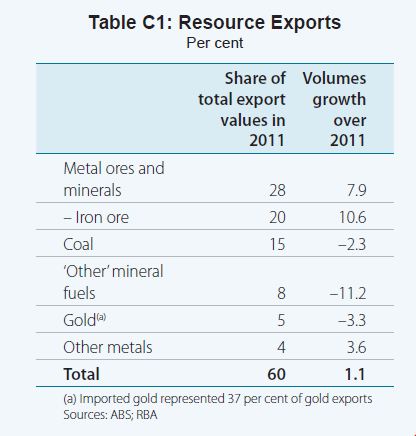
The RBA discusses Australia's resource exports. In relation to iron ore, the depth of Australia's dependence on China is revealed:
The analysis of recent developments is less gloomy, although the year-on-year declines are considerable.
The [commodity price] index remains at a historically high level, but is around 9 per cent lower than its peak in mid 2011. In general, commodity prices have been supported by the gradual pick-up in global economic activity since the start of the year, though increases in some prices have been partially retraced over April. Spot prices for iron ore and base metals have all increased, while spot prices for both thermal and coking coal have declined in recent months, largely reflecting increased supply. Australia’s terms of trade are estimated to have declined further in the March quarter, as average export prices for bulk commodities continue to decline gradually from their September 2011 peak.
What happens to prices will largely depend on Chinese demand and the prognosis on that is generally not a confident one by most commentators.
The RBA discusses Australia's resource exports. In relation to iron ore, the depth of Australia's dependence on China is revealed:
Iron ore is Australia’s most significant export, accounting for around 20 per cent of total export values in 2011. The primary destination of Australia’s iron ore exports is China, which accounted for around 70 per cent of iron ore export volumes in 2011, while Japan and Korea imported most of the remaining 30 per cent. Iron ore volumes grew by 10½ per cent over 2011, which is slightly slower than the average annual pace of growth over the past decade. In early 2011, iron ore export volume fell owing to production disruptions from a higher than average number of cyclones in the north of Western Australia. However, iron ore export volumes recovered strongly over the rest of the year to reach new highs, reflecting expansions in the capacity of mines and rail as well as some improvements in the utilisation of port facilities.
Tuesday, October 13, 2009
Industrial Overcapacity in China
One of the other potential problems for the Chinese economy is industrial overcapacity. There are a lot of resources beign stockpiled in China at the moment and while this has led to the maintenance of demand for Austrlain resources, eventually the have to be used up through either domestic or international demand.
Adjusting to this overcapacity is now apparently an important goal of the Chinese govt.
According to a Reuters' report in the NYT:
All of this will have significant implications for the Australian coal sector.
Another major economic figure bearish about the short-term prospects for China and Asia is Stephen Roach. (But like me optimistic about the medium to longer-term).
His most recent book is reviewed in the Financial Times by David Pilling:
Adjusting to this overcapacity is now apparently an important goal of the Chinese govt.
According to a Reuters' report in the NYT:
China's cabinet has laid out detailed plans to curb overcapacity in industries such as steel, aluminium, cement and wind power, warning that the country's economic recovery could otherwise be hampered.Part of the reason for the continuing expansion is of course another state directive for the banking sector to increase lending to stimulate the economy.
In a reiteration of existing policy targets, the State Council said meeting the government's long-standing goal of reducing overcapacity was urgent because the result of inaction would be factory closures, job losses and rising bad bank loans.
"What especially requires our attention is that it is not only traditional industries such as steel and cement that suffer from productive overcapacity and are still blindly expanding," it said in a notice posted late on Tuesday on www.gov.cn.
All of this will have significant implications for the Australian coal sector.
"There is 58 million tonnes of crude steel capacity under construction, most of which is illegitimate. Crude steel capacity could exceed 700 million tonnes and overcapacity will intensify if curbs are not implemented in time," it said.The cabinet said it would no longer approve or support any new steel projects or any expansion in existing projects.Analysts said the immediate casualty of the clamp-down could be Australia's coking coal sector, whereby exports to China have surged more than 10-fold from a year ago to reach 14 million tonnes in the first eight months of this year."
The policy would support our view that the surge in China's coal imports over the past few months will be short-lived. From an Australian perspective, we could be seeing some degree of a pullback over the coming months," said Clyde Henderson, a coal analyst at Wood Mackenzie consultancy in Sydney.Overall analysts argue that demand elsewhere will pick up compensating for declining Chinese demand.
"But still, many other steelmakers elsewhere are now looking to restart their capacity, so that will compensate for softer demand in China."Despite the climate change problems of coal, it's likely to be important for a long time yet.
Another major economic figure bearish about the short-term prospects for China and Asia is Stephen Roach. (But like me optimistic about the medium to longer-term).
His most recent book is reviewed in the Financial Times by David Pilling:
In The Next Asia, a collection of essays on the region’s place in the world, Roach could not fairly be described as bearish. “Don’t get me wrong,” he says at one point in a typically down-to-earth interjection. “I am a long-standing optimist on Asia.”For those students in 1003IBA this latter point relates to those global imbalances I'm so keen for you to understand!!
But he does challenge, and in forthright terms, any notion that the world can go back to business as usual. If Asia, particularly China, thinks that it can simply wait for the west to recover before merrily recommencing its export-dependent growth strategy, it is kidding itself, he argues. Only if it can rebalance its economy towards greater domestic consumption will it fulfil its enormous promise. “It may be premature to crack open the champagne. The Asian century is hardly as preordained as most seem to believe.”
So far, Roach has been disappointed by the Asian, particularly the Chinese, response. In the section on Chinese rebalancing, he concludes: “There are worrisome signs that China just doesn’t get it, that it is clinging to antiquated policy and economic growth strategies that presuppose a classic snapback in global demand.” He cites as evidence the make-up of the $585bn two-year stimulus package that, he says, is biased towards old-fashioned infrastructure projects and too light on pro-consumption measures such as bolstering national health insurance, the absence of which encourages people to make precautionary savings.
He welcomes China’s willingness to engage more actively in debate about the global financial system. But for Roach, Beijing’s emphasis on the US deficit and on seeking alternatives, such as special drawing rights, to the dollar as a reserve currency betrays a complacency towards its own problems. China’s massive holdings of US Treasuries, he contends, are the flip side of America’s: they reveal a dependence on exports and the need to recycle foreign currency reserves abroad for fear of putting upward pressure on the renminbi.
Thursday, September 24, 2009
Whither Coal?
Future demand for coal and iron ore will be very significant for the Australian economy.
What will happen to Chinese demand over the next few months, the next year?
My suspicion is that the rebuild in inventories and stockpiling will lead to a sustained decline in demand if final demand from the US and Europe does not pick up.
Nevertheless there is still considerable scope for the Chinese to build infrastructure.
See Back In The Black by Kishori Krishnan 23 September 2009
http://www.ibtimes.com/articles/20090923/back-black.htm
What will happen to Chinese demand over the next few months, the next year?
My suspicion is that the rebuild in inventories and stockpiling will lead to a sustained decline in demand if final demand from the US and Europe does not pick up.
Nevertheless there is still considerable scope for the Chinese to build infrastructure.
See Back In The Black by Kishori Krishnan 23 September 2009
http://www.ibtimes.com/articles/20090923/back-black.htm
In China though, no one expected the financial crisis to be the end of Chinese steel demand, and the Chinese government, as well as many private producers, have used the low international commodities prices as an opportunity to restock after years of high costs.
"Many domestic producers have arbitraged the low offshore prices [with higher onshore prices]," says Ben Simpfendorfer, head China economist at Royal Bank of Scotland. "This has made demand look stronger than it was in China," he added, warning that he expects a correction in the next one or two months, both due to the end of restocking, and to the regular slowdown in commodities demand that comes every summer.
Subscribe to:
Posts (Atom)