Showing posts with label currency reserves. Show all posts

Tuesday, May 14, 2013

The US-China Economic Relationship in Pictures

This from the US-China Business Council ... Well worth a read to break down a few myths about US-China relations.

Firstly, US exports to China have grown  at a far greater rate than US exports to the rest of the world.


 The next biggest growth market is Brazil, which has grown at 180% compared to 542%.


Not surprisingly Canada is a far more important export market for the US, followed by Mexico. See geography does still matter, despite the guff written about the "end of geography" in the 1980s. 


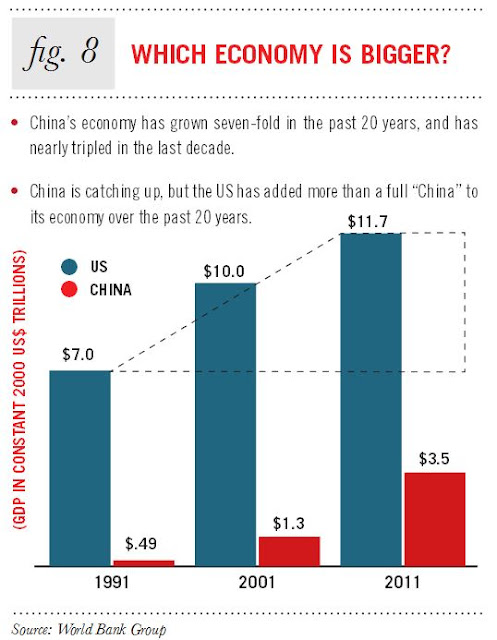
To prove its point about the continuing domination of the US economy, the authors use the USD exchange rate measure of economic weight. As I argue in How Big, How Rich and How Developed? The State of Play in the World Economy:
How we measure economies matters. To get a clearer picture of the world economy we need to look not only at size, but wealth, development and distribution. But even when measuring the size and wealth of economies, the method of measurement we choose will have a big impact on the outcome. ...
There are two ways to measure the size of economies. Firstly, we can convert the value of a country's gross domestic product (GDP) into US dollars and compare it to the GDP of other countries whose currencies have been converted into US Dollars also.  ... When exchange rates do vary considerably over time, such as the dollar–yen exchange rate after the 1970s, this method may cause distorted measures of size. ...
Such discrepancies have led to the increased use of an alternative method of measuring the size of economies based on the concept of purchasing power parity (PPP). Statisticians measure purchasing power within individual economies and then make comparisons on that basis. PPP measures GDP adjusted to reflect different costs of living and production within different economies. As most travellers know, goods and services and production costs are considerably lower in some countries than they are in others.


One should be very cautious about this projection, which seems to animate Australian policy-makers as well. It could turn out to be true, but before 2020 China is likely to suffer a big slowdown in growth, which might make these "middle class" growth projections come unstuck.


This is the one that would surprise most people. Although value-added measured via purchasing power parity would show a significantly different result I would think. Other analysts argue that the Chinese manufacturing sector surpassed the US manufacturing sector in terms of value-added late last decade. Remember too that value-added is just one way to measure the size of the sector (although it is perhaps the most important measure). China does a good deal of assembling still, but as wages increase these assembling operations will increasingly shift to elsewhere in Asia and perhaps Latin America.


Given the still very large US manufacturing sector it is not surprising that US companies' manufacturing assets are located mainly in the US itself.


Chinese foreign direct investment (non-bond investment) in the US has grown rapidly in recent years, but to put the level of Chinese FDI in the US into context, it is roughly the same as Chinese FDI in Australia.

As The Heritage Foundation reports: "The leading recipients of Chinese non-bond investment since 2005 have been Australia and the U.S. Other major recipients are Canada, Brazil, Britain, and Indonesia. In 2012 alone, Canada topped the list, thanks to the Chinese CNOOC's $15.1 billion acquisition of Nexen, the largest outbound investment to date. The U.S. was second: After a weak 2011, Chinese investment here shattered the old annual record with over $14 billion spent (including a $4.2 billion acquisition late in the year). North America drew a full 40 percent of Chinese non-bond investment in 2012."


Perhaps the most controversial and widely misunderstood aspect of the US-China economic relationship is the issue of Chinese purchases of US Treasury securities, with many commentators arguing that it represents a Chinese advantage over the US.  As Hillary Clinton said: "How do you deal toughly with your banker?"  Fortunately for the US, this 'problem' is overblown. Indeed, reduced Chinese purchases of US Treasury securities would be good, rather than bad, for the US. As the graphic makes clear most Treasuries are held by Americans anyway. For an explanation of China's Reserves see here and here


Thursday, March 29, 2012

China's Foreign Reserves: What they Mean and How they Can be Used

China's Foreign Reserves are huge. Indeed they are among the largest foreign reserves in the history of the world.

Historically two other countries held huge foreign exchange reserves - the United States in the 1920s and Japan in the 1980s. Neither of those experiences ended well. 

Many commentators see these huge reserves as a marker of growing Chinese power and consequently, of American weakness given that a good deal of those reserves are invested in US dollar assets. I've also seen it written that China should use these reserves to spend within China instead of buying foreign currencies. The problem with this view is that they can't be used domestically. The best explanation on this topic comes once again from Michael Pettis.

In a post entitled "What the PBoC Cannot Do with its Reserves", Pettis starts by explaining how the Peoples Bank of China (PBoC - China's Reserve bank) goes about keeping the renminbi (RMB) (the yuan if you prefer - see here for explanation) at a lower level.
as long as China ran the largest current account surplus ever recorded as a share of global GDP, and the US the largest current account deficit ever recorded, and especially since China also ran an additional capital account surplus (i.e. other non-PBoC agents ran a net capital inflow), it was almost impossible for the PBoC to do anything but buy US dollar assets.  Given the sheer amounts, a substantial portion of these assets had inevitably to be USG bonds.
This was not a discretionary lending decision. It is the automatic consequence of China’s currency regime, in which it pegs the RMB to a foreign currency, in this case the dollar. Why?  Because when the PBoC decides on the level of the RMB against the dollar, it does not do so by passing a law, and making it a capital crime for anyone to trade at a different price.  What it does is far simpler. It offers to buy or sell unlimited amounts of RMB against the dollar at the desired price.
No one will sell dollars for less than what they can get from the PBoC, nor will anyone buy dollars for more than what they can pay the PBoC, so all transactions get done at that price.  That is how the PBoC (or any other central bank that intervenes in the currency market) sets the foreign exchange value of its own currency. 
Now the reason the PBoC must buy dollars under the regime is because the rest of China is a net buyer of dollars. Remember China runs a current account surplus, which must be matched by a net capital outflow. 
This means that as long as it wants to set the exchange rate, then, it must take the opposite position of the market. Since the rest of the market is a net seller of dollars (China runs a current and capital account surplus), the PBoC has no choice but to be a net buyer of dollars, which of course it must then invest. 
If it stops buying dollars, it must let the market decide by itself on the new equilibrium price of the dollar. In that case the value of the dollar has to plunge in RMB terms (or the RMB soar, which is the same thing) in order for buyers and sellers to match up and for the market to clear.  The moment the PBoC stops buying, in other words, the RMB will rise in value – and so it cannot stop buying in anticipation of the RMB rising in value.
The next issue is how the PBoC funds these purchases of dollars.
It does so primarily by borrowing in the domestic money markets, selling PBoC bills or entering into short term repos (although it also issues some longer-term bonds), or by “creating” money by crediting the accounts of the commercial banks who sell it the dollars. 
This means, to simplify, that the PBoC has a balance sheet consisting on one side of dollar assets (and here “dollar” is short-hand for all foreign assets). Against this and on the other side it has a roughly equivalent amount of RMB liabilities (I say “roughly” because when you run a mismatched balance sheet, changes in the relative value of assets and liabilities will create losses or profits). 
Here is where things get interesting. China’s reserves are often thought of as if they were a treasure trove available for spending.  They are not.  They are simply the asset side of the mismatched balance sheet. If the PBoC wanted to “spend” $100, say for example to recapitalize a bank, it could do so, but this would automatically create a $100 dollar hole in its balance sheet. – it would still owe the RMB that it borrowed originally to purchase the $100.  To put it another way, the reserves are not a savings account, free for the PBoC to spend as it likes.  Reserves are effectively borrowed money.
...
So what are reserves good for? As long as China maintains its own currency and denominates all domestic transactions in RMB, the PBoC reserves cannot be used in China. They cannot go to pay doctors’ salaries, to build bridges, to lower taxes or to subsidize consumption. They can only be used to purchase or pay for things from outside China. This means that reserves ensure that China can import foreign commodities and other goods as long as it can pay for them domestically. It also means that the PBoC can ensure the availability of dollars to repay foreign debt and foreign investment. 
...
Reserves are useless in preventing domestic debt crises (not totally, because they affect the credibility of the currency, but the RMB today doesn’t seem to suffer from a lack of credibility).
Pettis then goes on to explain why a revaluation of the Renminbi against the dollar does not cause the simple scenario of huge losses for China and huge gains for the United States that most commentators allude to when they discuss the so-called economic balance of terror between the United States and China. There are still winners and losers, but the equations are more complex than most assume.
Many people in China and abroad have argued that China cannot afford to raise the value of the RMB against the dollar because it would mean that China will take huge losses because of its massive reserves. After all, if the RMB rises by 10% against the dollar, the value of its reserves will have necessarily declined by $250 billion in RMB terms. 
This is almost completely wrong – China will not take losses anywhere close to that amount and may probably even take a gain if it revalues the currency. One foreign economist even published a rather loony piece three months ago, which excoriated the Obama administration’s “bogus” trade argument for revaluation as done purely for nefarious and no doubt imperialistic reasons – and to strengthen the conspiratorial air it somehow ignored the fact that nearly every country in Europe and Asia has made the same argument.
Ironically enough, it replaced the very reasonable trade argument with one that is truly bogus, and indicates how foolish and even hysterical the discussion can become.  The argument is that the US wants China to revalue the RMB not because of trade rebalancing (wrong, and this makes a common but still annoying mistake about the relationship between the currency and the trade balance) but rather because of a secret American scheme to reduce the amount that the US government has to pay China on its PBoC holdings.  Appreciation of the RMB, according to this theory, represents a transfer of wealth from China to the US because it effectively reduces cost to the US of servicing the debt
An appreciation of the RMB cannot reduce the cost of the US government's debt obligations because:
The US government transacts almost exclusively in dollars, raises dollars in the form of taxes and borrowing, and owns dollar assets.  Since it will pay exactly the same number of dollars to Chinese investors after the change in the RMB value as it did before the change, simple arithmetic should indicate that there will be no impact at all on the cost to the US of repaying the debt. 
But this doesn't mean there aren't winners and losers including within China. Working them out requires an analysis of the "various balance sheets".
In a nutshell, anyone who is net long dollars against RMB loses, and anyone who is net short dollars against RMB gains.
For China, the equation is the same. Those who are short US dollars will gain. 
There is no precise way of answering this question, because every single economic entity in China implicitly has some complex exposure to the dollar (by which I mean foreign currencies generally) through current and future transactions, but generally speaking China is likely to gain from a revaluation because after the revaluation it will be exchanging the stuff it makes for stuff it buys from abroad at a better ratio.  The value of what it sells abroad will rise relative to the value of what it buys from abroad, and if we could correctly capitalize those values on the balance sheet, it would probably show that the Chinese balance sheet would improve with a revaluation of the RMB.
Some people might make a more sophisticated argument that since China is a net creditor – i.e. it is net long dollars – it will lose by a revaluation of the RMB.  This argument also turns out to be wrong, but for more complex reasons, and to explain why I have to put on my former-trader’s hat and explain the difference between a real loss and a realized loss.
This is where it gets even more complicated.
If you believe that the RMB is undervalued then you must accept that China takes a “real” loss every single time it exchanges a locally produced good or asset for a foreign one. It does not “realize” the loss, however, until it revalues the RMB to its “correct” value. 
In other words, the PBoC, as the representative of China’s net creditor status, will immediately realize a loss when the RMB revalues, but this loss did not occur because of the revaluation.  It occurred the very day the trade took place. When a Chinese producer sold goods to the US and took payment in US dollars, there was an unrealized economic loss equal to the undervaluation of the RMB. This unrealized loss was passed onto the PBoC when it bought the dollars from the exporter and paid RMB. 

This loss, however, will not actually show up until the RMB is revalued, which forces the real loss to be realized (i.e. recognized as an accounting matter).  Postponing the revaluation, then, is not the way to avoid the loss – it is too late for that. The only way to avoid future additional loss is to stop making the exchange, which means, ironically, that the longer the PBoC postpones the revaluation of the RMB, the greater the real loss it will take.
So a revaluation of the RMB will not cause any real loss to any Chinese entity today.  The loss already occurred but hasn’t been realized.
But wait, if the RMB is revalued by 10%, the value of the PBoC’s assets will immediately decline by $250 billion in RMB terms.  Since the Chinese measure their wealth in RMB, isn’t this a real additional loss for China?
No, because remember that the only thing you can do with reserves is pay for foreign imports or repay foreign obligations.  And just as the value of the reserves drops 10% in RMB terms, so does the value of all those foreign payments – by definition they must go down by exactly the same amount in RMB terms.
This means that China takes no loss.  It can buy and pay for just as much “stuff” after the revaluation, and with less implied PBoC borrowing, as it could before the revaluation – and the real value of money is what you can buy with it. So the real value of the reserves hasn’t changed at all – just the accounting value in RMB, but this simply recognizes losses that were already taken long ago when the trade was first made, and should be a largely irrelevant number (except perhaps for conspiracy theorists).
But there are important impacts within China. Who wins and who loses depends "on the structure of individual balance sheets." 
Basically everyone who is net long dollars against the RMB loses in an appreciation, and everyone who is net short dollars against the RMB wins.

Who loses?  Of course the PBoC is a big loser.  It has a hugely mismatched balance sheet in which it is long nearly $3 trillion (if everything were correctly counted), funded by an equivalent amount of RMB obligations.
Exporters and their employees, too, are naturally long dollars and so they would lose. They are long dollars because more of the net value of their current and future production less current and future costs is denominated in dollars (they are “sticky” to dollar prices) – for example labor costs, land, and almost all other inputs except imported components are valued in RMB, whereas most revenues are valued in dollars.
Chinese companies with more assets abroad then foreign debt might also lose. 
Who wins?  Nearly everyone else in China, since everyone in the country is short dollars to the extent that there are imported goods in his life. The local tea seller is short dollars if his tea is delivered to him in gas-guzzling trucks, as is the family planning to visit Egypt next year, as is the local provider of French perfumes, as is a teenager who wants to buy Nike shoes, and so pay for the corporate sponsorship of a Brazilian soccer star playing for a Spanish team. Every household and nearly every business in China is, in one way or another, an importer (and this is true in every country), so unless they own a lot of assets abroad they are effectively short dollars and will benefit from an appreciation in the RMB.
Revaluing the RMB, in other words, is important and significant because it represents a shift of wealth largely from the PBoC, exporters, and Chinese residents who have stashed away a lot of wealth in a foreign bank, in favor of the rest of the country. Since much of this shift of wealth benefits households at the expense of the state and manufacturers, one of the automatic consequence of a revaluation will be an increase in household wealth and, with it, household consumption. This is why revaluation is part of the rebalancing strategy – it shifts income to households and so increases household consumption.
So a revaluation has important balance sheet impacts on entities within China, and to a much lesser extent, on some entities outside China.
But the fact that the PBoC loses big time does actually matter and although Pettis doesn't mention it, it would actually lead to the same sort of structural changes in the Australian economy that many people in Australia are worried about right now - namely a decline in manufacturing and (traded) services competitiveness. Pettis's point probably is that the rise in household wealth would help to balance the economy away from the investment and export dominated growth model.
But since it merely represents a distribution of wealth within China should we care about the PBoC losses or can we ignore them?
Unfortunately we cannot ignore them and might have to worry about the PBoC losses because, once again, of balance sheet impacts. 

The PBoC runs a mismatched balance sheet, and as a consequence every 10% revaluation in the RMB will cause the PBoC’s net indebtedness to rise by about 7-8% of GDP.  This ultimately becomes an increase in total government debt, and of course the more dollars the PBoC accumulates, the greater this loss.  (Some readers will note that if government debt levels are already too high, an increase in government debt will sharply increase future government claims on household income, thus reducing the future rebalancing impact of a revaluation, and they are right, which indicates how complex and difficult rebalancing might be).   In that sense it is not whether or not China as a whole loses or gains from a revaluation that can be measured by looking at the reserves, and I would argue that it gains, but how the losses are distributed and what further balance sheet impacts that might have.
Simple right? If you're confused, you're not alone. It is easy to see why so many writers assume simple effects and consequences of actions because the real world complexity of a change in the value of the RMB is much harder to explain. Much easier just to say China loses from a revaluation of the yuan against the dollar!

Still I wouldn't want to betting on the certainty of anything in this field. As Keynes once said: "Markets can remain irrational a lot longer than you and I can remain solvent."

Sunday, February 14, 2010

Michael Pettis on China's Reserves and Bubbles

Never short a country with $2 trillion in reserves?

http://mpettis.com/2010/02/never-short-a-country-with-2-trillion-in-reserves/
February 2nd, 2010 by Michael Pettis
Filed under Balance of payments, Reserves.

I am traveling in DC, NY and Boston over the next few days, and between meetings and jet-lag it is hard for me to do much on my blog, but I did want to extend a short piece I wrote that was published yesterday in the South China Morning Post. This is because it is about central bank reserves, a topic that to my dismay probably generates more confused and mistaken thinking than any other topic in economics.


As many of my readers know (although I have not made any reference to it on my blog) hedge fund manager Jim Chanos recently made some headline-inducing claims about China. Chanos, a successful hedge fund manager who has made his reputation – and fortune – by identifying and shorting seriously overvalued assets, most famously Enron, seems to have read the PivotCapital piece that got a lot of attention last year, and partly as a consequence he claimed that China is undergoing a speculative bubble that makes it the equivalent of “Dubai times 1,000 – or worse”.


His claim was met with incredulity by New York Times columnist Thomas Friedman. Freidman is best known for his writings on globalization, and although I have no doubt that he is a very smart man when it comes to getting politics right, especially in the Middle East, which I believe is his area of specialty, I also have no doubt that he does not understand China much and understands almost nothing about central bank reserves and the functioning of the global balance of payment. I have read many of his articles, and so far I am pretty sure that these aren’t his strong points.


In response to Chanos’ claim Friedman made a number of very questionable statements about China. These are matters of dispute and although I think they are completely wrong, they are at least defensible. For example he says its true that there may have been risks of bubbles. ”In the last few days, though, China’s central bank has started edging up interest rates and raising the proportion of deposits that banks must set aside as reserves — precisely to head off inflation and take some air out of any asset bubbles.”


Really? I think you have to be a tad credulous to believe that the RMB 7.5 trillion lending target for 2010 and the slightly higher interest rates represents taking air out of the asset bubble. I would argue that they simply mean that the astonishing rate at which they were pumping air into the bubble has moderated slightly, to merely excessive.


He also says:


Now take all this infrastructure and mix it together with 27 million students in technical colleges and universities — the most in the world. With just the normal distribution of brains, that’s going to bring a lot of brainpower to the market, or, as Bill Gates once said to me: “In China, when you’re one-in-a-million, there are 1,300 other people just like you.”


Aside from perhaps his overestimating the quality of the education system, this is very bad statistics, and perhaps shows how easily we can get intellectually overwhelmed by large numbers. If China indeed has the same distribution of geniuses, or talent, as other countries, the fact that it has so many people won’t make it richer (and what about India?). After all if you cut China into four countries, each country will have only one-fourth the number of geniuses. Does that really mean that the four countries together are stupider? If we combine the US, Canada and Mexico into one country, its a pretty safe bet that the total number of geniuses will be more than any of the three countries currently possess, but will average intelligence rise? Can we really make the three countries richer that way (of course there may be good economic arguments for suggesting that unifying North American into a single country will make it richer, but the larger number of geniuses is not one of these arguments).


Ok, we can argue about these things, and we can agree to disagree, but where he completely blew it was, I suspect, on the one topic are where he was absolutely certain he could not be wrong.


Too bad, because he was. Friedman proposed, yet again, a common misconception over the meaning of China’s huge accumulation of foreign reserves. He argued that thanks in part to the size of the reserves it would be impossible to make money by shorting China. “First,” he warned, “a simple rule of investing that has always served me well: Never short a country with US$2 trillion in foreign currency reserves.”


Really? Friedman proposed the rule sarcastically – as both untestable and too obvious to need testing. It is so obvious that no country has ever had such high levels of reserves, so you can’t really test the hypothesis, but it’s also pretty obvious that a country with $2 trillion in reserves is in great shape. Anyone who wanted to short it must be pretty stupid, right?


But it turns out that reality is not as obvious as he imagines. Let us leave aside that the PBoC’s reported reserves are a lot more than $2 trillion, and that if correctly accounted they would be pretty close to $3 trillion. China’s foreign reserves are certainly huge. They add up to an amount equal to about 5-6 % of global gross domestic product.


But they are not unprecedented. Twice before in history a country has, under similar circumstances, run up foreign reserves of the same magnitude.


The first time occurred in the late 1920s when, after a decade of record-beating trade and capital account surpluses, the United States had accumulated what John Maynard Keynes worriedly described as “all the bullion in the world”. At the time, total reserves accumulated by the US were more than 5-6% of global GDP. My back-of-the-envelope calculations suggest that this was probably the greatest hoard of central bank reserves ever accumulated as a share of global GDP, but please check before you accept this claim.


The second time occurred in the late 1980s, when it was Japan’s turn to combine huge trade surpluses, along with more moderate surpluses on the capital account, to accumulate a stockpile of foreign reserves only a little less than the equivalent of 5-6% of global GDP. By the late 1980s, Japan’s accumulation of reserves drew the sort of same breathless description – much of it incorrect, of course – that China’s does today.


Needless to say, and in sharp rebuttal to Friedman, both previous cases turned out badly for long investors and brilliantly for anyone dumb enough to have gone short. During the early years of the Great Depression of the 1930s, US stock markets lost more than 80 per cent of their value, real estate prices collapsed, and the US economy contracted in real terms by an astonishing 30-40 per cent before recovering in the 1940s.


Japan’s subsequent experience was economically less violent in the short term, but even costlier over the long term. During the period following its astonishing accumulation of central bank reserves, its stock market also lost more than 80 per cent of its value, real estate prices collapsed, and economic growth was virtually non-existent for two decades.


The idea that massive levels of reserves are a guarantor of economic stability is, in other words, based on a profound misunderstanding both of history and of the nature of reserves. Reserves of course are not useless as an enhancer of financial stability, but their use is for very specific forms of instability. Having large amounts of reserves relative to external claims protects countries from external debt crises and from currency crises.


Great, but neither Chanos, nor even the most pessimistic Sino-analyst, has ever said that these are the kinds of risks China faces today, any more than they were the risks faced by the US in the late 1920s or Japan in the late 1980s. The risks that China faces today (and the US in the late 1920s and Japan in the late 1980s) is of excessive domestic liquidity having fueled asset and capacity bubbles, the latter requiring the uninterrupted ability of foreign countries to absorb via large and growing trade deficits. These risks include an explosion in domestic government debt directly and contingently through the banking system.


These are, very typically, the kinds of risks that threaten rapidly developing large economies, unlike the external debt and currency risks that typically threaten small economies. And reserves are almost totally useless in protecting these economies from the risks they face (and, no, no, no, reserves cannot be used to recapitalize the banks – only domestic government borrowing or direct or hidden taxes on the household sector can be used to recapitalize the banks).


In fact, it was the very process of generating massive reserves that created the risks which subsequently devastated the US and Japan. Both countries had accumulated reserves over a decade during which they experienced sharply undervalued currencies, rapid urbanization, and rapid growth in worker productivity (sound familiar?). These three factors led to large and rising trade surpluses which, when combined with capital inflows seeking advantage of the rapid economic growth, forced a too-quick expansion of domestic money and credit.


It was this money and credit expansion that created the excess capacity that ultimately led to the lost decades for the US and Japan. High reserves in both cases were symptoms of terrible underlying imbalances, and they were consequently useless in protecting those countries from the risks those imbalances posed.


We must be careful how we read history. The fact that the US and Japan had terrible decades following periods during which they had amassed levels of reserves that China has subsequently matched, and under conditions similar to those of China, does not necessarily mean that China too must have a lost decade or two. Chanos is not being crazy when he worries, but it is still an open question as to whether or not he will turn out to be right.


But the history does indicate that facile statements about central bank reserves should, at the very least, be measured against the obvious historical precedents. Chanos might still lose this debate, but Friedman has already proven himself to be hopelessly wrong.